Brian Haara
Bourbon. Law. Author.
Sipp’n Corn Tasting Notes: Bluegrass Distillers Bottled-in-Bond Blue Corn Bourbon.
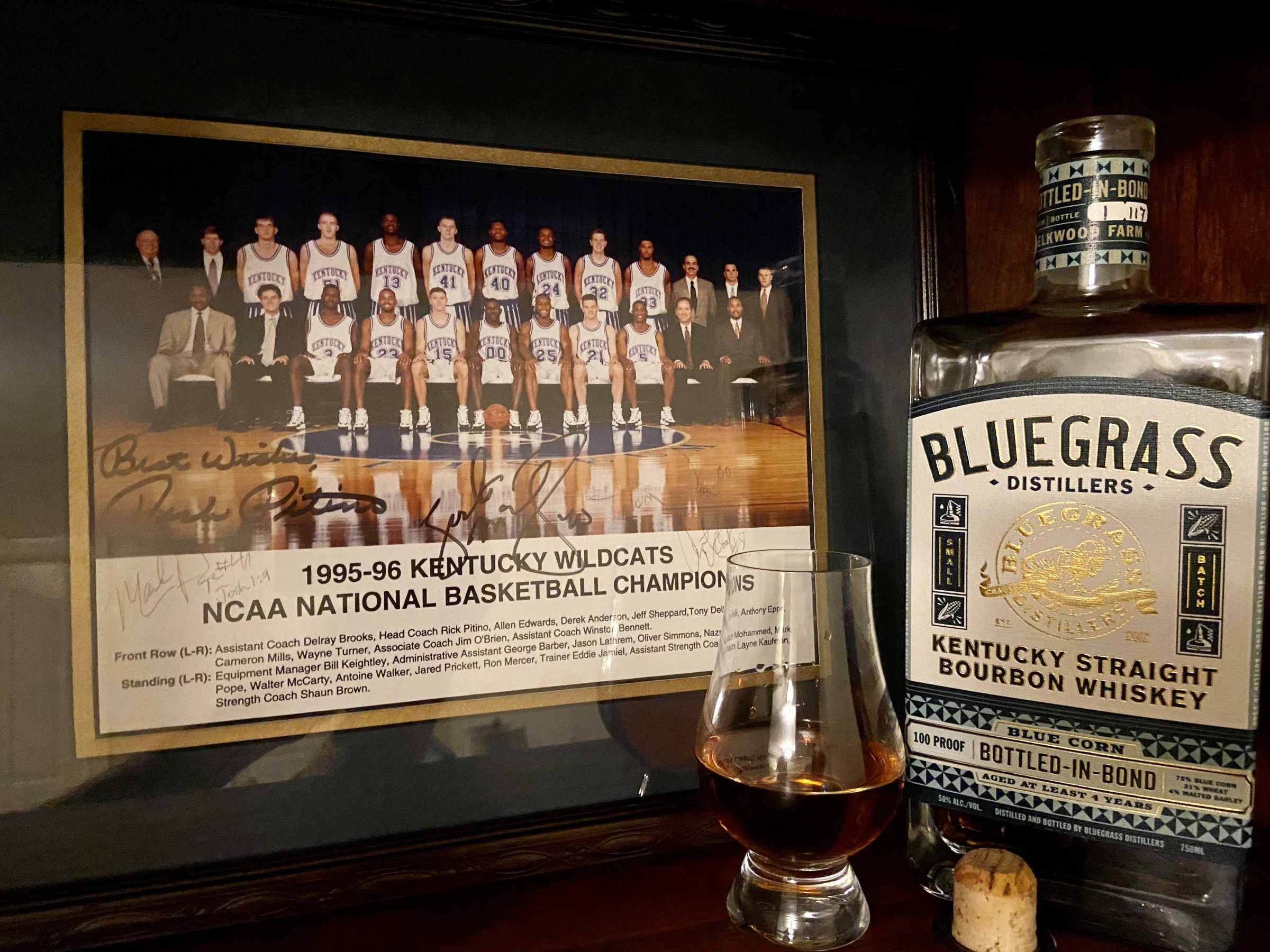
Earlier this fall, Bluegrass Distillers in Lexington (www.bluegrassdistillers.com), released the first ever Kentucky Blue Corn Bottled-in-Bond Bourbon. Bluegrass Distillers is the only Kentucky distillery that produces a wheated bourbon with 100% blue corn, a non-GMO corn grown locally in Central Kentucky. Distilling a mash of blue corn can result in a sweeter, nuttier distillate.
This Bottled-in-Bond Blue Corn Bourbon release is comprised of just four 53 gallon barrels, aged 4½ years. Bluegrass previously released a younger blue corn bourbon in 2017, and a Bottled-in-Bond release with yellow corn, but this is the first Bottled-in-Bond release using blue corn.
Bluegrass is banking on more blue corn because this past season it grew 25 acres of blue corn in Woodford County, which will one day go into roughly 500 barrels. To help accommodate that growth, Bluegrass is expanding at the Historic Elkwood Farm in Midway, Kentucky, where it will ultimately relocate in 2022.
Bluegrass Bottled-in-Bond Blue Corn Bourbon Tasting Notes
Bourbon: Bottled-in-Bond Blue Corn Kentucky Straight Bourbon Whiskey Batch 001
Distillery: Bluegrass Distillers
Age: 4½ years
Mash Bill: 75% blue corn; 21% wheat; 4% malted barley
ABV: 50% (100 proof)
Cost: $60.00
Appearance:
Amber gold.
Nose:
Sharp cedar, corn mash, spring grass, honeysuckle, and brown sugar. There’s also some light fruit similar to a non-peated Scotch.
Taste:
Soft wheat behind youthful pepper, pecan nuttiness, and subtle earthiness.
Finish:
Medium finish with lingering herbal and cedar notes, and a bit smokey.
Bottom Line
Wheat can be tough under six years but this doesn’t have the hallmarks of a young wheater. While I still give younger bourbons plenty of air, this Bluegrass Blue Corn Bottled-in-Bond is unlike any other wheated bourbon that I’ve had. The earthy, nutty notes are unique and they play well with the brighter fruit and pepper flavors. Maybe it’s the blue corn, but it’s extremely promising for Bluegrass Distillers and I’m excited for future bottlings. Definitely check out Bluegrass Distillers!
Disclaimer: The brand managers kindly
sent me a bottle for this review,
without any strings attached.
Thank you.
Sipp’n Corn Tasting Notes: Evan Williams 1783 Small Batch.
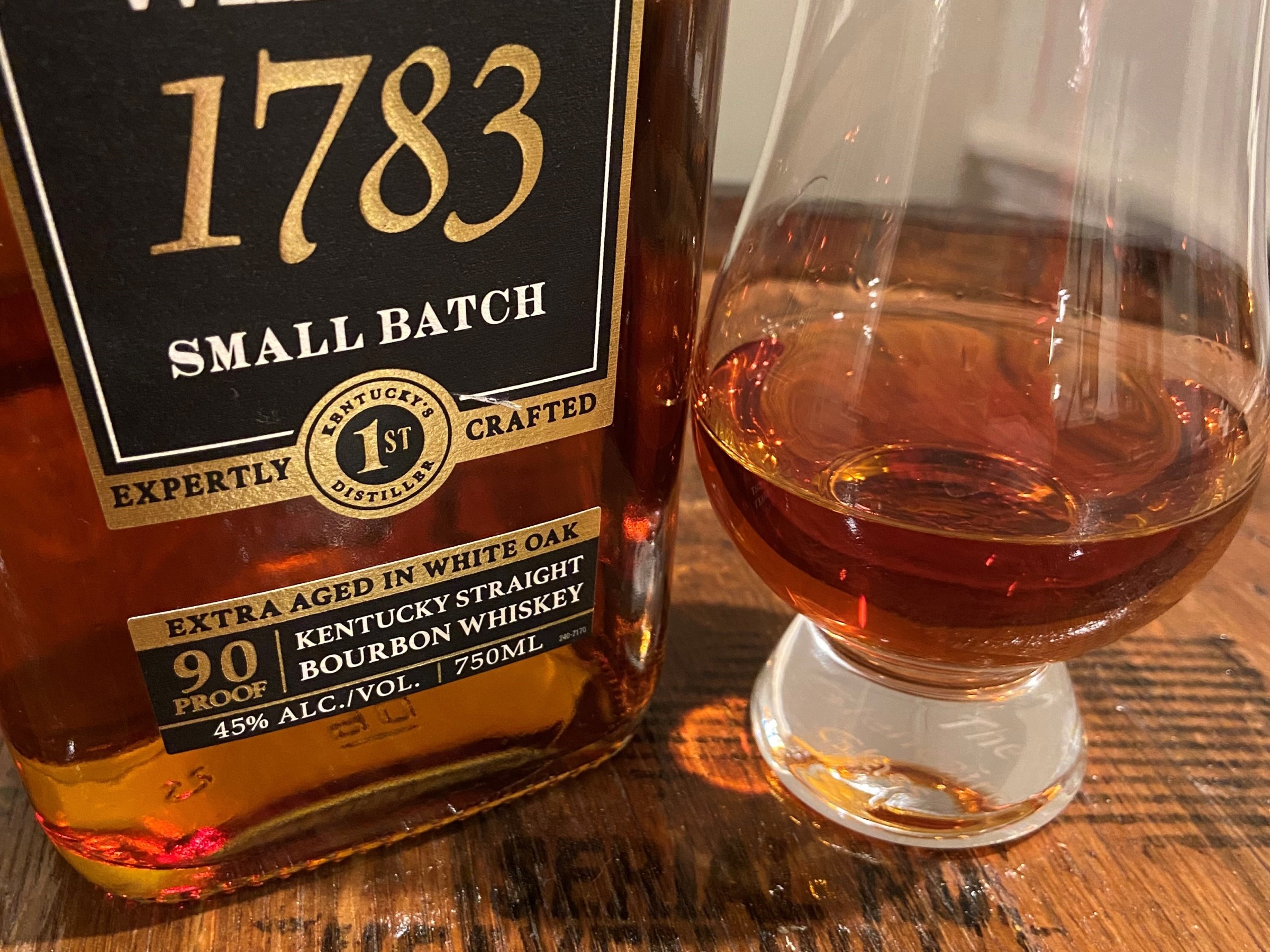
Evan Williams is insanely popular worldwide, and now Heaven Hill has released a newly-redesigned 1783 Small Batch, along with a bump in proof. The name 1783 comes from the year Evan Williams first opened his distillery on the Ohio River in Louisville, when Kentucky was still part of Virginia. Check out the Evan Williams Bourbon Experience in downtown Louisville for more of that history—it’s a must-stop for anyone visiting town.
Evan Williams 1783 Small Batch Tasting Notes
Bourbon: Evan Williams 1783 Small Batch Kentucky Straight Bourbon Whiskey
Distillery: Heaven Hill
Age: Unstated, but 6-8 years
Mash Bill: 78% corn; 12% malted barley; 10% rye
ABV: 45% (90 proof)
Cost: $20.00
Appearance:
Bright amber.
Nose:
Corn pudding, brown sugar, ginger, clove, and oak. Mostly mellow.
Taste:
Surprising balance between drying oak, black pepper, and cinnamon, on the one hand, and caramel apple, honey, and chocolate on the other. The flavors are pronounced without being robust, making it suitable for easy sipping neat or using in a cocktail.
Finish:
Medium length and warming with a fade of nuttiness, brown sugar, popcorn, and oak.
Bottom Line
I can’t help comparing this Evan Williams 1783 Small Batch to its competitors. It’s a classic bourbon with incredible balance that leads the market in this price range. And the flavors burst too; so many bourbons at 90 proof or less are far too subtle, or they’re so young that you get graininess and green wood. I can’t think of a better bourbon in this price range.
After the demise of my top-ever value buy—the $11.99 Kentucky-only Heaven Hill 6-year Bottled in Bond—my new house bourbon became a 1.75L of Evan Williams Bottled in Bond. With the proof increase and insane affordability, this Evan Williams 1783 Small Batch will be part of the rotation.
Disclaimer: The brand managers kindly
sent me a bottle for this review,
without any strings attached.
Thank you.
Sipp’n Corn Tasting Notes: Five Brothers Kentucky Straight Bourbon Whiskey (Heaven Hill).

As part of the grand opening of the Heaven Hill Bourbon Experience in Bardstown, Kentucky, Heaven Hill has released a new Kentucky Straight Bourbon Whiskey to celebrate the five Shapira brothers, who admittedly “didn’t know a barrel from a box,” but nevertheless started a new distillery from scratch at the end of Prohibition. Today Heaven Hill is the largest family-owned and operated distillery in America.
The five brothers, David, Ed, Gary, George, and Mose, are all pictured on the front label of the new bourbon release, aptly named “Five Brothers.” Five Brothers is available at the Heaven Hill Bourbon Experience and select Kentucky retailers, so you’ll have to come to Kentucky to get this one.
Five Brothers Tasting Notes
Bourbon: Five Brothers Kentucky Straight Bourbon Whiskey
Distillery: Heaven Hill
Age: Unstated, but five different ages, ranging from five to nine years
Mash Bill: 78% corn; 12% malted barley; 10% rye
ABV: 45% (90 proof)
Cost: $59.99
Appearance:
Copper penny.
Nose:
This is a classic bourbon nose if there ever was one, which covers all of the bases. It has a caramel backbone with peanut brittle and light fruit for sweetness, black pepper and baking spice, and a beautiful oak balance with a hint of tobacco.
Taste:
Flavors burst, most notably with classic caramel, brown sugar, and vanilla. But there’s also a mouthwatering maple syrup aspect that tempers the rye spice and black pepper that follow, while all still riding on a backbone of oak.
Finish:
Balancing oak and nuttiness with chocolate, caramel, and light fruit, the finish is predominantly sweet, which lingers as it fades.
Bottom Line
The blending for Five Brothers is an absolute showcase of talent. Heaven Hill uses bourbon that is five, six, seven, eight, and nine years old, representing each of the five brothers. Beyond the symbolism, this creates a something unique and different from Heaven Hill’s other brands, but, at the same time, is immediately recognizable as a Heaven Hill “House Style.”
Lawsuits from the 1930’s show many of the failures of the post-Repeal rush to make a buck in the new bourbon industry. Heaven Hill is one of the greatest Repeal success stories because these five brothers started from scratch. They played by the rules, unlike the startups who tried to misappropriate heritage, and they took the risky and expensive step of relying on selling their own Bourbon. Within a decade, Heaven Hill’s gamble paid off in spades. It built new brands and started purchasing other brands with historic relevance, and today Heaven Hill produces 1,300 barrels per day with over 1.8 million barrels aging in 60 rickhouses.
The new Heaven Hill Bourbon Experience in Bardstown is a must-see attraction on the Kentucky Bourbon Trail® and this Kentucky-only bourbon is a perfect way to honor the Shapira legacy.
Disclaimer: The brand managers kindly
sent me a sample for this review,
without any strings attached.
Thank you.
Sipp’n Corn Tasting Notes: W.H. McBrayer Kentucky Straight Bourbon.

This is a story that I love because it combines bourbon, history, and law. Sound familiar?
Judge William Harrison McBrayer wrote a letter to E.H. Taylor, Jr. on November 10, 1870, concerning their discussions about Taylor purchasing some of the Judge’s whiskey. The back side of the letter contained the Judge’s mash bill, and now, about 150 years later, the Judge’s descendants used that very mash bill to revive the family legacy. But they used more than a recipe—they used local heirloom grains and 105 barrel-entry proof, harkening back to the bygone era.
Judge McBrayer’s distillery in Anderson County was wildly popular, with the value of his distillery and “Cedar Brook” easily making him a multi-millionaire in today’s dollars. McBrayer’s Ex’r v. McBrayer’s Ex’x, 16 Ky.L.Rptr. 18 (1894) tells the story of how the Judge’s legacy was almost extinguished after his death in 1888.
Before he died, Judge McBrayer had contracted with Levy & Bro. of Cincinnati to sell all of his existing barrels and all future distillery production through December 1, 1891. So, the distillery essentially had to be operated to fulfill the production contract. The Judge wrote in his will that the distillery could only be operated for three years after his death, at which such time he ordered that his name should be stricken from the business. He also wrote in his will that his wife should be given the most prominent role in deciding the affairs of his estate if the Executors were ever in disagreement.
The Judge’s only heirs were his widow and three grandchildren (children of his only daughter, who had died earlier), and the lawsuit set up a fight between grandmother and grandchildren. The Judge’s widow wanted to enforce the provision stripping the McBrayer name from the distillery and prohibiting her granddaughters from using the valuable Cedar Brook trademark, while the granddaughters wanted to continue to use the McBrayer and Cedar Brook names. The court engaged in linguistic gymnastics to rule that Judge McBrayer was so wise, and was such a savvy businessman, that what he really meant was that he did not want the distillery to be operated by the estate for more than three years, but it would be just fine for the granddaughters to form a new entity to operate the distillery, and of course the valuable McBrayer and Cedar Brook names should continue to be used. Essentially, the court held that the McBrayer and Cedar Brook names were just too valuable to let them go to waste.
W.H. McBrayer Tasting Notes
Bourbon: W.H. McBrayer Kentucky Straight Bourbon Whiskey
Distillery: Contract distilled at Wilderness Trail
Age: Unstated, but four years and four months old
Mash Bill: 88.4% corn; 5.8% rye; 5.8% malted barley
ABV: 51.8% (103.6 proof)—Barrel Strength
Cost: $100
Appearance:
Peach tea.
Nose:
Butterscotch galore and chocolate, with a slight alcohol sting.
Taste:
Butterscotch carries through on the flavor too, with honey and a buttery mouthfeel.
Finish:
Short-ish but flavorful finish that is predominantly sweet.
Bottom Line
Start with a story, follow the old ways, and then close with a great bourbon. Far too many brands make up stories just to hustle us with the same old sourced whiskey that we can all buy for half as much from the real brand. Here though, McBrayer did it right. My only surprise is that McBrayer didn’t produce a Bottled-in-Bond bourbon, at least for historical accuracy.
Be on the lookout for future McBrayer releases!
Disclaimer: The brand managers kindly
sent me a sample for this review,
without any strings attached.
Thank you.
Sipp’n Corn Tasting Notes: 2021 Four Roses Small Batch Limited Edition.

Four Roses Small Batch Limited Edition is routinely one of the most anticipated limited edition bourbons in the September release season because Four Roses has so much flexibility with its ten recipes and variety of ages, so it’s always unique. This year I tasted the Small Batch Limited Edition with Master Distiller Brent Elliott and a dozen lucky recipients of samples.
I asked Brent whether it was intentional to keep the high-rye “B” mash bill so restricted here, to less than 20%. The lower-rye (but still higher rye than almost every other distillery) “E” mash bill historically is used more often for the limited editions. Brent said that he really did not focus on the rye content, and instead is more focused on the yeast. The “K” and “V” yeasts are perennial favorites and used extensively each year. This year, the big news is the use of “Q,” albeit at only 6%. But, as Brent explained, a little bit of Q goes a long way.
2021 Four Roses Small Batch Limited Edition Tasting Notes
Bourbon: Four Roses Small Batch Limited Edition Kentucky Straight Bourbon Whiskey
Distillery: Four Roses, Lawrenceburg, Kentucky
Recipes:
16-year OBSV – 13%
16-year OESV – 58%
14-year OBSQ – 6%
12-year OESK – 23%
ABV: 57.2% (114.4 proof)
Cost: $150.00
Appearance:
Brown with a reddish glint.
Nose:
Brown sugar, caramel, dark chocolate, candy apple, and leather create mouth-watering aromas.
Taste:
The flavors are incredibly well balanced with plenty of sweetness like butterscotch, more brown sugar, and honey, combined with a firm antique oak backbone, probably from the OESV, and this oak really drives the overall experience. The “youngest” component—the 12-year OESK—brings vibrancy and spice, but not as much of the rich berry flavors that Four Roses knows so well. And even at just 6%, the OBSQ pronounces its inclusion with candied sweetness and baked cinnamon apples, but the age mellowed the Q’s floral notes.
Finish:
The finish is long and layered with complexity. It unfolds with cinnamon and vanilla, and the last few sips—after plenty of chance to open up—shifts more to chocolate and dark cherries.
Bottom Line
Brent and his team have another home run this year with Q continuing to shine, just like it has in the single barrel program, with uniqueness that makes this limited edition stand out from its peers. With only 14,500 bottles they’ll be difficult to find, but this Four Roses Small Batch Limited Edition will also be available at the distillery gift shop through a lottery system open online to the public. Good luck in the lottery!
Disclaimer: The brand managers kindly
sent me a sample for this review,
without any strings attached.
Thank you.

