Brian Haara
Bourbon. Law. Author.
Sipp’n Corn Tasting Notes – My Imperial Stout Diversion with the Bourbon Community Roundtable

I’m way behind the curve on barrel-aged Imperial Stout. I never really gave bourbon-barrel aged anything a chance because more than a decade ago, when bourbon barrel aging started creeping into beer and wine, I liked to keep my beer and my bourbon separate.
Fast forward to spring 2019 at The Bar at Willett when I tried an Imperial Stout from Other Half Brewing Company in Brooklyn aged for 12 months in a Willett bourbon barrel. I was shocked at what I had been missing and it sent me on a quest.
Around the same time, the Bourbon Community Roundtable was getting close to receiving our own Imperial Stout brewed by 3rd Turn Brewing in Louisville aged in a Buffalo Trace barrel that we had selected, so my excitement for that went through the roof. 3rd Turn used a recipe with Carafa light-roasted spring barley along with chocolate wheat malt to add an espresso-like bouquet and chocolate flavors, and I was hoping that our barrel produced the same magic as the Willett barrel.
As I waited impatiently for our Imperial Stout, I made several trips to Liquor Barn, each time trying a new array of Stouts, Imperial Stouts, and barrel-aged Imperial Stouts. It’s safe to say that I’m hooked now.
I’ve arranged these Stouts by price per ounce except for our Bourbon Community Roundtable collaboration Imperial Stout, which I saved for last. Try these or others and comment below so that I can continue my Stout journey.
Nitro Milk Stout
Brewery: Left Hand Brewing Co., Colorado
Barrel Aged: No
ABV: 6%
IBUs: 25
Cost: $12.99 6 pk. 12 oz. bottles (18 cents per ounce)

Appearance:
Very thin and light head. The bottle suggests pouring it hard, but even then, there’s not much head.
Nose:
All lactose and cocoa.
Taste:
Not heavy. Its lightness was refreshing, but that also means that it wasn’t particularly complex or contemplative. Soft roasted malt and lots of cocoa with extremely low carbonation—too low in my book.
Finish:
Nothing really, just a fresh, milky aftertaste.
Old Rasputin Russian Imperial Stout
Brewery: North Coast Brewing, Fort Bragg, California
Barrel Aged: No
ABV: 9%
IBUs: 75
Cost: $10.99 4 pk. 12 oz. bottles (23 cents per ounce)
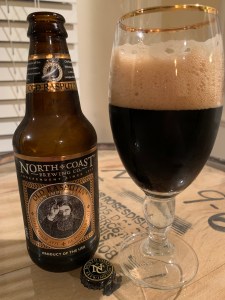
Appearance:
Black with a huge creamy light tan head.
Nose:
Malty, faint dark chocolate, nutty, raisins, and maybe caramel.
Taste:
Higher carbonation than most of these Stouts. Flavor of Italian espresso. I tasted it right after the Left Hand Milk Stout and it was so different—no lactose of course, not very creamy, and not nearly as much chocolate. The chocolate was different; instead of chocolate milk it was more of a slightly boozy dark chocolate dessert.
Finish:
A little bitter coffee / espresso and richly warming.
35k Milk Stout
Brewery: Against the Grain Brewery, Louisville, Kentucky
Barrel Aged: No
ABV: 7%
IBUs: 26
Cost: $14.99 4 pk. 16 oz. cans (23 cents per ounce)

Appearance:
Dark black with a light brown head.
Nose:
Roasted malt, whoppers, and chocolate milk.
Taste:
Milky, creamy, whoppers, and chocolate. A light fizz and the sweetness made it mouthwatering, but the thick sweetness wasn’t overpowering. This was really good.
Finish:
Nothing really other than sustained mouthwatering sweetness and roasted malt.
Dragon’s Milk Bourbon Barrel-Aged Stout
Brewery: New Holland Brewing, Holland, Michigan
Barrel Aged: Yes—time undisclosed
ABV: 11%
IBUs: 30
Cost: $16.99 4 pk. 12 oz. bottles (35 cents per ounce)
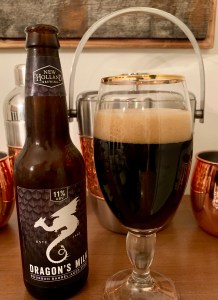
Appearance:
Nice tan head that dissipates quickly.
Nose:
Pure chocolate malt.
Taste:
Definite barrel influence and lightly carbonated, with roasty malt, cocoa, and vanilla.
Finish:
Fading chocolate malt.
70k Imperial Milk Stout
Brewery: Against the Grain Brewery, Louisville, Kentucky
Barrel Aged: Yes—“for a really, really long time”
ABV: 13%
IBUs: 48
Cost: $19.99 750 mL bottle (~25 oz) (80 cents per ounce)
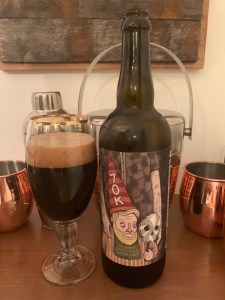
Appearance:
Dense black with a creamy tan head.
Nose:
Coffee and cream, light oak, vanilla, chocolate shop, and coconut.
Taste:
So creamy; mocha, sweetened cream, sticky caramel, and more coconut. No hint of the high ABV. I’m still looking for the bourbon and oak. But there was something acidic that maybe was the bourbon coming through, and it was distracting.
Finish:
Not overly sweet, lots of malted barley.
Ink Imperial Stout
Brewery: Rhinegeist Brewery, Cincinnati, Ohio
Barrel Aged: No
ABV: 10%
IBUs: 57
Cost: $18.99 22 oz. bottle (86 cents per ounce)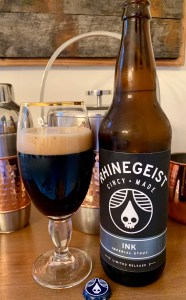
Appearance:
Let’s just say “Ink” is an appropriate name. Pitch black with a thick tan head.
Nose:
Vanilla, roasted malt, light cocoa, sugary cereal, and sweet cappuccino.
Taste:
This is really superb—coffee, roasted malt, mocha, and toffee. I can’t wait to hunt for the barrel-aged version of Ink. I was surprised to like it so much. The balance, the creaminess, just the right amount of carbonation—all left me wanting to stock up.
Finish:
Coating, thick, dark chocolate, but somewhat drying.
And now, for the barrel-aged Imperial Stout that all of this has been leading up to:
Pursuit Series / Bourbon Community Roundtable barrel-aged Imperial Stout
Brewery: 3rd Turn Brewery, Louisville, Kentucky
Barrel Aged: Yes—15 months in a Buffalo Trace barrel that we selected
ABV: 12.2%
IBUs: Not disclosed
Cost: $25.00 32 oz. crowlers (78 cents per ounce)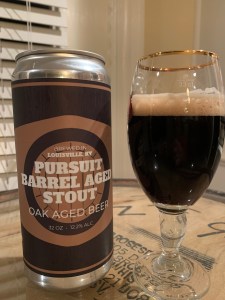
Appearance:
Black with a creamy tan head.
Nose:
Roasted malt, cocoa, and sweet cream.
Taste:
It’s boozy for sure—boozier than any of the others—but not distractingly so. Instead it’s more of an afterthought to the creaminess and the pure Whoppers with coconut balanced by robust oak character.
Finish:
Warming milk chocolate fondue with remaining tannins to balance the sweetness.
Bottom Line
While I’m going to stick to bourbon as a whole, I’ve thoroughly enjoyed my Stout diversion. I learned that—like bourbon—Stout is best when shared with friends and best when you can open a few different varieties. After trying each of these individually on my own, I had many of them again with friends, along with a few others; it’s great to compare and contrast them and, most of all, to enjoy them with company.
Like bourbon, my test for these Stouts is essentially which ones would I buy again, which ones would I just a soon pass on, and which ones will I affirmatively seek out? I didn’t dislike any that I tried, so I’m not avoiding any and depending on which are available, I’d buy them all again. But I certainly have priorities. After my BCR Barrel-Aged Imperial Stout is gone, I have a feeling that I’m going to be all about Rhinegeist. I’d happily pay the price for another bottle of Ink and I will definitely be on the lookout for barrel-aged Ink.
I’ll also be repeat purchaser of 70k and 35k if I can’t find Rhinegeist. After those, the prices were more reasonable, and my order of preference was Dragon’s Milk, Old Rasputin, and Left Hand Nitro Milk Stout. And, of course, there are a multitude of other Stouts and Imperial Stouts that I’ll need to try and maybe one day I’ll even luck into a Goose Island Bourbon County barrel-aged Stout. So, with apologies to the beer enthusiasts out there, you have one more fan who is looking for Stouts. At least the other enthusiasts have our BCR Barrel-Aged Imperial Stout to add to their hunt.
Lux Row Bourbon Battle Cocktail Competition – We Crowned the Winner During the Kentucky Bourbon Festival!

On September 18, 2019, six semifinal winners from across the United States and the European semifinal winner converged on Lux Row Distillers in Bardstown, Kentucky, for the Championship of the Bourbon Battle Cocktail Competition.
These mixologists were challenged to create original bourbon cocktails crafted with either Rebel Yell or Ezra Brooks, and they competed in live events from May through July.
The regional champion contestants were:
Derek Jeffries, Seattle, with the “Alpha Centauri” (surprise ingredient: Jagermeister).
Naomi Roquet, St. Louis, with the “Millions of Peaches” (bourbon, peaches, and mint are perfect together).
Giacomo Ciminello, Cincinnati, with “Three Ways to Midnight” (evoking Cincinnati-style chili even to the point where it was garnished with shredded Gjetost cheese).
Brock Schulte, Kansas City, with the “We Jammin’” (so insightful with dual acids and texture).
Jake Smith, Louisville, with the “Kentiki Masala” (a pinch of Garam Masala makes this cocktail the most creative without being weird).
Marie Teckmyer, Cleveland, with the “Down the Rabbit Hole” (Marie’s a story-teller and this was the most refreshing cocktail of them all).
Mike Pendergast, London, England, with “If you Don’t Dance, Then Sit Down” (my overall best cocktail of the first round).
As a judge for the Championship, I was asked to score each cocktail based on appearance, aroma, creativity, taste, and overall impression. Each contestant had seven minutes to prepare the cocktail that got them here. For me, Marie and Mike unquestionably had the best cocktails in the first round. They advanced along with Brock and Naomi.
Round Two had each contestant prepare a second cocktail of their own creation. I was blown away by Brock’s second cocktail, which he named “(W)risky Colada” that again used dual acids (pineapple and lime), a splash of apple cider, and was topped with coconut cream. I also loved Marie’s second cocktail, named “Kettle Popcorn Milk Punch a/k/a ‘Dancing With Myself.’” From her base of Rebel Yell, to her homemade butter corn cream, the creative addition of sweet potato Soju, and a Billy Idol leather bracelet around each glass, Marie absolutely nailed it.

Both Naomi and Mike made a pretty boozy cocktail, although both were certainly still solid. Naomi’s was pure dessert, like a chocolate hazelnut torte, but too boozy. Mike’s smelled like a lemon drop candy and the flavors were balanced by toasted pecan bitters, but I was sure that Brock and Marie were advancing.


I was only half right. After the votes were tallied, Marie and Mike advanced to the final round, which was done “Chopped” style. Each contestant received a sealed box of surprise ingredients and they were given seven minutes to craft a new cocktail on the spot. The pressure was palpable!
Marie and Mike enjoyed each other’s company (and stress) as they devised their plans, even sharing a cutting board. As Marie emptied her basket, checking out each potential ingredient, she remarked “Oh, I like that” under her breath when she found the coffee liqueur. Her plan was taking shape. With Ezra Brooks, a little bit of dry vermouth, and orange zest, Marie created “The Wake Up Call.”
Mike went for Rebel Yell along with two of the safest bourbon cocktail ingredients in existence—blackberries and mint—with crème de banana, sweet and dry vermouth, and Angostura bitters to create what he named “Crème de Banan-hattan a/k/a Brass Tacks Truth” (it’s hard enough to create a cocktail under pressure, let alone come up with a name…).
It was an incredibly close vote, but we crowned Mike the 2019 Champion of the Lux Row Bourbon Battle. As the Bourbon Battle Champion, Mike won a private barrel selection with Head Distiller John Rempe that he’ll receive with a custom-made label.
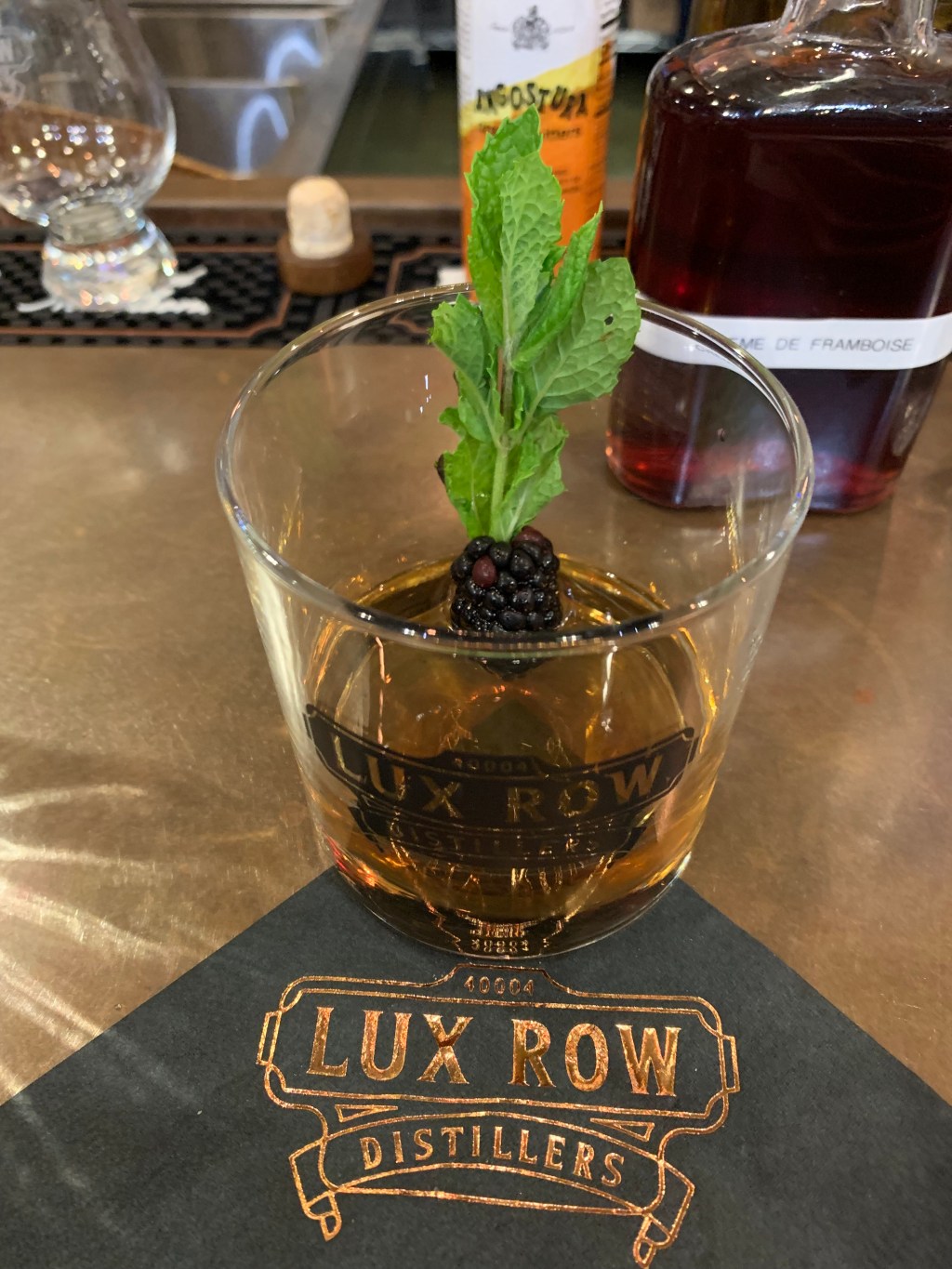
The creativity was off the charts for all the contestants. The variety and uniqueness of the ingredients created aromas and flavors that you’ll never find if you stick to tried-and-true cocktails. So be adventurous. Try new bourbon cocktails. Talk to these masters behind the bar. And prepare to be amazed.


Sipp’n Corn Tasting Notes: Heaven Hill Parker’s Heritage Collection 13th Edition—It’s Finally a Rye!
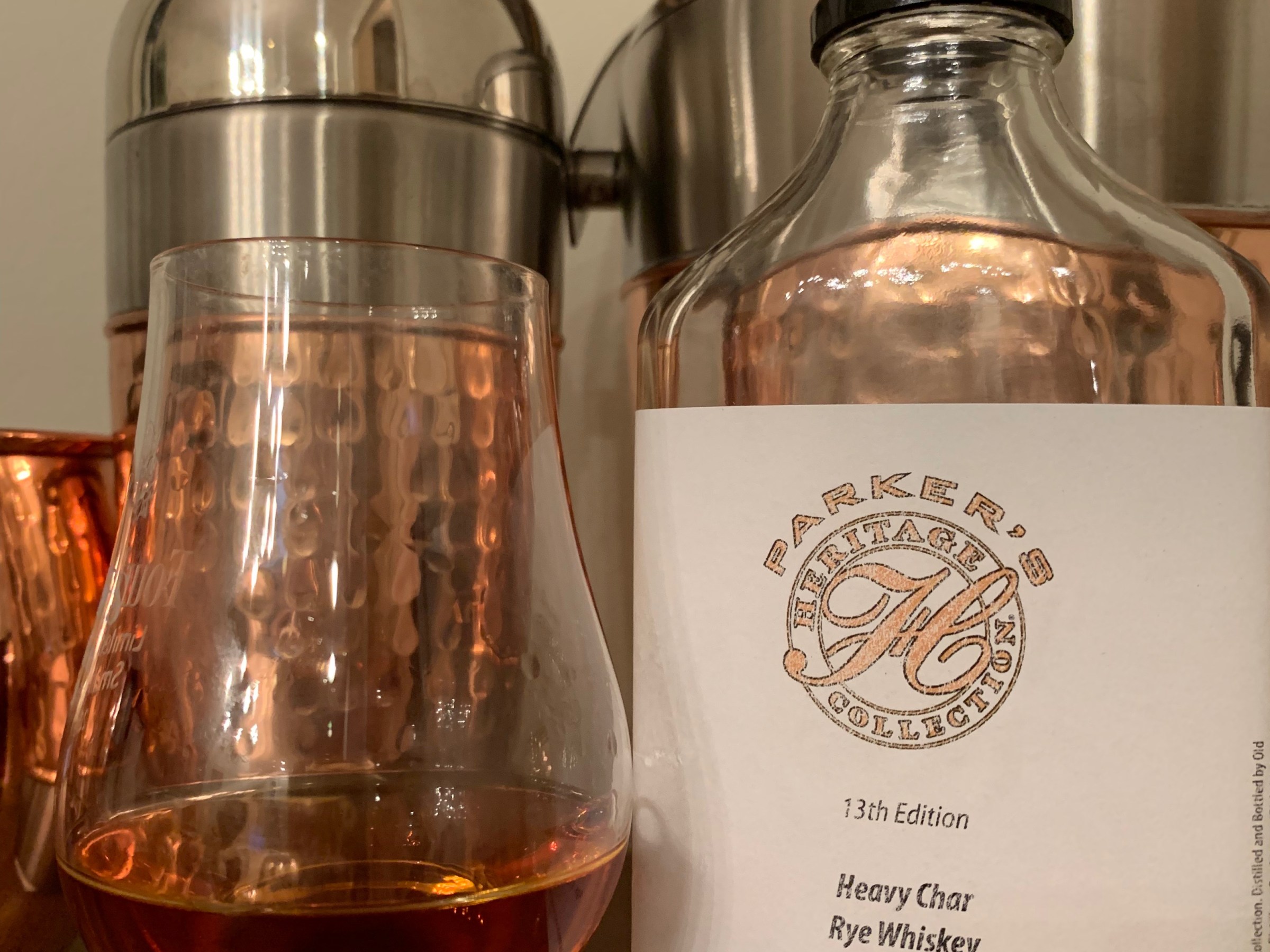
Reviews posted on consecutive days? It must be National Bourbon Heritage Month! This makes the timing right for the perennial highly-anticipated limited edition Parker’s Heritage Collection from Heaven Hill, which for the first time ever is a Rye Whiskey.
Heaven Hill continues to honor its late Master Distiller Emeritus Parker Beam while also continuing to support ALS research and patient care with the 2019 release of Parker’s Heritage Collection. Heaven Hill used its standard 51% rye-grain mashbill, but this time the barrels were Level 5 char (instead of level 3, which means an additional 50 seconds of flame) and they were all aged high in the warehouse (7th floor). So, the combination of the heavier char and hottest location in the warehouse should produce a spicier, more oaky whiskey from greater interaction with the barrel. Of course, this limited edition whiskey is non-chill filtered to retain more flavor.
Parker’s Heritage Collection Tasting Notes
Bourbon: Parker’s Heritage Collection, 13th Edition (2019) Kentucky Straight Rye Whiskey
Distillery: Heaven Hill, Bardstown, Kentucky (distilled in Louisville and aged in Bardstown)
Age: 8 years, 9 months
ABV: 52.5% (105 proof)
Cost: $149.99
Appearance:
Brown with a shimmer of gold.
Nose:
Heavy oak and leather, but wow, there’s a blast of alcohol heat too. While there’s a hint of some cotton candy sweetness, that’s about the only sweetness.
Taste:
My first impression on the first pour was that it was way too hot neat. The first week I needed to try it on ice, which really improved it for me. It retained its rye spice, oak, and cinnamon, but added a little more balance with vanilla and a mint kicker. I came back for a second pour a week later and the heat had definitely dissipated. During the second week I didn’t add ice and enjoyed it neat with a robust blast of oak, char, pepper, and baking spice for an overall dry, spicy experience. My third and final tasting had the same sort of heat and spice as the first time; I wish that I could have duplicated that middle tasting.
Finish:
The finish had the same night-and-day difference for me between tastings. During the first week when it seemed too hot, the finish was overshadowed by the burn, but on ice, the finish was warming with caramel sweetness before shifting back to spice and oak for a dry finish. On my second tasting, I never wanted ice or a splash of water; I enjoyed the robust finish that was overall spicy and dry, but it had an almost sherry-cask-finished dark sweetness. My final tasting gave me more of the heat again as a big robust whiskey.
Bottom Line
Pikesville Rye is one of my favorite whiskies, so I was hoping for Pikesville on steroids for PHC 13. That’s not really where it landed for me. Kudos to Heaven Hill for including a Rye Whiskey in the Parker’s Heritage lineup and for continuing to support the fight against ALS, but expect some push-back at this price. The proof doesn’t sound high in today’s climate of barrel-proof mania—and Heaven Hill no doubt would have received all kinds of grief if it released PHC 13 under 100 proof—but especially on the first taste it might have been over-proofed. I still don’t understand the chemistry enough to know why some 120 proof whiskies mask their high ABV while other lower-proof whiskies seem to taste so much higher, but regardless, be ready to add a splash of water to PHC 13 or to pour it over ice.
But I also re-learned my lesson about going back for a second try. The tasting experience is influenced by your surroundings, your mood, what you had for dinner, and innumerable other factors. My second try was so much better than the first to the point that I wouldn’t have bought it during the first week whereas I would definitely buy it the second week. My third try was somewhere in between, so I’ll be on the hunt for PCH 13, and I recommend it as a buy for barrel-proof fans, rye fans, and anyone who favors dryness and spice over sweetness in their whiskey.
Disclaimer: The brand managers kindly sent me a sample
for this review, without any strings attached.
Thank you.
Sipp’n Corn Tasting Notes: 2019 Four Roses Limited Edition Small Batch
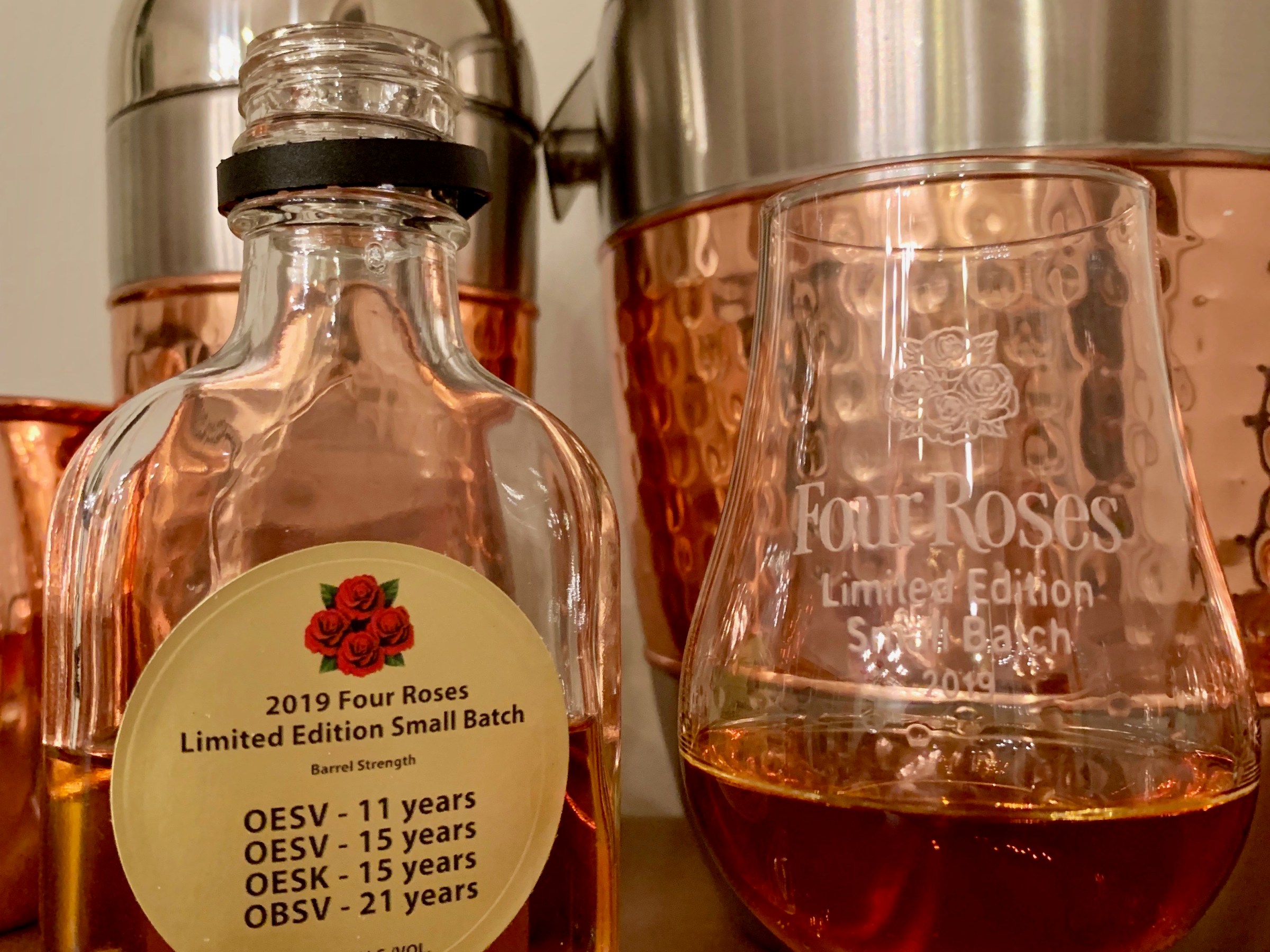
I love this time of the year! It’s Bourbon Heritage Month and that means Four Roses releases its annual Limited Edition Small Batch. With its unique 10 recipes Four Roses has a tremendous single barrel program, but it really allows Four Roses to shine by blending, which no other distillery can match.
This year Master Distiller Brent Elliott used the following recipes and ages:
OESV – 11 years
OESV – 15 years
OESK – 15 years
OBSV – 21 years
While the percentages were not disclosed, this Limited Edition is mostly the lower-rye recipe mash bill (although of course at 20% rye grain that’s still far more rye that other distillers use), and a majority of the “V” yeast, which Four Roses describes as “delicate fruit.”
Four Roses Limited Edition Tasting Notes
Bourbon: 2019 Four Roses Limited Edition Small Batch Kentucky Straight Bourbon Whiskey
Distillery: Four Roses, Lawrenceburg, Kentucky (and aged at Cox’s Creek)
Age: 11-21 years (% not disclosed)
ABV: 56.3% (112.6 proof)
Cost: $140.00
Bottles: 13,440 for U.S. distribution only
Appearance:
Old copper.
Nose:
Unmistakable Four Roses dark berries, honey, caramel, and oak and as well-rounded as I can imagine.
Taste:
Whoa—Four Roses touts being “Mellow,” and this Limited Edition nails Mellow. It’s silky, has subtle complexity of butterscotch, berries, and vanilla cream balanced by cinnamon and oak. This is an elegant bourbon that keeps revealing more flavors sip after sip. This is a bottle that will go way too fast.
Finish:
Long, full, sweet and buttery with a lingering balance of oak.
Bottom Line
I don’t know how Four Roses continues to perform at this level. First, in my book Small Batch Select destroyed the field this year for best new bourbon of 2019. But this whole time Four Roses had an Ace in the hole; its 2019 Limited Edition Small Batch has got to be in the running for best bourbon of the year. This is a fantastic bourbon that should be tops on your hunting list this fall. Look for it at the distillery and at the bottling facility on September 21, and then at retailers later in the month.
Disclaimer: The brand managers kindly sent me a sample
for this review, without any strings attached.
Thank you.
Sipp’n Corn Tasting Notes – Old Taylor (1953) Bottled in Bond; Old Fitzgerald Decanter; and Cream of Kentucky
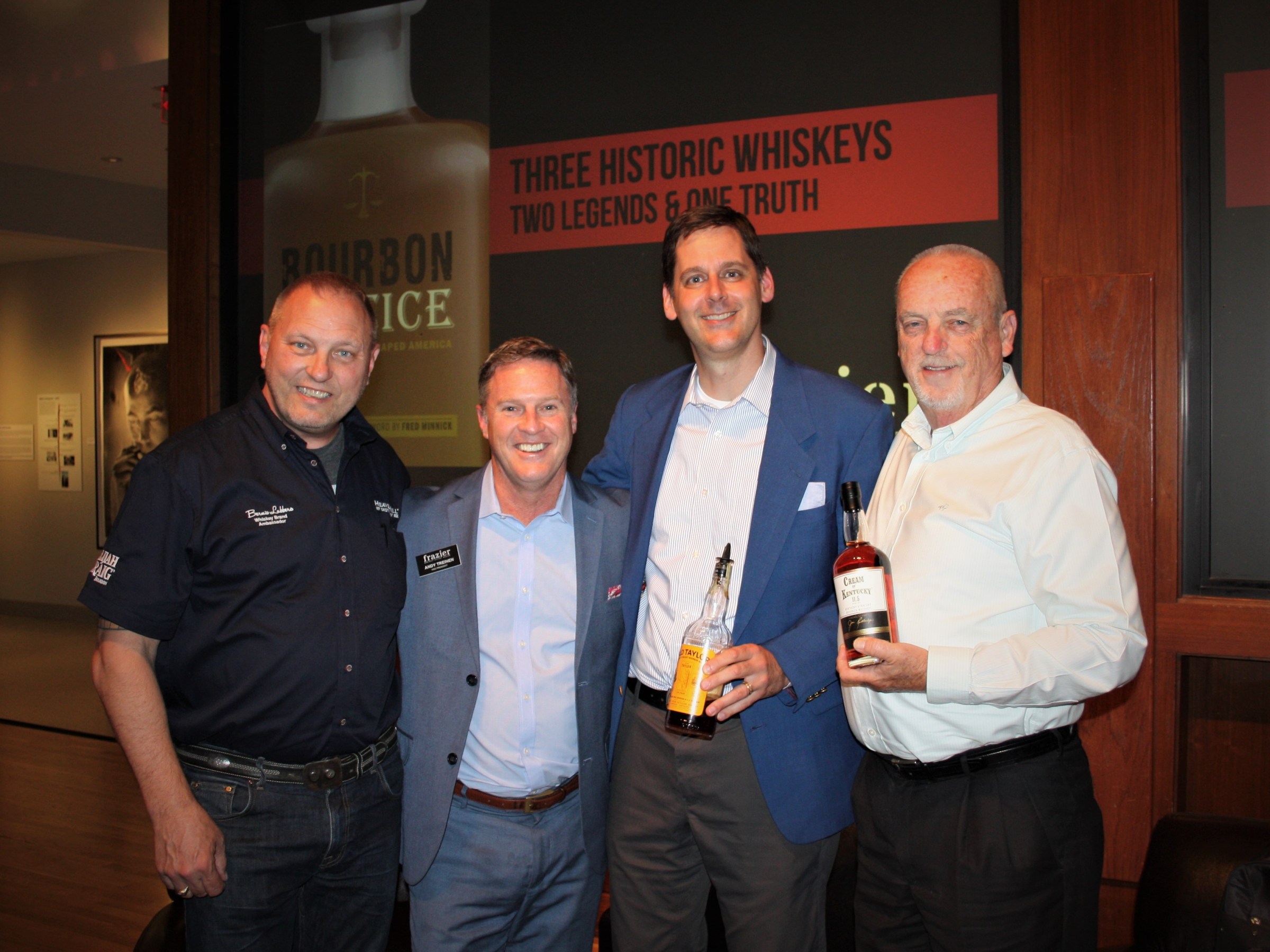
The Frazier History Museum presents a bourbon series and I was lucky enough to be part of it earlier this summer to discuss Bourbon Justice alongside legendary Master Distiller Jim Rutledge and incomparable Heaven Hill brand ambassador and author Bernie Lubbers.
In addition to the lively discussion, The Frazier provided a guided tasting of two current-day classics—Jim’s revival of Cream of Kentucky and Heaven Hill’s Old Fitzgerald Decanter—along with a vintage Old Taylor distilled and aged at the historic Old Taylor Distillery, which is now the home of Castle & Key.
We had a lively discussion and an engaged crowd, and some folks who missed it have asked about tasting notes, so here we go:
Bourbon: Cream of Kentucky (Batch 2, 2019)
Distillery: Sourced by J.W. Rutledge Distillery, Crestwood, Kentucky
Age: 11.5 years
ABV: 51% (102 proof)
Cost: $149.99
Bourbon: Old Fitzgerald Decanter Series (Second Release, Fall 2018)
Distillery: Heaven Hill, Bardstown, Kentucky
Age: 9 years
ABV: 50% (100 proof)
Cost: $89.99
Bourbon: Old Taylor (distilled Fall 1953; bottled Fall 1957)
Distillery: The Old Taylor Distillery, Millville, Kentucky
Age: 4 years
ABV: 50% (100 proof)
Cost: priceless


Tasting Notes
Appearance:
Surprisingly, the much younger Old Taylor was just as dark—if not darker—than Cream of Kentucky and Old Fitzgerald, and it wasn’t because the Cream of Kentucky or Old Fitzgerald were light. As the oldest and because it was bottled at (barely) the highest proof, the Cream of Kentucky should have been the darkest. Maybe because of lower entry proof, higher barrel char level, tighter wood grain, or aging conditions, however, the Old Taylor never would have been taken for a four-year bourbon in a blind tasting.
Nose:
Jim remarked how much difference a mere four months of aging meant for his second run of Cream of Kentucky; the aromas are sweeter and less peppery. The Old Fitzgerald 9-year had more baking spice, familiar aromas of baking fresh bread, brown sugar, caramel, and oak. Old Taylor was remarkable—again, there’s no way that this is a four-year old bourbon. Warm, deep aromas of oak, pepper, and caramel make this an inviting nose.
Taste:
The second batch of Cream of Kentucky also has a fruiter palate according to Jim, but I wouldn’t call it fruity just yet; it’s still more focused on oak and baking spice. The Old Fitzgerald had more caramel with a transition to pepper spice, not really what I might have picked blind as a wheated bourbon, but checking all of the boxes and with the most complexity of the three. It will sound like a broken record, but the Old Taylor was unlike any other four-year old bourbon that I’ve ever tried: creamy, spicy, less sweet than the nose, and full-bodied.
Finish:
The finish on all three bourbons were fantastic, but in different ways. Cream of Kentucky was more elegant and gentle. The Old Fitzgerald was more robust, like a big warm hug that trails off with vanilla and oak. And Old Taylor had the biggest initial burst of warmth that trailed off with lingering oak.
Bottom Line
There’s a reason that Kentucky passed a Vintage Spirts law—many truly dusty bourbons pack in a unique experience that can’t be duplicated by current-day brands. Sure, there’s also the sense of exclusivity and historical awe, but for people focusing on the spirit itself, it’s about experiencing bourbon made the old way, producing a depth of flavors rarely found today. If you have the opportunity, definitely try mid-century or older bourbon.
Of course, many current-day brands are still worth pursuing hard. Cream of Kentucky and these limited release Old Fitzgerald Decanters are two that should be at the top of every enthusiast’s list.
Jim Rutledge is not only one of the best distillers, but he has the added dimension of being a genius blender. His decades of experience distilling at Four Roses gave him the unique role of blending ten recipes to create a consistent profile for Four Roses and blending a handful of recipes of varying ages each year to create his award-winning Limited Edition Small Batches. I will buy any bourbon that Jim has touched, and even though Jim didn’t distill it, Cream of Kentucky is one of those.
And finally, as for the Old Fitzgerald, Heaven Hill not only continues to lead the way in both age-stated bourbon and Bottled in Bond bourbon, but it also does so by reinvigorating a once-famous brand that had slipped to a “value brand,” and seemed all but replaced by Larceny. I have a soft spot for historical brands but those names aren’t worth anything unless you strive to exceed the quality of the past. That’s what Heaven Hill has done with the Old Fitzgerald Decanter Series.

