Brian Haara
Bourbon. Law. Author.
The Pimento Cheese Social at Stitzel-Weller.
The fourth annual Pimento Cheese Social was held last night at the historic Stitzel-Weller Distillery in Louisville. The Pimento Cheese Social is quickly becoming a Derby Week tradition, with tickets selling out and a festive crowd clearly ready for Bourbon and the Derby, even getting into the spirit of hats, a longstanding Derby Week tradition.

 The crowd was entertained by live jazz from the incomparable Billy Goat Strut Revue performing outdoors in the perfect spring weather.
The Bulleit Frontier Whiskey Experience was also open, with Tom Bulleit spinning tales in his office, Doug Kragel introducing crowds to the two new I.W. Harper editions, and Bulleit punch and Old Fashioneds at every turn.
But the focus of the party was pimento cheese, a quintessential Southern food, thus fitting right in with Bourbon and the Kentucky Derby. While pimento cheese is a Southern institution, it has not necessarily spread to the rest of the nation like other Southern foods (think of the ubiquitous biscuits and gravy, corn bread, or even shrimp and grits). Pimento cheese typically starts by blending grated cheddar cheese with diced pimentos and mayonnaise, but then it can launch in many different directions, depending on the spices and secret family ingredients passed through the generations.
Chefs from six of Louisville’s more imaginative restaurants vied for the honor of best pimento cheese creation. Showing that pimento cheese isn’t limited to sandwiches and crackers, they paired it everything from bacon to pickled celery to ice cream and caviar. The lineup was outstanding:
|
Wiltshire on Market:
|
Pimento cheese Taco on a black peppercorn tortilla, with double-smoked country ham and pickled celery
|
|
Grind Burger Kitchen:
|
Pimento cheese gratin with country ham, lacto-dilly bean and bread & butter pickled celery
|
|
Feast BBQ:
|
Pimento cheese ice cream with paddlefish caviar, green apple chow chow in a pretzel cone
|
|
Please & Thank You:
|
Pimento cheese and jalapeño biscuit
|
|
Garage Bar:
|
Smoked cheddar pimento cheese with Broadbent bacon and arugula
|
|
Proof on Main:
|
Fried pimento cheese ball
|
It was a night of Southern hospitality at its finest, and a perfect kickoff for more Derby festivities.

If I had a Benjamin for Bourbon …
After being asked to participate in the multi-blogger post “If I had a Benjamin” to spend on Bourbon or other American Whiskey, I thought it would be fun and easy. I’d find the perfect balance between cost and taste for optimal “value,” and I’d deftly maneuver around the deceptive brands and marketing scams, resulting in a stockpile of great Bourbon at economic prices. It turns out that this exercise is easier said than done, but still fun.
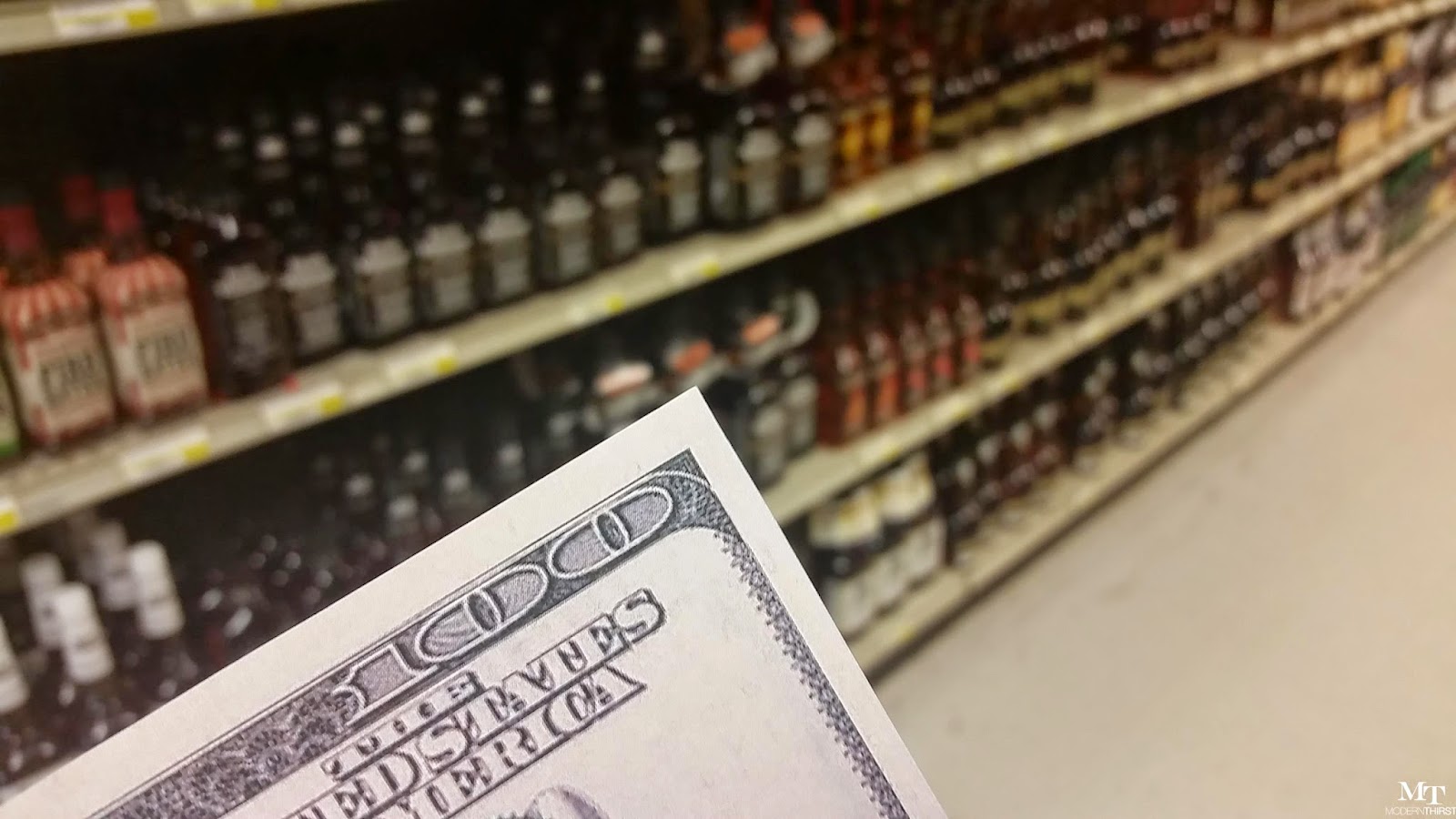
The participating bloggers got to pick their scenario for their $100 purchase – like for a milestone birthday, a week at the beach, or “the only Bourbons you’ll ever drink again” – so we should end up with a wide array of purchases. I would definitely have vastly different selections for each of those scenarios.
I’m a “best buy for the money” guy at heart who looks at the relationship between cost and overall quality and experience, meaning that I appreciate the rationale of an expensive gift shop bottle of Willett Family Estate 22 year-old wheated Bourbon being a better value buy than a $9.00 bottom shelf bottle. It also means that Weller Special Reserve and Four Roses Yellow Label are a better value than many brands that cost $40.00 or more. It’s a highly subjective process.
To put my value theory to the test, for my scenario, I imagined the old “if you were stranded on a desert island” setup. I don’t know how long I’ll be stranded, so I need to make my $100 go as far as possible, without making matters worse by buying eleven bottles of Ten High. Plus, I wouldn’t leave the island a Bourbon enthusiast after all of that swill, and at 80 proof, it wouldn’t even be useful for starting a bonfire to signal for help…
The scenario was difficult from the outset because price inflation eats up the Benjamin. In the past few years most brands have been raising prices by at least 5% yearly, if not more. Plus, every bottle in contention seemed to be a few dollars higher than I remembered, which I’m chalking up to bad timing of Kentucky Derby pricing. I’d get out for about $90 at another time of the year.
It was also difficult because one of our rules is that our choices must be reasonably available at retail. That means no retail-priced Four Roses Limited Edition or Buffalo Trace Antique Collection, but also no brands that I used to highly recommend and that were once readily available and reasonably priced (Elmer T. Lee, W. L. Weller 12 year, or now even Old Weller Antique 107 proof).
But have no fear, there are still plenty of options to make my math work and to keep me happy on the island. In fact, once I had a few Bourbon drinks to clear my head, I came up with at least ten bottles priced from the mid-teens to mid-$30’s in my local market. I prefer most of these ten over many brands that retail for $40.00 or more, so I just monkeyed with my ten until I hit $100.
|
(1)
|
Elijah Craig 12 Year Small Batch Kentucky Straight Bourbon Whiskey:
|
$31.00
|
|
(2)
|
Four Roses Single Barrel Kentucky Straight Bourbon Whiskey:
|
$34.00
|
|
(3)
|
W.L. Weller Special Reserve Straight Kentucky Bourbon Whiskey
|
$18.00
|
|
(4)
|
Old Grand-Dad Bottled in Bond Kentucky Straight Bourbon Whiskey:
|
$17.00
|
|
$ 100.00
|
||
 This list gives me the flexibility of enjoying bourbon cocktails (I’m assuming that there will be lush gardens on the island), drinking on ice, or drinking neat. I tried to go for higher proof, there’s a nice mix of high-rye and low-rye, and I’ve got some decent age. I would have loved to have included Old Weller Antique or W. L. Weller 12 year, but I couldn’t pick them under our rules since they’re no longer regularly on the shelf, so I went with the 90 proof sibling to make sure that I had a wheated mash bill represented.
I picked Elijah Craig 12-year because for me it has replaced Weller 12 and Elmer T. Lee as an inexpensive restaurant pour or a casual pour at home. It has a great nose, balanced flavors of caramel, oak and light fruit, and a nice finish. I wish that I could have selected a Barrel Proof version of Elijah Craig to bring with me to the Island, but at the standard 94 proof and usually about $28.00, this is one of the best buys in Bourbon.
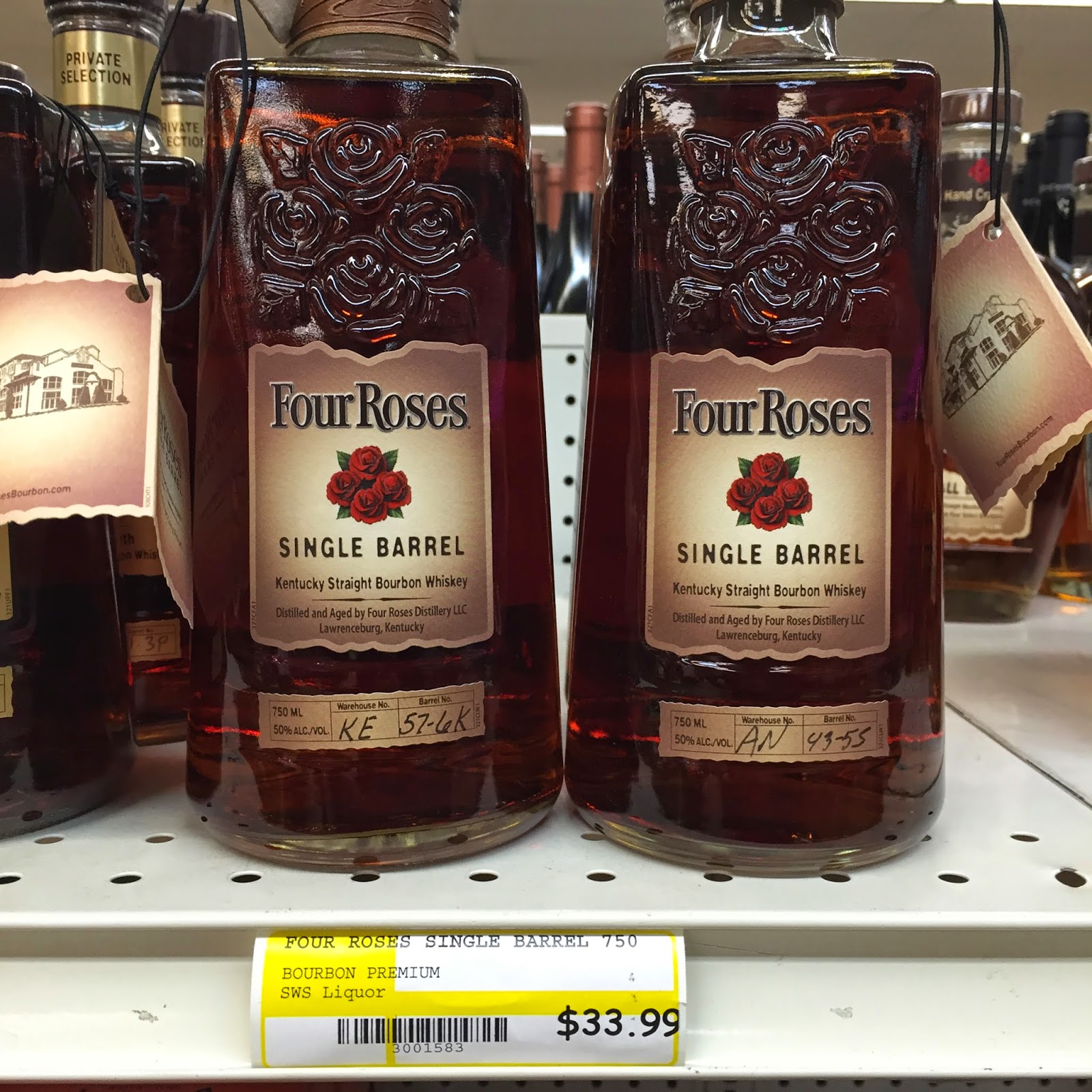 The Four Roses Single Barrel was also a no-brainer. I looked for room in my budget for Four Roses Small Batch or even Four Roses Yellow Label, which is one of the best price performers on the market, and I’ve never found it to be batchy or inconsistent. Still, Four Roses Single Barrel with its standard OBSV recipe (containing a whopping 35% rye) and 100 proof will keep me happy on the island. I was extremelytempted to bring a private barrel bottle of OBSK or OESK plus two bottles of Yellow Label to the island, but I decided to go for variety.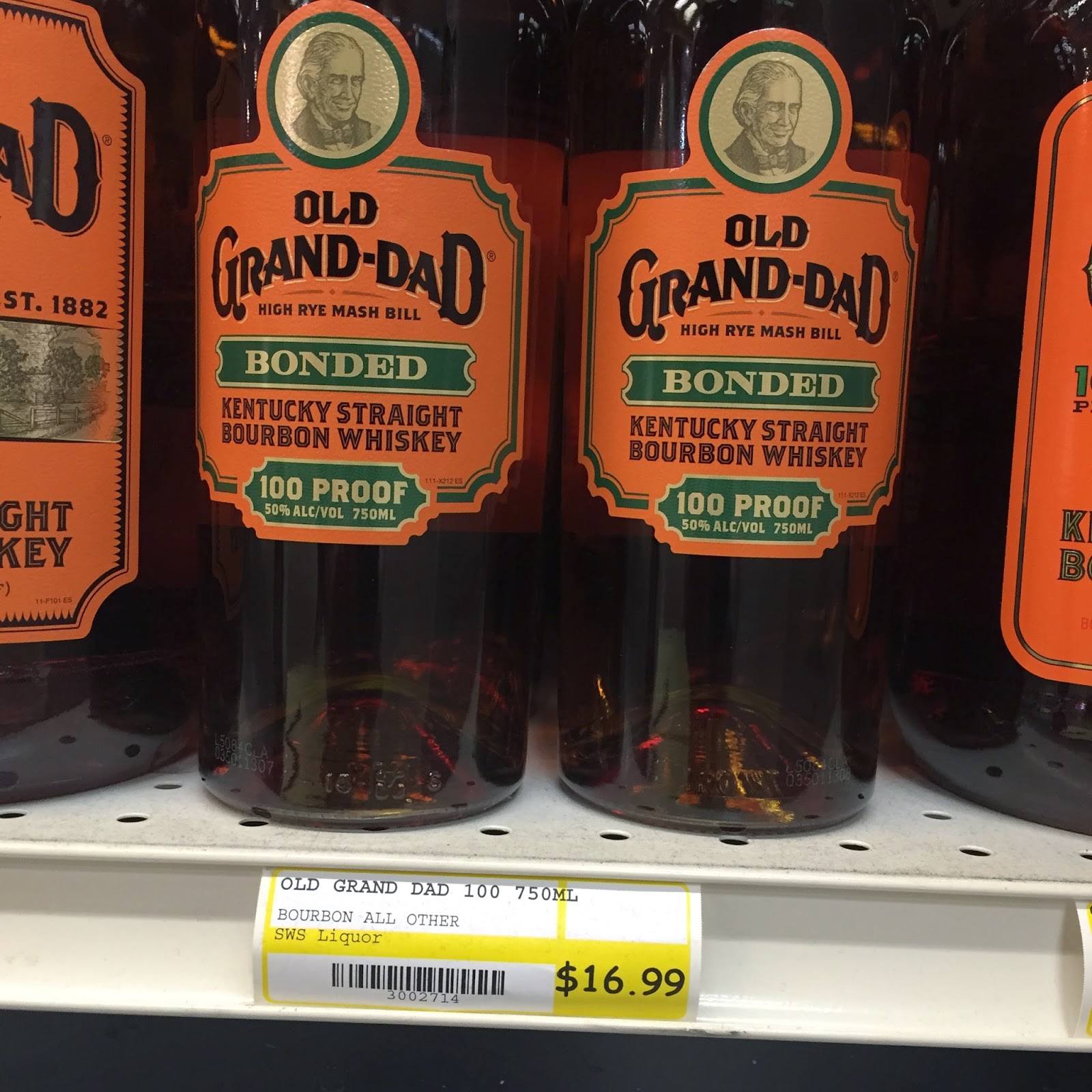
Old Grand-Dad is one of my favorite inexpensive Bottled in Bond Bourbons. It uses Beam’s high-rye mash bill (27% rye), but it’s very different from the Four Roses Single Barrel. It is robust for its age and balances spice with brown sugar, butterscotch and a hint of orange citrus. I might have substituted Very Old Barton Bottled in Bond for Old Grand-Dad, but I’m still not over the age statement removal and the misleading numeral 6 that remains on the neck of the bottle. I was also tempted to use Four Roses Yellow Label as my last pick, but I went for variety and proof.
Now I just need to find an island with the right barware, an ice-maker, a relaxing hammock strung between palm trees, and cruise-ship rescue after about two weeks.
Thanks to Bill at Modern Thirst for organizing “If I had a Benjamin” and for inviting me. I also want to give a special thanks to Eric W. at Springhurst Liquor Barn for his help and for humoring me as I paced around the Bourbon section with my calculator and camera.
Finally, here are links to the complete list of participating bloggers; be sure to check out their selections too:
Cheers!
Life and Passion Return to the Old Taylor Distillery.
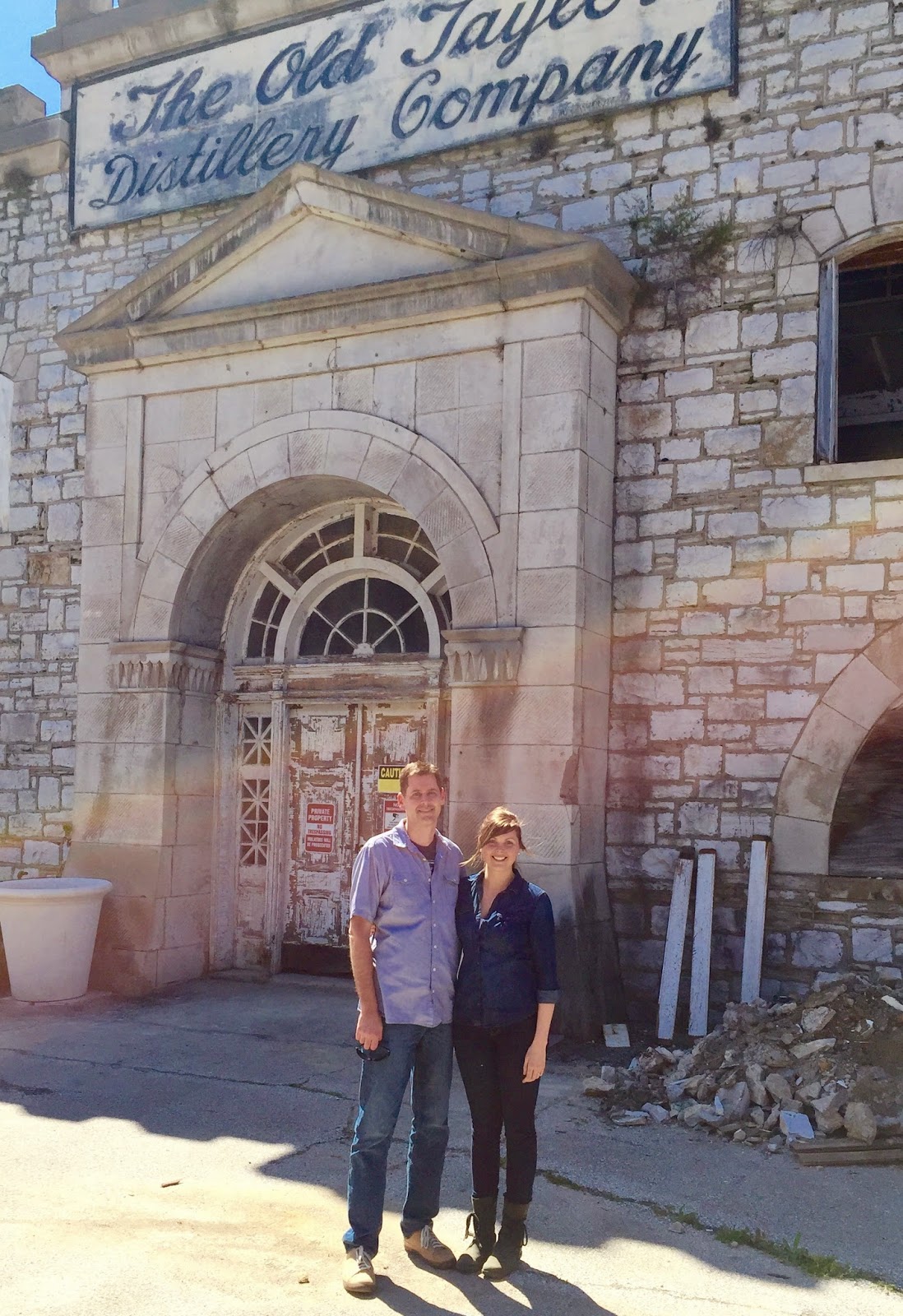
I’ve heard stories and seen pictures from people who have snuck onto the Old Taylor grounds near Millville, Kentucky, on Glenn’s Creek between Versailles and Frankfort, but I had never been there myself before this past weekend. Apparently I was waiting for the right opportunity, and for once I’m glad that I waited. The property is in the midst of a $6.1 million revival (or up to $9 million in other press reports), and while it might not ultimately be called “Old Taylor,” I’ll stick with that name since it’s the historical name.
 Marianne Barnes, who until being named Master Distiller for Old Taylor worked as Master Taster under Chris Morris at Brown-Forman, gave us a personal behind-the-scenes tour, and described the plans for renovations. Marianne is on her way to rock stardom. She’s a professional beyond her years, and her passion and vision for the Old Taylor property is inspiring. While another distillery should have hired the first female Master Distiller long ago, Marianne’s breaking of the barrier is icing on the cake.
The Old Taylor property was built by Col. Edmund H. Taylor, Jr., who was one of the Bourbon pioneers in the 1800’s and 1900’s. He owned or had ownership interests in many renowned distilleries throughout Kentucky, and he was a larger than life figure in Kentucky Bourbon, banking and politics. He built this literal castle of a distillery in 1887, just 2½ miles away from another distillery that he once owned in part, the Old Oscar Pepper Distillery, and not far from the O.F.C. in Frankfort, which he also owned.
Col. Taylor continued to transform the Bourbon industry at the Old Taylor Distillery. He successfully fought off his former partner, George T. Stagg, to retain the use of his trade name and the famous script signature that he used on his bottles (link here); he pushed for enactment of the Bottled in Bond Act of 1897 (link here), and he took the laboring oar in fighting off rectifiers (link here).

The Old Taylor Distillery is big for today’s standards, let alone in 1887. Col. Taylor used one of the world’s largest stills, he built one of the world’s longest warehouses, and he was the first to bottle one million cases of straight Bourbon. Col. Taylor used limestone spring water from the property, and he built an ornate colonnaded spring house complete with limestone pillars, roses and a chandelier over the spring. Even in its near-apocalyptic current state, the grandeur of the Old Taylor Distillery is evident at every turn.
The distillery closed in 1972, but the warehouses were still used for aging until the 1990’s. Owners through this time did the unthinkable to such a treasure – they let it crumble. It was essentially sold for scrap, including to an Atlanta group that ripped apart some of the buildings for “vintage” brick, stone and lumber, further contributing to the property’s demise.
 Fortunately, the current owner, Peristyle LLC, had much more noble plans, with the ultimate goal of returning the Old Taylor Distillery to greatness. (“Peristyle” means “a colonnade surrounding a building or court,” invoking Col. Taylor’s magnificent spring house.) When renovations are completed, the spring house will be used as cocktail garden, and cocktail herbs will be planted around it. Marianne plans for the first distillation run to be in November or December 2015, with the core brand being a traditional Bourbon, but she will also produce gin.
Back to the “Old Taylor” naming issue, Peristyle isn’t calling it “Old Taylor” yet because it is in the middle of a trademark battle with Sazerac, the owner of the Old Taylor brand name. Sazerac sought to trademark the name “Old Taylor” and Peristyle has opposed it before the U.S. Patent & Trademark Office Trademark Trial and Appeal Board (“TTAB”). Peristyle’s opposition (Peristyle, LLC v. Sazerac, No. 91217760) contends that Sazerac’s intended use improperly invokes the geographic location owned by Peristyle, and therefore is “geographically deceptive.” The parties are discussing settlement, however, and have obtained numerous extensions of time upon reporting to TTAB that they “are actively engaged in negotiations for the settlement of this matter.”
Sazerac should keep in mind that the use of “Old Taylor” as the name of the distillery is not trademark infringement because it is a historically accurate geographic name. While Country Distillers could prevent T. William Samuels (a/k/a, Bill, Sr.,) from using “Samuels” as a brand name (link here), and while National Distillers could prevent K. Taylor Distilling Co. from using “Taylor” as a brand name (link here), this dispute is more like the 1880’s lawsuit where James E. Pepper tried to prevent Labrot & Graham from using “Old Oscar Pepper Distillery” as the name of the distillery that is now Woodford Reserve (link here).
The case of Pepper v. Labrot [& Graham], 8 F. 29 (C.C.D. Ky. 1881) describes how the limestone distillery built by Oscar Pepper in 1838 became known as the “Old Oscar Pepper Distillery,” and it was brought to prominence because of its Master Distiller, James Crow. Oscar Pepper died in June 1865, and the distillery was leased to Gaines, Berry & Co. (a partnership that included Col. Taylor). Through this time, the distillery continued to be known as the Old Oscar Pepper Distillery, but also by the Old Crow brand name or even “Oscar Pepper’s ‘Old Crow’ Distillery.”
One of Oscar’s sons, James Pepper, gained control of the distillery, but he soon was forced into bankruptcy and lost the distillery. Labrot & Graham purchased the distillery and continued to call it the “Old Oscar Pepper Distillery.” James found his financial footing and sued Labrot & Graham because he believed that only he should be able to use the “Pepper” name. Labrot & Graham won the case, however, because they owned what was actually called the “Old Oscar Pepper Distillery.” The court ruled that reference to “Old Oscar Pepper’s Distillery” meant the place of production, and was not a trademark.
While Peristyle might be legally entitled to use the name “Old Taylor Distillery,” I suppose there are good reasons to not use it as a primary name, but still find a way to honor Col. Taylor’s legacy. Whatever Marianne and Peristyle decide to name their legendary distillery, expect big things, just like Col. Taylor would have wanted.
Sipp’n Corn Bourbon Review – I.W. Harper Returns.
There I was, 20 minutes south of Louisville on a Thursday night in the middle of a forest, tasting the return of I.W. Harper to the United States. This is the way I get to Jim Beam (which is right across Clermont Rd.) and Four Roses at Cox’s Creek (just five miles east down Clermont Rd.), so why was I trying I.W. Harper, a brand that hasn’t been here for the last 20 years?
Bourbon enthusiasts may know that “Harper” was the brand name used by Isaac W. Bernheim, instead of using his own German-Jewish immigrant name, to sell his popular brand of whiskey in the late 1800’s and early 1900’s. Bernheim’s real name is memorialized in both the “old” and the “new” Bernheim Distilleries, along with Bernheim Original Wheat Whiskey from Heaven Hill. Isaac Bernheim was also a philanthropist, and as noted in the Bernheim Forest website (link here), he donated land for the forest preserve:
Isaac W. Bernheim established Bernheim Arboretum and Research Forest in 1929. I. W. Bernheim (1848-1945) was a German immigrant who settled in Kentucky. From a humble beginning as a peddler, he became successful in the whiskey distilling business where he established the I.W. Harper brand. Grateful for his good fortune, he gave Bernheim Arboretum and Research Forest to the people of Kentucky as a gift.
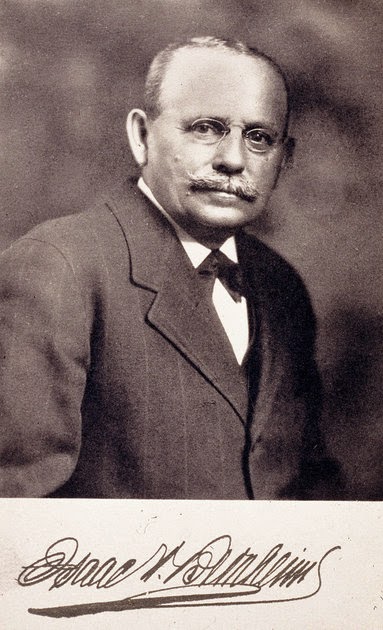 I have expressed my intention that said property … be held in trust … and said fourteen thousand (14,000) acres be used for a park, for an arboretum, and, under certain conditions, for a museum, all of which are to be developed and forever maintained … for the people of Kentucky, and their friends, as a place to further their love of the beautiful in nature and in art, and in kindred cultural subjects, and for educational purposes, and as a means of strengthening their love and devotion to their state and country.
– I.W. Bernheim
Isaac Bernheim seems to have largely avoided the type of distillery litigation that I write about, but his Foundation was involved in litigation in the 1970’s which challenged its tax-exempt status. That case, Commonwealth ex rel. Luckett v. Isaac W. Bernheim Foundation, Inc., 505 S.W.2d 762, 763 (Ky. 1974), also noted the lofty purpose of Bernheim’s gift:
The Isaac W. Bernheim Foundation was incorporated for the following purposes:
1. To afford means for further development in the people of Kentucky, regardless of race or creed, of love for the beautiful in art, music, and in natural life, and for kindred educational subjects, and to strengthen their love and devotion to the State of Kentucky and the United States, and the institutions which have made possible the development thereof.
2. To establish and permanently maintain, an arboretum and herbarium for the raising of trees and shrubs, and to distribute, free of charge, through the State of Kentucky, such trees and shrubs grown on the lands of the Corporation in order that the work of the Corporation may add to the beautification of the highways, public parks and places in the State of Kentucky, and also that the Corporation may be an aid to the maintenance of forestration and reforestration of the lands of the State of Kentucky.
3. To provide a sacred sanctuary for the nondestructive wild birds and wild animal life, in order that their extinction may be prevented.
4. To establish and permanently maintain an art gallery and to acquire and add thereto from time to time, objects of art, including paintings, statuary, bronzes, procelain, and all other kindred subjects, both modern and antique, which may come under the nomenclature of artistic endeavor.
5. To establish and permanently maintain, a museum of natural history patterned after and following the general lines of the museum of natural history of New York City.
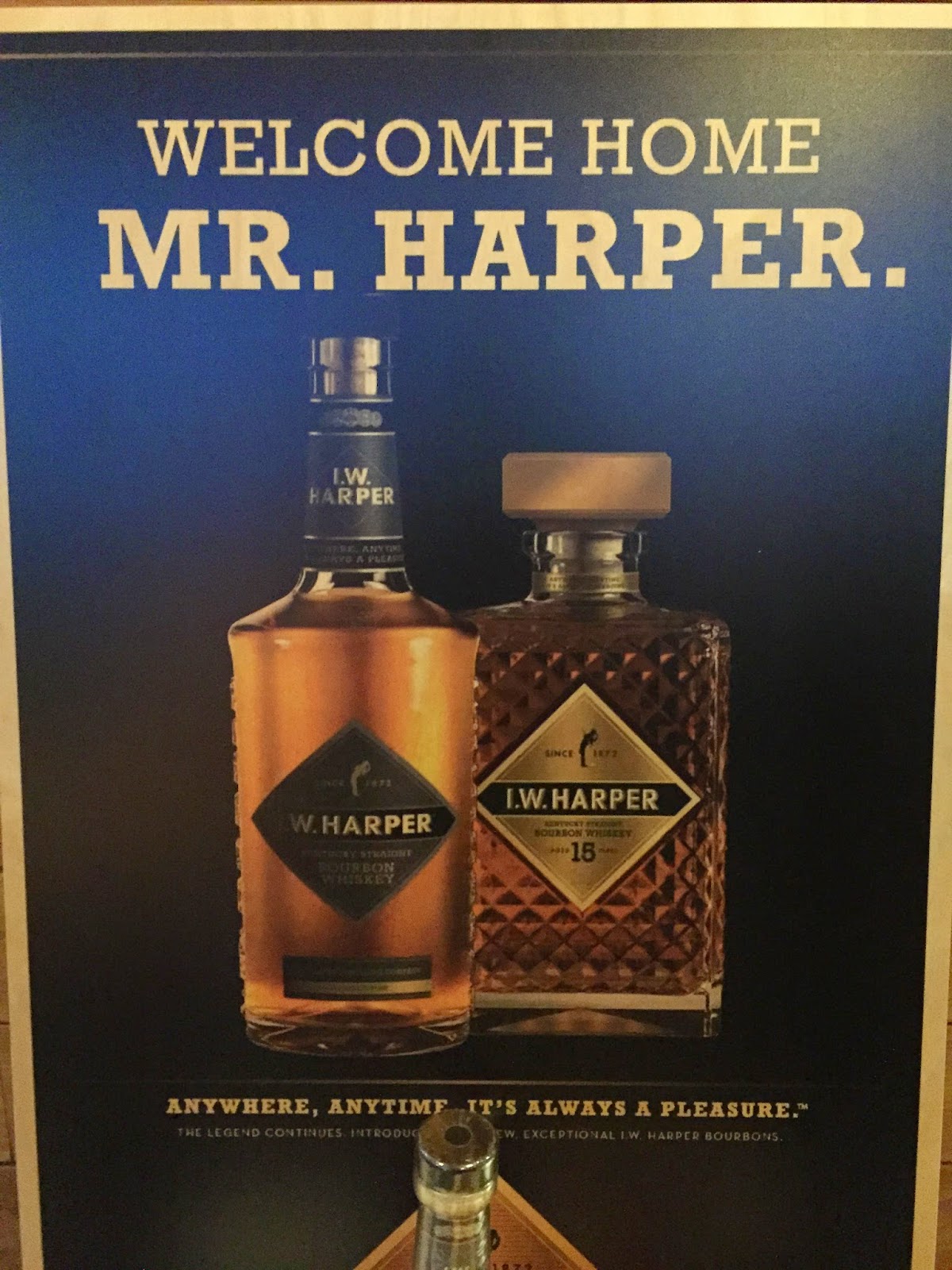
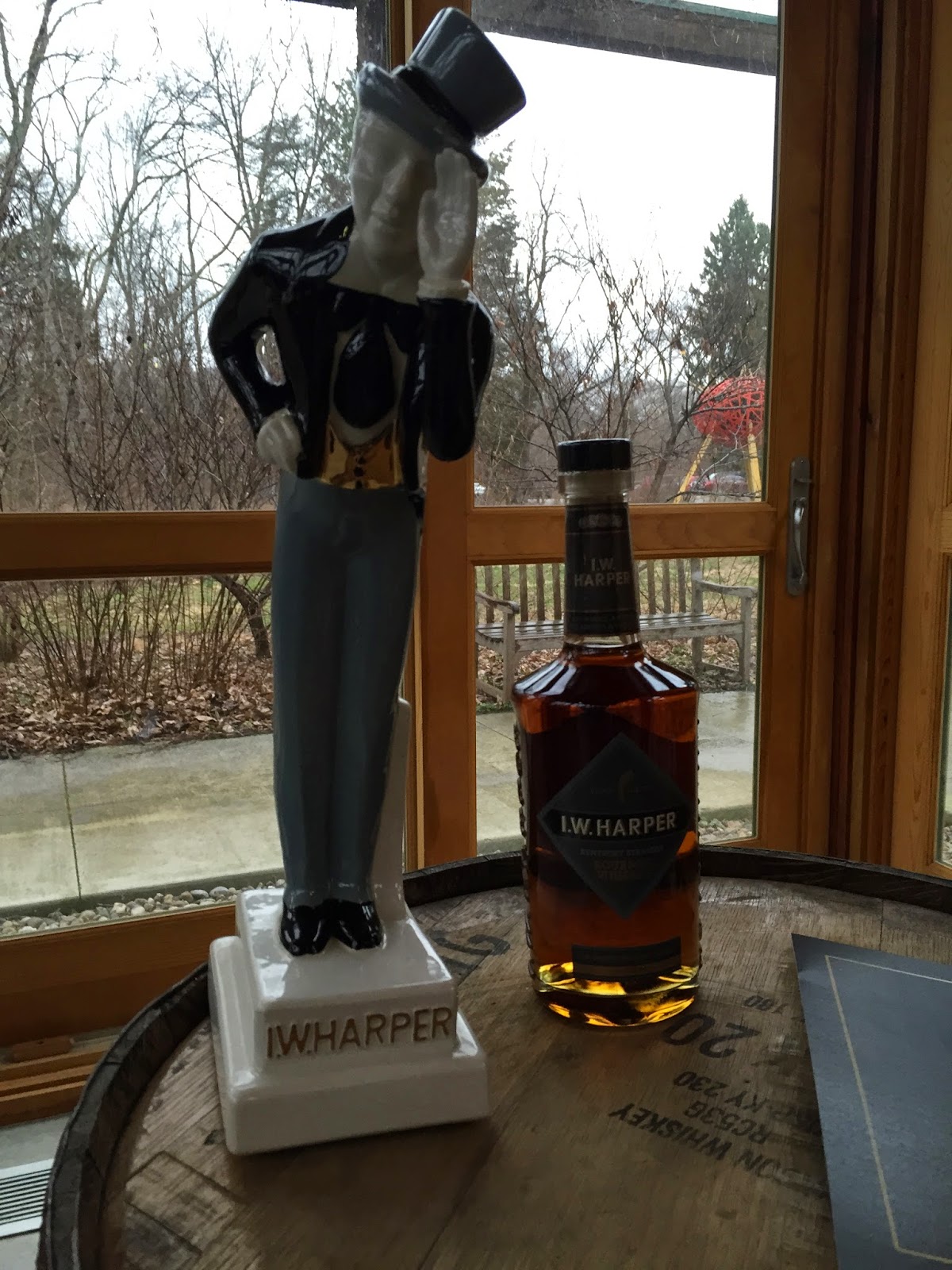 Anyhow, that’s how Bernheim Forest is connected to I.W. Harper, and how I came to be drinking Bourbon in the middle of a forest as part of Diageo’s launch event. After being sold only in international markets for 20 years, Diageo is bringing it back to the U.S. within a month in a 15-year version and a no-age statement (NAS) version.
Doug Kragel, a brand ambassador for Diageo, explained that the New Bernheim Distillery is the source of the new I.W. Harper 15-year (presumably just before it was sold to Heaven Hill). The source of the NAS version is not being disclosed.
J. M. Hirsch of the Associated Press reported that Doug told him that this new I.W. Harper “isn’t quite the same … [as] back in the day … but it’s awfully close.” It’s also bound to be slightly different than the 12-year international variety, so let’s see how the new versions do.
Tasting Notes
Disclaimer: Diageo kindly invited me to the launch
event at the Bernheim Arboretum and Research Forest
to sample both new I.W. Harper brands
event at the Bernheim Arboretum and Research Forest
to sample both new I.W. Harper brands
for this review, without any strings attached.
Thank you.
|
I.W. Harper Kentucky Straight Bourbon Whiskey
|
|
|
Distillery:
|
Undisclosed
|
|
Mash Bill:
|
73 corn; 18% rye; 9% malted barley
|
|
Age:
|
No Age Statement, but the youngest Bourbon in the bottle must be at least 4 years old under applicable regulations
|
|
Proof:
|
82 proof
|
|
Cost:
|
$34.99 / 750 mL bottle
|
Color:
Light amber.
Nose:
Very subtle, corn sweetness and vanilla.
Taste:
Very sweet with corn, vanilla and caramel, along with a nice orange citrus note. Not as youngish as I expected, but still lacking spiciness, and not much oak to speak of. However, it was creamier than I expected, and overall it clearly has older stock blended in.
Finish:
Really short.
|
Limited Edition I.W. Harper 15-Year Old Kentucky Straight Bourbon Whiskey
|
|
|
Distillery:
|
New Bernheim, Louisville, Kentucky
|
|
Mash Bill:
|
86% corn; 6% rye; 8% malted barley
|
|
Age:
|
15 years
|
|
Proof:
|
86 proof
|
|
Cost:
|
$74.99 / 750 mL bottle
|
Color:
Darker in comparison, as expected.
Nose:
Again, very subtle, but predominantly sweet.
Taste:
A ton of corn sweetness along with caramel and vanilla, but well balanced with oak, a little pepper spice, and plum. Creamy. I missed the pop of rye spice or fruitiness, but I still really enjoyed it.
Finish:
A much better finish in comparison, but a little one dimensional.
Bottom Line
I’ll have to revisit these since it’s risky to review based on a single tasting, and I’ll hold my normal scoring until I can try these again. In the meantime, from the samples provided, I.W. Harper Straight Bourbon Whiskey strikes me good, but under-proofed with better options for the price. However, due to blending in older stocks, it’s light years better than standard issue four-year Bourbon. Others at the event liked the younger version over the 15-year version, but I will say that the younger version made some fantastic cocktails. Between the two, I preferred the I.W. Harper 15-year, although again I think that it was under-proofed. I’ll definitely buy a bottle of both of these when they’re released, and I’m hoping to score at least a sample of the international 12-year version to review all three blind.
Copycat Whiskey – the Story of Ezra Brooks and Jack Daniel’s.
Although it was founded in 1866, Jack Daniel’s really figured out marketing in the 1950’s. Through the investment of $3.5 million dollars over a few years, Jack Daniels increased its sales by a staggering 900% between 1950 and 1956, when it was purchased by Brown-Forman. The surge in demand actually created a legitimate shortage by 1957, and Jack Daniel’s had to allocate supply.
Kentucky Bourbon producers typically have not missed many opportunities to increase sales (often leading to the lawsuits that I’ve written about), and the high demand and low supply of Jack Daniel’s brought an imitator out from nowhere. The case of Jack Daniel Distillery, Inc. v. Hoffman Distilling Co., 190 F. Supp. 841 (W.D. Ky. 1960) tells the story of how Frank Silverman created a brand without a distillery in 1957, which he called the “Ezra Brooks Distilling Company.”
Frank sourced Bourbon from the Hoffman Distilling Company in Lawrenceburg, Kentucky (DSP-KY-112), which at the time was still in the famous Ripy family. Bourbon enthusiasts might recognize the Hoffman Distillery as the early bottling location for Pappy Van Winkle after Julian Van Winkle renamed it “Commonwealth Distillery,” and where other assumed names for bottling purposes have included A.H. Hirsch, Old St. Nick., Michter’s, and Black Maple Hill.
According to the court, Frank also sourced from other distilleries in addition to the Hoffman Distillery, but regardless of where it was sourced, Ezra Brooks was bottled in its early days at the Hoffman Distillery. Frank was able to get his new brand to market by April 1957, just in time to take advantage of the shortage of Jack Daniel’s. It was clear to the court that Frank “intentionally copied and imitated the appearance of the well-established and attractive Jack Daniel’s Black Label package and advertising techniques for its new and unknown brand Ezra Brooks.”
Frank didn’t just try to make his new brand look similar to Jack Daniel’s; he went for all-out imitation. The court described the following ways in which Frank copied Jack Daniel’s:
|
Jack Daniel’s
|
Ezra Brooks
|
|
Square bottle
|
Square bottle
|
|
Black and white wrap-around label
|
Black and white wrap-around label
|
|
“90 Proof by Choice”
|
“90 Proof for Character”
|
|
Pictures a small old-time distillery
|
Pictures a small old-time distillery
|
|
“Rare Old Sippin’ Whiskey”
|
“Real Sippin’ Whiskey”
|
|
“Charcoal Mellowed Drop by Drop”
|
“Every Sip is Mellowed ‘Cause Every Drop is Charcoal Filtered”
|
|
Small black and white cardboard neckpiece
|
Small black and white cardboard neckpiece
|
|
Advertised that it was in short supply (which was true in 1957): “There isn’t quite enough to go around.”
|
Advertised that it was in short supply (which was false in 1957): “There just ain’t enuf to go around.”
|
Frank’s lack of originality and misrepresentation to the public about the availability of his new brand were not enough to win the lawsuit for Jack Daniel’s, however. The court ruled (and it was upheld on appeal) that because Frank used a completely different name for his brand, and because the source – Tennessee vs. Kentucky – was clearly marked on the labels, Jack Daniel’s could not prove that Frank was unfairly competing or attempting to pass off Ezra Brooks as Jack Daniel’s.
Hot of this victory, Frank continued to pretend that Ezra Brooks was in limited supply, as shown in this 1965 ad provided by our friends over at Bourbon & Banter (check out http://www.bourbonbanter.com/ and on Twitter @BourbonBanter):

The Ezra Brooks brand then passed as an assumed name around the industry, including Jim Beam, Julius Wile Sons & Co., Medley Distilling Company, and more recently Luxco, with distillation by Heaven Hill. Many of the subsequent owners of the brand continued to market Ezra Brooks as a substitute for Jack Daniel’s, as shown in this 1983 ad:
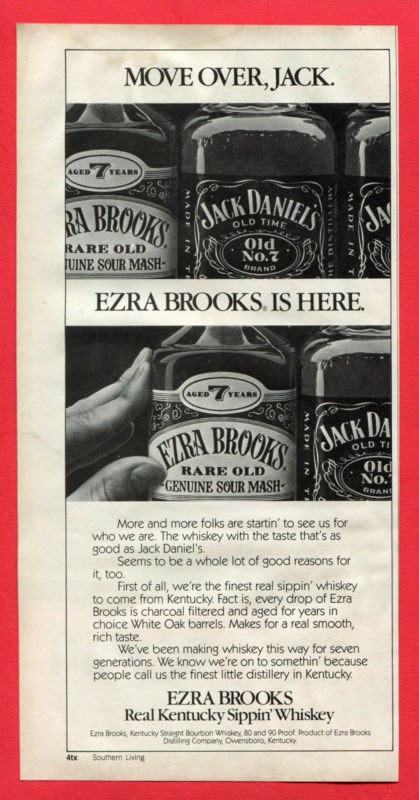
The current website for Ezra Brooks doesn’t focus on Jack Daniel’s, and doesn’t pretend that Ezra Brooks is in short supply, but it still seems to make a few unsupported claims. For example, the prominent “Seven Generations” claim can’t be true for a brand that was created in 1957.
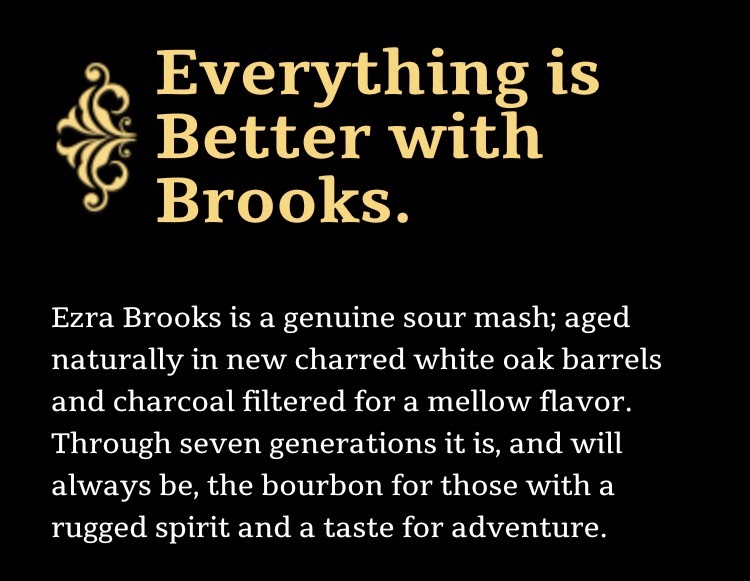
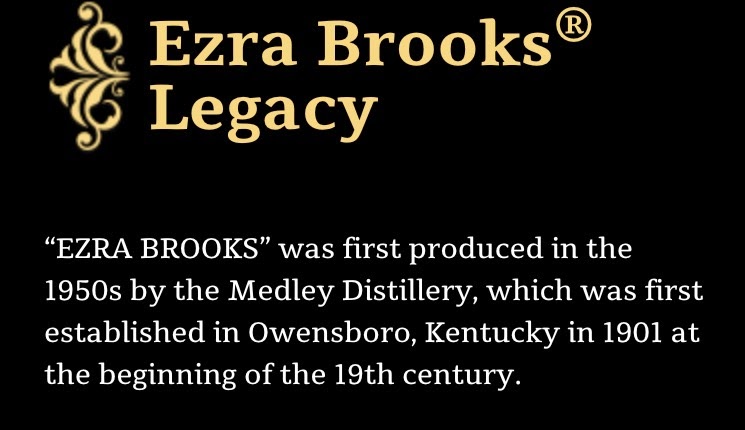
The initial involvement of the Hoffman Distillery is ignored, instead claiming that the brand started with Medley in Owensboro. Additionally, calling 1901 “the beginning of the 19th century” should have been “20th century.”
Then there’s the claim that “Ezra Brooks Distilling Co. was praised by the U.S. Government in 1966 as ‘Kentucky’s Finest Little Distillery.’”
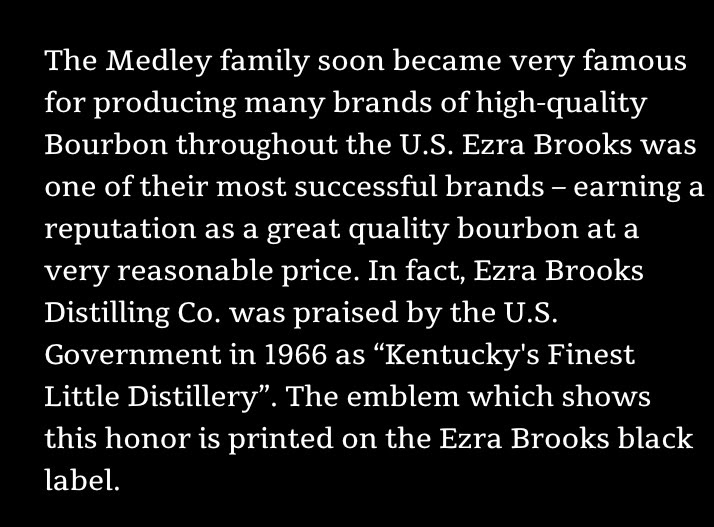
Whateverdistillery (or distilleries) Ezra Brooks sourced from in 1966, it clearly was not the large-scale factory operated by Heaven Hill which produces Ezra Brooks today, so the whole “Kentucky’s Finest Little Distillery” bit should be removed from contemporary bottles. Plus, I could not find any such published “praise.”
While it may be true that “imitation is the sincerest form of flattery,” I don’t blame Jack Daniel’s for not being flattered. Too many brands with no real history and questionable provenance take roads similar to Frank Silverman. A Tennessee Whiskey might not be able to win a lawsuit against a Kentucky Bourbon, but consumers can drive change where the courts don’t.

