Brian Haara
Bourbon. Law. Author.
Sipp’n Corn Bourbon Review – 10 Recipes of Four Roses Single Barrel.
It may be an epic endeavor to rate all ten Four Roses recipes (as a few reviewers have already done before me), but I’m up for the challenge.
 Before jumping in, as a refresher, the ten total Four Roses recipes are each represented by a four-letter code. The only letters that change in the code are the second and fourth letters, however, so you can start with “O___S___” where “O” designates Four Roses in Lawrenceburg, Kentucky and “S” designates that the Bourbon qualifies as “Straight” whiskey under the federal regulatory scheme.
The second letter will either be “E” or “B,” which represents one or the other of the two mash bills used by Four Roses. Unlike many brands who try to hide their mash bill percentages, Four Roses is upfront, and has disclosed these percentages:
“E” = 75% corn, 20% rye, 5% malted barley
“B” = 60% corn, 35% rye, 5% malted barley
Note that each mash bill has a higher rye content that most other distilleries who claim to have a “high rye” Bourbon.
The fourth letter in the code represents one of the five proprietary yeast strains used by Four Roses, represented by the letters V, K, O, Q or F, which Four Roses describes as having these characteristics:
“V” = delicate fruitiness
“K” = slight spice
“O” = rich fruitiness
“Q” = floral essence
“F” = herbal essence
Some of these are very different from the others, while some show distinct family traits and are hard to differentiate. Trying each of the ten recipes might let you identify which mash bill / yeast combination you prefer, or maybe you’ll conclude that for the money you prefer the standard OBSV at 100 proof.
There’s a bit more deciphering to do on Four Roses Single barrel bottles, though, whether you buy the standard OBSV 100 proof, or a private barrel. I’ve always appreciated Four Roses for giving not just barrel number, and not just the warehouse location, but also the directional side of the warehouse (North, South, East or West), the rack number (out of 180 racks per warehouse), the tier where the barrel lived, and a letter code for depth into the row (A=1, B=2, etc.). This is a wealth of information that no other distillery shares.
For example:
· The barrel of OESK that I helped select in 2013 is labeled “KW-89-1I.”
· Last year’s Limited Edition Single Barrel (OESF) is labeled “HW-47-1G.”
· And my empty barrel at home (which serves as the platform for most of the pictures that I post) is “ME-9-6N.”
Here’s how to decipher it:
· My OESK was from the West side of Warehouse K, in the 89th rack, tier 1, barrel I (9 barrels deep).
· The 2014 Limited Edition was from the West side of Warehouse H, in the 47th rack, tier 1, barrel G (7 barrels deep).
· And my home barrel was from the East side of Warehouse M, 9th rack, 6th tier, barrel N (14 barrels deep).
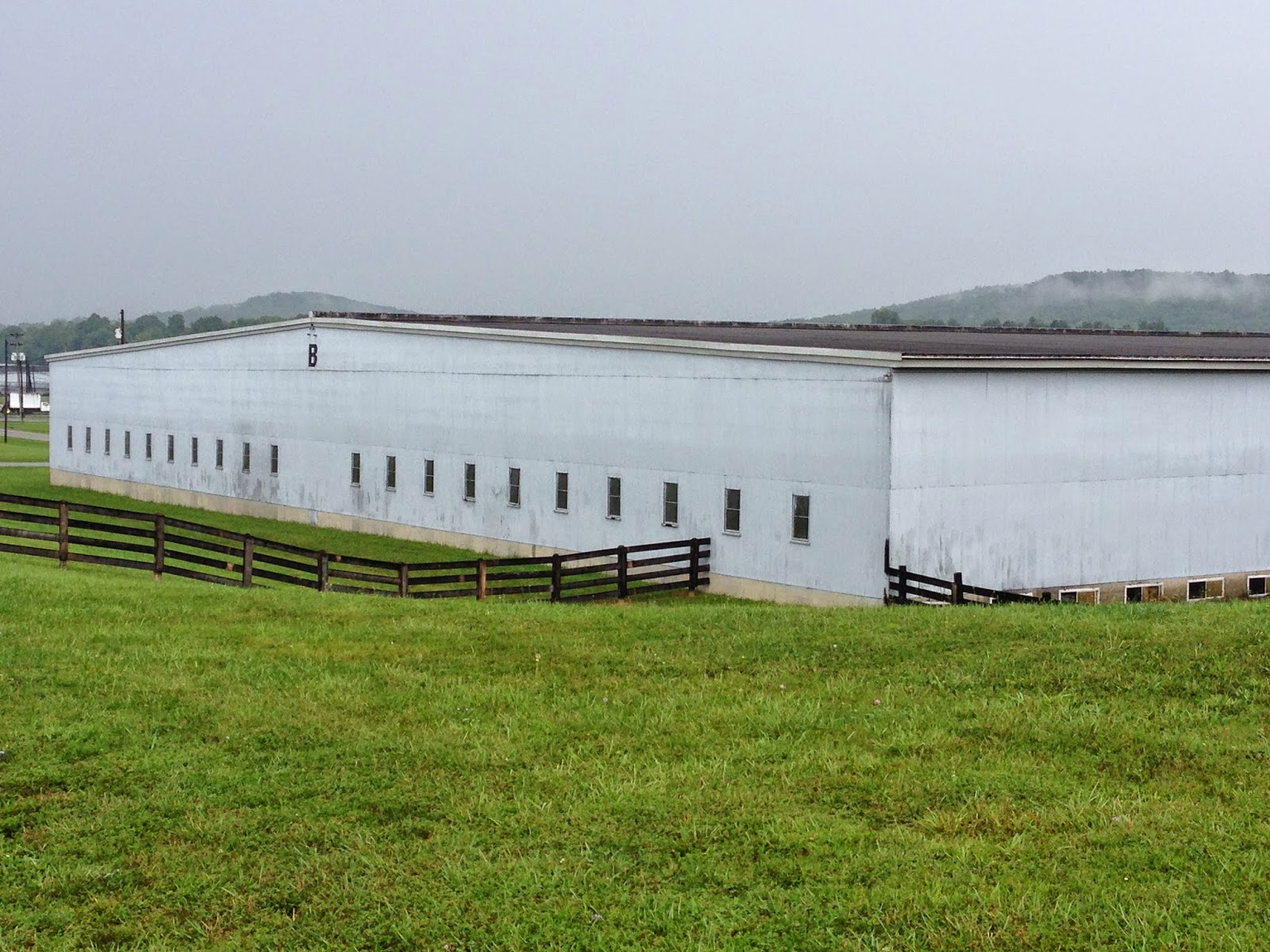
“B” is for “Bourbon,” but the Warehouse is on the label too.
I haven’t purchased all ten recipes yet, so for those missing recipes, I’ve simply noted characteristics from private barrel selections that I’ve attended, and I’ll be updating this post as I add new bottles. In the meantime, let me know your favorite Four Roses single barrel recipe in the comments below or on Twitter.
(1) OESV
A 9-year, 5-month barrel of OESV was one of my favorites in an October 2013 private barrel selection. It had a huge nose, great warmth and an outstanding balance of spice and fruit. Nothing was particularly dramatic about it, but on the other hand, all of its pieces were put together just about perfectly.
2015 Whiskey Barrel Society GW-39-4V
11 years 2 months
ABV: 62.4%
Cost: $60.00
Notes: This OESV is full of dark wood and spice, but also plum, brown sugar, toffee, and mint. There was nothing “delicate” about this one, despite the reputation for the “V” yeast, but it seemed to me that its rawness was due more to the vigorous heat. The complexity and flavors of Four Roses private barrels are usually notoverpowered by a heat, but the high proof along with prickly oak of this private barrel make it a bit of a brute. Even the finish was more of a burn than a swell of flavors.
2015 Whiskey Barrel Society GW-39-4V
11 years 2 months
ABV: 62.4%
Cost: $60.00
Notes: This OESV is full of dark wood and spice, but also plum, brown sugar, toffee, and mint. There was nothing “delicate” about this one, despite the reputation for the “V” yeast, but it seemed to me that its rawness was due more to the vigorous heat. The complexity and flavors of Four Roses private barrels are usually notoverpowered by a heat, but the high proof along with prickly oak of this private barrel make it a bit of a brute. Even the finish was more of a burn than a swell of flavors.
Score on The Sipp’n Corn Scale: 3.0
(2) OESK
*Used in 2012 for the Limited Edition Single Barrel (12 year) and the 2016 Elliott’s Select Limited Edition Single Barrel (14 year).
2013 Yankee Spirits Private Barrel KW-89-1I
9 year 9 month
ABV: 55.5%
Cost: $60.00
Notes: The pairing of the low rye mash bill with a spicy yeast resulted in a Bourbon that starts with a fantastic spicy nose, followed by a balanced taste with big caramel and vanilla balanced with great cinnamon and rye, and opens up with more candy sweetness and ripe fruit with a splash of water. The finish is medium to long with vanilla, oak and fresh-baked cookies.
Score on The Sipp’n Corn Scale: 4.0
As a comparison:
2014 Evergreen Liquors Private Barrel HE-24-3R
9 year 6 month
ABV: 58.6%
Cost: $49.99
Notes: Dark amber with a great nose of rye, caramel, vanilla and blackberries. Rye and cinnamon mark the taste, along with dark fruit, oak and a creamy feel. Overall dry but great balance, and fine to sip neat despite the ABV. Sweeter with ice or a splash of water. Long, warming finish.
Score on The Sipp’n Corn Scale: 4.0
(3) OESO
*Used in 2007 for the Limited Edition Single Barrel (13.5 year).
I’ve tried two of these barrels, both aged 11 years, and they were both very good, most noticeably with a lot more spice and warmth than I might have predicted from the recipe, and less fruitiness than I expected from the yeast.
(4) OESQ
*Used in 2009 for the Limited Edition Single Barrel (11 year).
2014 Liquor Barn Private Barrel RN-85-3H
10 year 1 month
ABV: 59.0%
Cost: $53.99
Notes: The floral yeast resulted in a Bourbon that was way too perfumey for me. It reminded me of potpourri. I don’t know if this was the pairing with the low rye mash bill that did this, whether it was just the yeast coming through, or whether this barrel just turned out this way, but it’s not drinkable in my opinion. To be fair, others have absolutely raved about this recipe.
Score on The Sipp’n Corn Scale: 1.0
(5) OESF
*Used in 2014 for the Limited Edition Single Barrel (11 year).
2014 Limited Edition Single Barrel HW-47-1G
11 year
ABV: 54.5%
Cost: $99.99
Notes: Wow. Check out the full review here: Four Roses Limited Edition Single Barrel & Small Batch 2013 vs. 2014
Score on The Sipp’n Corn Scale: 4.5
As a comparison:
2014 Liquor Barn Private Barrel GE-5-2C
10 year 8 month
ABV: 56.6 %
Cost: $53.99
Notes: Close, but doesn’t touch the 2014 Limited Edition.
Score on The Sipp’n Corn Scale: 3.5
(6) OBSV
*Used in 2010 for the Limited Edition Single Barrel (17 year), reported to be Jim Rutledge’s favorite of the LE Single Barrels.
This is the standard recipe used by Four Roses for its 100 proof Single Barrel, pairing the high-rye mash bill with the slightly fruity yeast to create a really outstanding balanced Bourbon. This is one of my absolute favorites, and thankfully I can always find it priced right about $30-$35 in Louisville.
2015 Bourbon Crusaders Private Barrel JE-1-1E
9 years 2 months
ABV: 58.6 %
Cost: $62.00
Notes: Pronounced legs with a standard amber color. Nice intensity with aromas of caramel, brown sugar, dry grasses, and cola. Cola comes through in the taste too, with rich caramel, brown sugar, dark, ripe fruit, with a kick of pepper, cinnamon, and oak. The amount of oak was just right. The finish was medium-long, and it had the gear-shifting transition that I love to find, from warm brown sugar to oak with faint spearmint. This is a remarkable Bourbon.
Score on The Sipp’n Corn Scale: 4.0
2015 Bourbon Crusaders Private Barrel JE-1-1E
9 years 2 months
ABV: 58.6 %
Cost: $62.00
Notes: Pronounced legs with a standard amber color. Nice intensity with aromas of caramel, brown sugar, dry grasses, and cola. Cola comes through in the taste too, with rich caramel, brown sugar, dark, ripe fruit, with a kick of pepper, cinnamon, and oak. The amount of oak was just right. The finish was medium-long, and it had the gear-shifting transition that I love to find, from warm brown sugar to oak with faint spearmint. This is a remarkable Bourbon.
Score on The Sipp’n Corn Scale: 4.0
(7) OBSK
*Used in 2008 for the Limited Edition Single Barrel (12 year).
*Used in 2013 for the Limited Edition Single Barrel (13 year).
2013 Limited Edition Single Barrel BS-3-2B
13 year
ABV: 57.7% (115.4 proof)
Cost: $79.99
Notes: I love OBSK, and it’s probably my favorite along with OESK. I scored this particular bottle slightly lower in a head-to-head comparison with the 2014 Limited Edition Single Barrel (OESF), but between normal private barrels, I’ll pick OBSK and OESK every time. Check out the full review here: Four Roses Limited Edition Single Barrel & Small Batch 2013 vs. 2014
Score on The Sipp’n Corn Scale: 4.0
(8) OBSO
Pairing the high rye mash bill with the richly fruity yeast strikes me as a winning combination, so long as they don’t fight against each other. But when I tried OBSO out of the barrel last August, I reacted immediately with a “no.” Instead of rye spice or fruitiness, I got a lot of baking spice and floral notes.
(9) OBSQ
*Used in 2011 for the Limited Edition Single Barrel (12 year), reported to be Jim Rutledge’s least favorite of the LE Single Barrels.
Our OBSQ barrel was fourth in the lineup at a barrel selection last year, and it jumped out to an early lead with the best nose and finish to that point. It had caramel with distinct candied cinnamon, along with nice oak, and importantly for my preferred profile, the floral notes from the Q yeast were extremely subtle. It stayed in contention, but ended up being ranked third or fourth overall.
(10) OBSF
The “herbal essence” yeast combined with the high rye mash bill was a little too much for me this past August. It had a ton of heat, spice and perfume. I have an unopened bottle from a Bourbon Society private barrel, so I’m hoping for a better experience.
The Sipp’n Corn Scale:
1 – Wouldn’t even accept a free drink of it.
2 – Would gladly drink it if someone else was buying.
3 – Glad to include this in my bar.
4 – Excellent bourbon. Worth the price and I’m sure to always have it in my bar.
5 – Wow. I’ll search high and low to get another bottle of this.

Barrel selection with Jim last year on my birthday.
KDA v. Sazerac – Who Gets To Be On The “Kentucky Bourbon Trail®” Or Public Television?
As more and more people become interested in Bourbon and want to experience the living histories of Kentucky’s Bourbon distilleries, they might visit the “Kentucky Bourbon Trail” website (link here) to plan their visit.
In the course of planning their trip along the Kentucky Bourbon Trail, they might wonder why Buffalo Trace, with all of its venerable history, isn’t included on the Trail or the map:
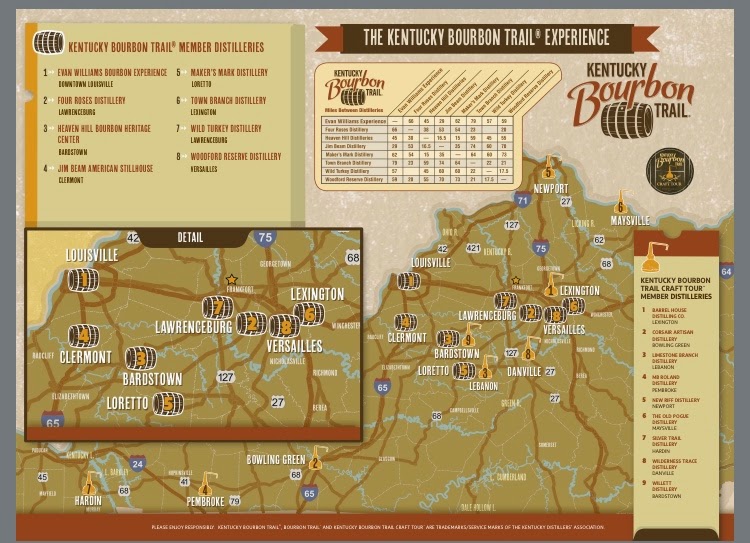
The answer is as simple as understanding that members can benefit from participating in a trade organization. The Kentucky Distillers’ Association (“KDA”) is a trade organization made up of member distilleries, which traces its roots back to 1880 when distillers banded together to reduce whiskey taxes and to protect the industry. The group disbanded during Prohibition, but reformed in 1935 to assist with repeal efforts. According to its website, the KDA is a non-profit organization with a mission “to protect the trade interests of the industry whenever they may be threatened and to handle common problems in a concerted action.”
The KDA created the Kentucky Bourbon Trail in 1999, at a time when the owner of Buffalo Trace, Sazerac Company, Inc., was a member of the KDA. Anyone who toured Buffalo Trace between 1999 and 2009 might have noticed Kentucky Bourbon Trail trademarked logos and advertisements, and might have even had their Kentucky Bourbon Trail “passport” stamped at Buffalo Trace to memorialize their visit.
This all changed at the end of 2009, however, when Sazerac terminated its membership in the KDA (Click here to view the December 31, 2009 letter) and then, according to a complaint filed by the KDA against Sazerac in April 2010 in federal court in Louisville, it tried to keep using the Kentucky Bourbon Trail trademarks (Click here to view the Complaint).
Trademark protection has been a recurrent theme in Bourbon litigation, and is a frequent subject of my posts. While many of those cases arose very early in the development of trademark rights, it’s probably indisputable that trademark rights are well-understood by today’s sophisticated corporations, Sazerac included. Worse for Sazerac, according to court filings, as a KDA member, “Sazerac participated in the creation and development of the KDA’s promotion and tourist attraction, the KENTUCKY BOURBON TRAIL®, including the creation and adoption of the mark ‘KENTUCKY BOURBON TRAIL®.’” Buffalo Trace was even one of the first members of the KDA’s promotion and tourist attraction.
Between 1999 and 2009, when Buffalo Trace used the KDA’s trademark for the Kentucky Bourbon Trail on its website, it used the standard acknowledgment that the KDA owned the trademarks. But then, after Sazerac left the KDA, it kept using the Bourbon Trail name albeit slightly revised to “Buffalo Trace Distillery on the Bourbon Trail,” it tried to register that as a trademark (along with a similar trademark for its Tom Moore Distillery), and it even tried to cancel the KDA’s trademarks.
The case never went to trial, and instead the parties settled, so the case was dismissed in November 2011. While the terms of the settlement were not released (the Order that the parties prepared for the Court stated simply that all claims have “been resolved and settled to the mutual satisfaction of the parties” – Click here to view), a review of today’s Buffalo Trace website can give us a hint about the result: neither the “Kentucky Bourbon Trail” nor “Buffalo Trace Distillery on the Bourbon Trail” are anywhere to be seen.
If there were any smoldering embers of the dispute between the KDA and Sazerac, they might have been fanned last week when a prominent whiskey writer complained about the new Bourbon documentary which aired on Kentucky Educational Television (“KET”) earlier this month. The documentary, “Kentucky Bourbon Tales; Distilling the Family Business,” aired to much acclaim. For those who missed it or are outside of Kentucky, you can find it at this link: Kentucky Bourbon Tales.
Kentucky Bourbon Tales was produced by the Louie B. Nunn Center for Oral History and was funded by the KDA. I’ve linked to the Louie B. Nunn Center interviews for other posts, including great information related to Buffalo Trace.
As the subtitle “Distilling the Family Business” indicates, the focus of the documentary is people who grew up distilling and handed down Bourbon tradition generation after generation. The Beam family (stretched far wider than Beam Suntory), Wild Turkey with Jimmy and Eddie Russell, Heaven Hill (still a privately-owned company), Brown-Forman, Four Roses with nearly 50 years of Jim Rutledge working his way through Seagram’s and finally bringing the brand back to prominence, were all featured.
Buffalo Trace – which I’ve written about extensively and which I’m personally a big fan of – wasn’t mentioned, nor were two other distilleries owned by Sazerac. Maybe that was because those distilleries did not fit into the “Distilling the Family Business” framework due to their changes in ownership and lack of family lineage for Master Distillers. But, of course, since Sazerac voluntarily decided to abandon the KDA, it’s reasonable to conclude that’s why the Sazerac distilleries were not included in a KDA-sponsored production. Is there a problem with that?
I didn’t think there was anything wrong with excluding a non-member who didn’t pay any dues that would have supported the documentary, so I was surprised to read criticism that the documentary hid an “ugly secret” of a “petty commercial dispute,” and even more surprised to read the claim that the KDA was “lying,” and the pronouncement that KET and the University of Kentucky “should be ashamed of themselves for their complicity in this charade.” So far as I know, Sazerac has not complained about the KET documentary; it’s just coming from one writer.
Sazerac itself probably hasn’t complained because there’s no “secret” (let alone an “ugly” one) about the membership of the KDA, and trademark infringement is no “petty” matter. I’m not sure that anyone really thinks that Sazerac should have been given the benefit of a production financed by the group that it spurned, and from which, according to the court documents, it tried to appropriate the Bourbon Trail trademark. Personally, I’m glad that we’re not going down the road of socialized television. Sazerac is thriving and is happy to take care of its own marketing, and the KDA is doing a great job for its members. Let’s just all enjoy our Bourbon in harmony for the New Year, and not root for a Round Two of the KDA v. Sazerac lawsuit.
Sipp’n Corn Bourbon Review – Four Roses Limited Edition Single Barrel & Small Batch 2013 vs. 2014.
I wasn’t sure that I could contribute much on a straight review of any of these Limited Edition Bourbons, especially when one of these competitors was named the Whiskey of the Year last year (the second year in a row that Four Roses Limited Edition Small Batch snagged that honor), so I decided to throw them all into the same ring. But doing that still makes my head spin. How can I possibly rank these against each other? Would the acclaim of last year’s 125th Anniversary Small Batch put subconscious pressure on me to rank it highest? Or maybe I’ll be expecting too much and score that expression too harshly? Plus, these are all stellar and they’re all bottles that you’d better buy if you luck into an opportunity, but I have to find some way to critique them, right?
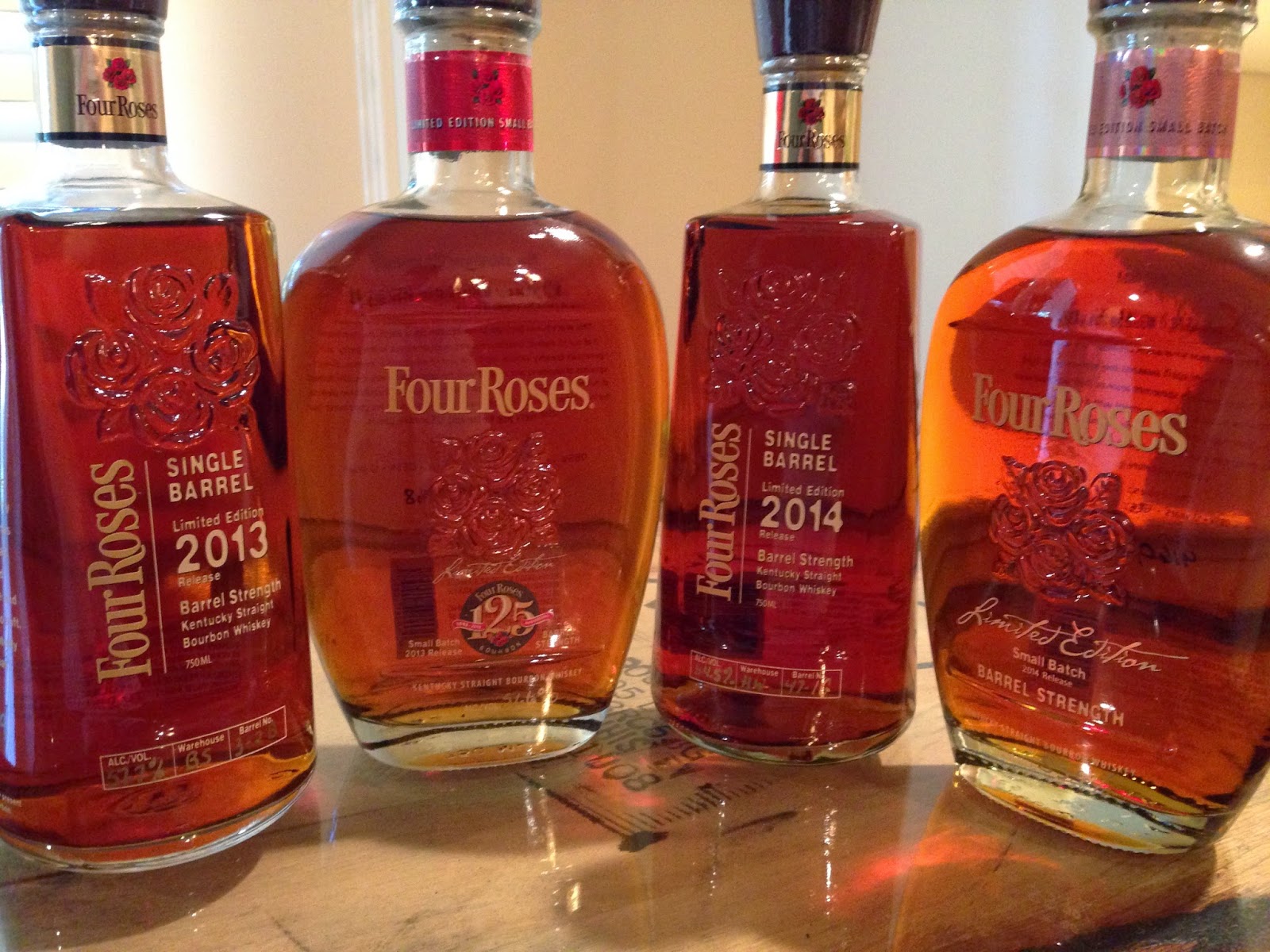
Jim Rutledge – who has been the Master Distiller at Four Roses since 1995 but is pushing 50 years of experience since he goes back to the Seagram’s days where he started in Research & Development in Louisville, before moving with Seagram’s to New York and finally to Lawrenceburg, Kentucky – is pretty much a genius. Jim is the mastermind who finally got the rotgut off the shelves and real Four Roses available again in the U.S., although it took years of his efforts and the demise of Seagram’s before it was a reality. Plus, Jim is gracious with his time, meticulous with his art, and proud (without arrogance) of the brand he has built.
Now we’re a dozen years into the return, ten years into Four Roses Single Barrel (OBSV), and eight years into the Limited Editions, so just under the wire before 2015, let’s review 2013 and 2014:
Four Roses 2014 Limited Edition Single Barrel – Bottle No. 2,206
Age: 11 Years
Recipe: OESF
ABV: 54.5% (109 proof)
Cost: $99.99
Total bottles: 7,122
The color of many Four Roses Bourbons is remarkably consistent, and the dark amber with an orange/reddish shimmer of this Limited Edition is no exception. The nose is big, with dark fruits, cinnamon, vanilla and mint. The 2014 Single Barrel doesn’t hold back on flavors. It has the classic flavors of toffee and caramel with fresh orange zest followed by creamy vanilla, pear and cherry pie, leading to a bit of dark chocolate, leather and mint. There’s a lot going on. For the finish, the 2014 Single Barrel brings oak, cherries and fresh mint. This is a true gem to savor and drink neat.
I had my doubts about the OESF recipe. The lower rye content combined with the “herbal essence” yeast seemed to me like it was bound to underwhelm. I was about as wrong as I’ve ever been about Bourbon. Still, out of curiosity, I compared this 2014 Single Barrel to a private barrel of OESF, which was 10 years and 8 months old, and 56.6% ABV. While the color is essentially the same, the private barrel has more floral and herbal notes both on the nose and in the taste, the fruit is not as rich, and the finish is not as long as the Limited Edition. Overall it’s comparable, just not in the same league. It was also a good lesson about Jim Rutledge being able to pick out the honey barrels; you just can’t match that.
Four Roses 2013 Limited Edition Single Barrel – Bottle No. 2,725
Age: 13 Years
Recipe: OBSK
ABV: 57.7% (115.4 proof)
Cost: $79.99
Total bottles: 6,559
I remember really anticipating this Limited Edition Single Barrel because of the combination of the “B” mash bill (higher rye) combined with the “K” yeast strain (slight spice) because I thought it would be a true powerhouse, and word has it that OBSK is one of Jim’s favorites.
Color-wise, there’s nothing significant; it’s the darker amber expected from a 13 year-old Bourbon, with a slight orange/reddish hue. The nose is restrained but complex. It has caramel, honey, citrus zest layered in with toasted almonds and mint. The taste starts with sweet flavors of butterscotch and honey, pear, and banana, along with the richness of dark chocolate and dark fruits, balanced with the powerful spice that I expected to find. The finish finally brings a little more oak into the picture, along with maple syrup, for a sweeter finish than I expected. Overall, this was not the pure spicy beast that I expected, and instead it was full of flavors and incredibly well balanced.
Between the two – based on my expectation of the respective recipes – I thought that I would prefer the 2013 LE Single Barrel, but I actually preferred the 2014 LE Single Barrel. Normally though, I think I will default to the OBSK.
Four Roses 2014 Limited Edition Small Batch – Bottle No. 9,224
Recipes: OBSK (9 years); OBSV (13 years); OESV (12 years); and OBSF (11 years)
ABV: 55.9% (111.8 proof)
Cost: $110.00 (gift shop price)
Total bottles: 12,516
After two years of winning “American Whiskey of the Year,” the 2014 Limited Edition Small Batch heaped pressure on Jim Rutledge, and he answered, while not with a “three-peat,” with an excellent Bourbon. With a deep amber color, without approaching brown, it looks pretty standard. The nose has caramel, pears and vanilla, noticeable citrus, and never getting drowned out by the scent of alcohol. The taste follows up with more of the traditional caramel and vanilla, but more prominently features pear and honey for the sweetness, balanced with rye spice, pepper, clove and oak, and then some mint. The finish is punchier and more oaky than 2013 and is medium length with great warmth.
Four Roses 2013 Limited Edition Small Batch – Bottle No. 516
Recipes: OBSV (18 years), OBSK (13 years), OESK (13 years)
ABV: 51.6% (103.2 proof)
Cost: $85.00
Total bottles: 12,468
I’ve tasted the 2013 Limited Edition Small Batch blind, and while I scored it very high, I didn’t score it stratospheric, as might be expected. So in this non-blind comparison, I tried to be especially cautious about not getting swept up in the wave of accolades heaped on this award-winning whiskey, or the magic that is contained in the 18-year OBSV.
The color is standard amber, with good legs in the glass. The nose is pretty remarkable, though. It starts with tea, ripe pear, plum, caramel and vanilla, and also has hints of fresh sweet cherries. The taste follows up in a huge way with the traditional caramel and vanilla, but adds the richness of dark berries and cocoa balanced with rye spice, pepper, leather and oak. Both the nose and the taste hid the proof, or maybe that’s because this is the lowest proof of the four. The long finish keeps the same balance has lingering warmth that slowly fades. It had the longest finish of the four.
As good as the 2014 LE Small Batch is, the 2013 LE Small batch outshines it in every way. The bar is so high for the Four Roses Limited Edition Small Batch, and the 2013 LE is the standard-bearer.
Single Barrel Winner: 2014 Limited Edition Single Barrel
Small Batch Winner: 2013 Limited Edition Small Batch
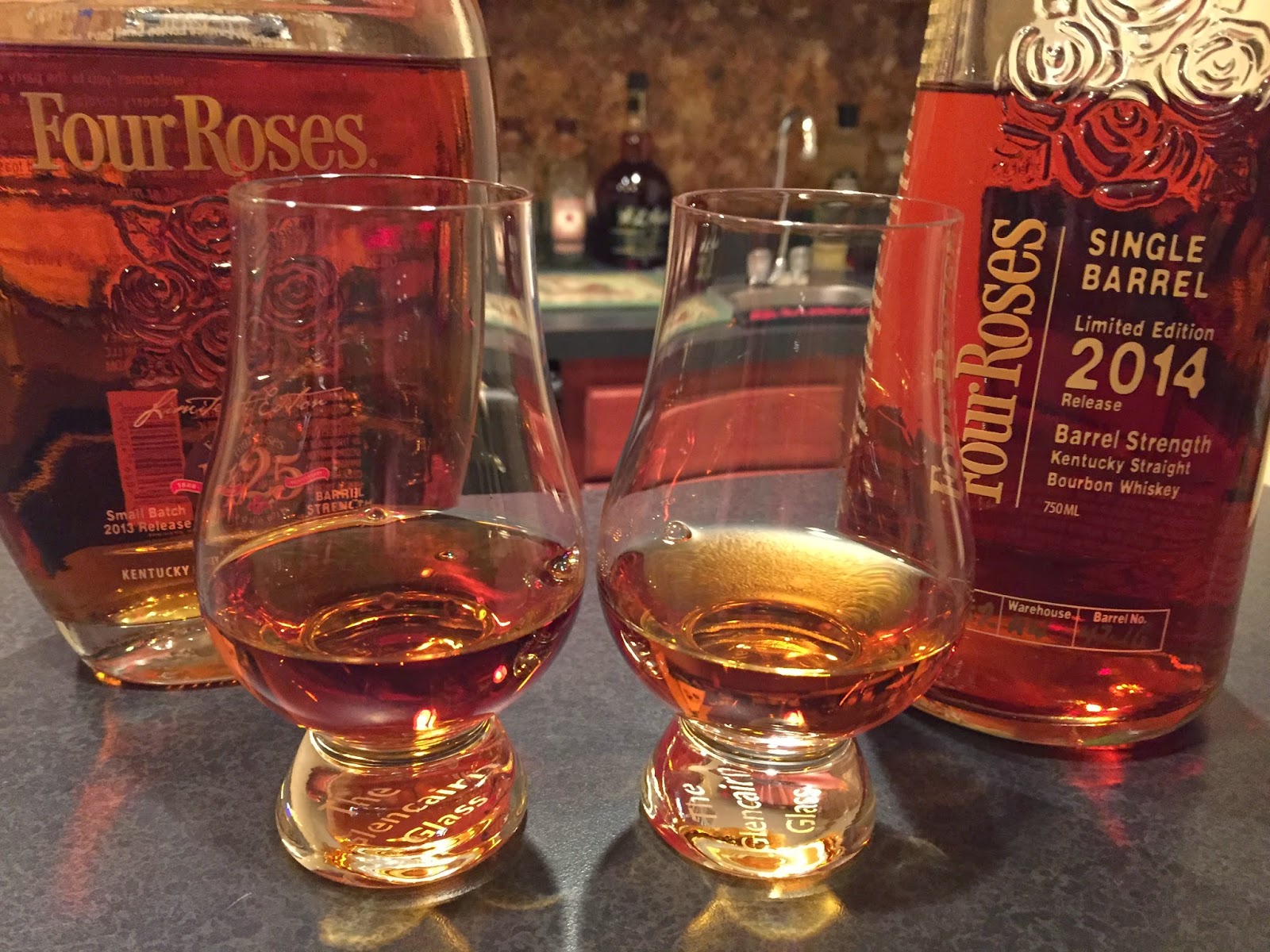
Bottom Line:
The small batch winner was a no-brainer and the single barrel winner surprised me because I initially focused too much on the respective recipes. Between these two winners, my ultimate favorite was really difficult to call, in part because they’re so similar. The color is basically identical, the noses are similar (but I liked the 2014 slightly more), they have similar taste profiles (but the 2014 is a more robust), and the 2013 has the best finish. I might pick one or the other on any given day depending upon mood. Both the 2013 LE Small Batch and the 2014 LE Single Barrel are as close as I’ve considered to an outright “5” on my five-point scale. But at post time, with the chilly December weather, it’s the 2014 single barrel for me.
A normal single barrel probably shouldn’t ever prevail over a fine-tuned small batch. Except for a true “honey barrel,” a single barrel will almost always have a raw element that can’t be hidden, whereas with the small batch Jim can complement the strengths of certain barrels and mask minor deficiencies in others. Still – at least over this month’s comparison tastings – I slightly preferred the robust punch of the 2014 Limited Edition Single Barrel over the lighter, perfectly balanced, flavors of the champion.

Should the color really be this identical?
Scores on The Sipp’n Corn Scale
2014 LE Single Barrel: 4.5+
2013 LE Small Batch: 4.5+
2013 LE Single Barrel: 4.0
2014 LE Small Batch: 3.5
Liquor Barn’s Private Barrel OESF: 3.5
The Sipp’n Corn Scale:
1 – Wouldn’t even accept a free drink of it.
2 – Would gladly drink it if someone else was buying.
3 – Glad to include this in my bar.
4 – Excellent bourbon. Worth the price and I’m sure to always have it in my bar.
5 – Wow. I’ll search high and low to get another bottle of this.
The Wathen Family Pokes The 800-Pound Gorilla (The Whiskey Trust).
Members of the Wathen family were whiskey pioneers in Kentucky, but only the basics are written about them. At most, some writers briefly mention the Wathen family as being part of the early distilling tradition in Kentucky, and some acknowledge the family’s deft maneuvering to succeed during Prohibition by forming the American Medicinal Spirits Company (“AMS”), which was eventually sold to National Distillers. More often, however, the Wathen family is relegated to mere passing reference (if at all), or incorrect names and dates are given to fill in chronologies in other stories (like Old Grand-Dad or National Distillers), or the name is only recognized through the current Wathen/Medley sourced brands.
In reality, lawsuits spanning over 50 years (ranging from the late 1800’s through the post-Prohibition era) provide an incredible history of family tradition, partially selling out to the Kentucky Distilleries and Warehouse Company (“KDWC” – the Whiskey Trust) and starting over with the next generation, fighting with the KDWC, battling the temperance movement, defending criminal charges, surviving through the genius of AMS, and helping position National Distillers Products Corporation as a behemoth.
There’s actually too much litigation and history for just one post, so here I’m focusing on the sale of J. B. Wathen & Bros. Co. to KDWC in 1899, and the lawsuit that led John Bernard’s (“J. B.”) son, Richard Eugene (“R. E.”), to start his own distilling company, probably with the support of J. B., and immediately poking KDWC in the eye.
But first, to set the stage, the history leading up to 1899 is important. Henry Hudson Wathen (1756-1851) settled seven miles south of Lebanon, Kentucky in 1788. Two years later, in 1790, he started a “very small and crude distillery” according to a family history published in a 1905 edition of The Wine and Spirit Bulletin.

In 1852, Henry’s youngest son, Richard Bernard Wathen (1815-1880), started his own distillery just about one mile from Henry’s distillery. Richard, it turned out, became the father of perhaps the most prolific whiskey distiller brothers in American history.

Richard had five sons who eventually worked in the distilling business, the most prolific of whom was John Bernard (“J. B.”) Wathen (1844-1919). The other brothers were Richard Nicholas (“R. N.”), Martin Athanasius (“M. A.”), William H. (“W. H.”), and John A. (“J. A.”). In turn, J. B.’s most prolific distilling son was Richard Eugene (“R. E.”) Wathen, although most of his brothers and other sons were also involved in the family business.
J. B. built his first distillery in Lebanon, near his father’s and grandfather’s distilleries, in 1875. By 1879, J. B. added the first non-Wathen partners to the family business, H. Mueller and Chas. Kobert of Cincinnati. J. B. sold out of that partnership in 1880, leaving it in the capable hands of his brother, R. N. and J. A., along with Mueller and Kobert.
J. B. sold out because he had bigger plans. He moved to Louisville and built the J. B. Wathen & Bros. Distillery in 1880 with his brother, W. H. Their brother M. A. joined them in 1881, and by 1885 the brothers rolled the partnership into a corporation called “J. B. Wathen & Bros. Company.” The Wathen brothers experienced incredible success and reinvested in the company by installing one of the first continuous column stills in Kentucky and installing steam heat in the warehouses. J. A. Wathen joined his brothers in 1887 to manage the company.
On April 13, 1899, J. B. sold J. B. Wathen & Bros. Co. to KDWC, but in the meantime, the family’s other distilleries stayed in the family. “Wathen, Mueller & Co. was still going strong in Marion County and in 1899 J. B.’s brother, M. A., along with J. B.’s son, R. E., purchased the Old Grand-Dad distillery in Hobbs Station.
After the sale to KDWC, J. A. Wathen stayed with KDWC as an employee. In a move that must have led to awkward dinner-table discussions, however, J. B. Wathen apparently orchestrated the formation of a new business for his sons – calling it “R. E. Wathen & Co.” after his oldest son (who was only 22 at the time) – to immediately compete with KDWC and to try to use brand names that infringed on the brand names that J. B. had just sold to KDWC. R. E. Wathen & Co. even employed former J. B. Wathen & Bros. Co. employees, used the office space from which J. B. had run his company, and used J. B.’s equipment.
The primary brands of J. B. Wathen & Bros. Co., which of course were sold to KDWC, were “Ky. Criterion” and “Honeymoon” and the distillery was sometimes known as the “West End Distillery.” The new R. E. Wathen & Co. called its distillery the “East End Distillery” and promoted its brands as “Ky. Credential” and “Honeycomb.” As we might expect, KDWC sued and asked for an injunction.
The court’s July 16, 1901 ruling held that these two brands unfairly impinged on the brands just acquired by KDWC, even though consumers were not necessarily deceived.
The court noted that federal law had required, since 1892, that the name of the distiller be stamped or burned upon the head of every barrel of distilled spirits (hence the origin of the term “brand name”). The court also noted that distillers sold their whiskey in barrel lots to wholesalers, then it was sold by “drummers” to retailers, who then sold the whiskey to the public in bottles that did not necessarily include the brand name of the distiller. KDWC apparently acknowledged that the wholesalers were not misled by the similar names used by the new Wathen company, but in possibly the first extension of brand name rights, the court still enjoined the Wathens from using “Ky. Credential” and “Honeycomb” simply to protect the brand names acquired by KDWC.
The Wathens were true Kentucky Bourbon pioneers, and like so many of the colorful characters of Bourbon legend, they had a maverick instinct and didn’t shy away from litigation. This time though, the Whiskey Trust won the fight in court. However, the Wathen family fought on, and succeeded with Old Grand-Dad and other brands, even thriving during Prohibition. Stay tuned for future posts about more cases involving this legendary family.
Sipp’n Corn Bourbon Review – Orphan Barrel Lost Prophet
Lost Prophet is Diageo’s fourth Orphan Barrel brand, a 22 year-old Bourbon distilled at the George T. Stagg Distillery (now Buffalo Trace) and moved for storage to Stitzel-Weller in Louisville, although I cannot find a definitive answer to the question of when or why these barrels were sold to Stitzel-Weller or its subsequent owners, who continued to age Bourbon after distilling ceased there.
However, I think the reason can be put together from the status of the Bourbon industry at the time. According to the Buffalo Trace timeline (link here), in 1991 employment at the distillery had dwindled to 50 people and the distillery was in danger of closing. That’s when Lost Prophet was distilled. As a reminder, lean times had struck the Bourbon industry, but the resurgence was practically around the corner for any distillery that could outlast the downturn. The George T. Stagg Distillery had been known by several names before Prohibition, and some of my posts about Col. E. H. Taylor, Jr. have tracked its progression.
The distillery was bought in 1920 by Col. Albert B. Blanton where it served as a concentration warehouse and bottling facility for “medicinal” whiskey, and also continued to distill medicinal whiskey. Schenley bought the distillery in 1933 and developed the Ancient Age brand with Col. Blanton still in charge of the distillery.
Ancient Age Distilling Co. bought the distillery in late December 1982, and in 1992 the Ancient Age brands, using what is now known as the Buffalo Trace mash bill #2, were sold to Takara Shuzo Co. of Japan, while the distillery itself was sold to Sazerac. Sazerac developed other brands, eventually including its namesake Buffalo Trace, using a lower-rye mash bill, now known as mash bill #1, while continuing to use mash bill #2 for Blanton’s, Elmer T. Lee, Ancient Age, and others under an agreement with Takara Shuzo. Given the timing of the distillation, it is not surprising that the Lost Prophet mash bill is similar to what is popularly believed to be the current mash bill #2.
So now through corporate mergers, Diageo has come to own Bourbon distilled at George T. Stagg in the last years before that floundering distillery was saved by the Sazerac turn-around. Has it been worth the wait?
|
Orphan Barrel Lost Prophet
|
|
|
Distillery:
|
George T. Stagg Distillery
|
|
Mash Bill:
|
75-78% corn; 15% rye; 7-10% malted barley
|
|
Age:
|
22 years
|
|
Proof:
|
90.1 proof
|
|
Cost:
|
$120.00 / 750 mL bottle
|
Tasting Notes
Disclaimer: Diageo kindly invited me to an event at Stitzel-Weller to sample Lost Prophet for this review, without any strings attached.
Thank you.
Color:
Dark amber to old copper. Much darker than our comparison Barterhouse.
Nose:
Some oak, but not overpowering. Dark fruit, honey sweetness, corn, and clove.
Taste:
This is a full, creamy Bourbon, with a prominent butterscotch flavor, along with rich fruit, vanilla, nuttiness, and a bit of leather. Like the nose, there’s some oak, but it’s nowhere near overpowering.
Finish:
Nice finish with similar sweet flavors and smokiness.
Bottom Line
I’ll have to revisit this since it’s risky to review based on a single tasting, and I’ll hold my normal scoring until then. I’ll also have to compare Lost Prophet one day to the other Orphan Barrel editions, but more interestingly, maybe to Elijah Craig 23. In the meantime, from the samples provided, Lost Prophet strikes me as the best Orphan Barrel thus far, although the price dampens my enthusiasm. Still, this one will be worth shelling out the expected retail price, and I’ll start hunting after the release later this week and next week.


