Brian Haara
Bourbon. Law. Author.
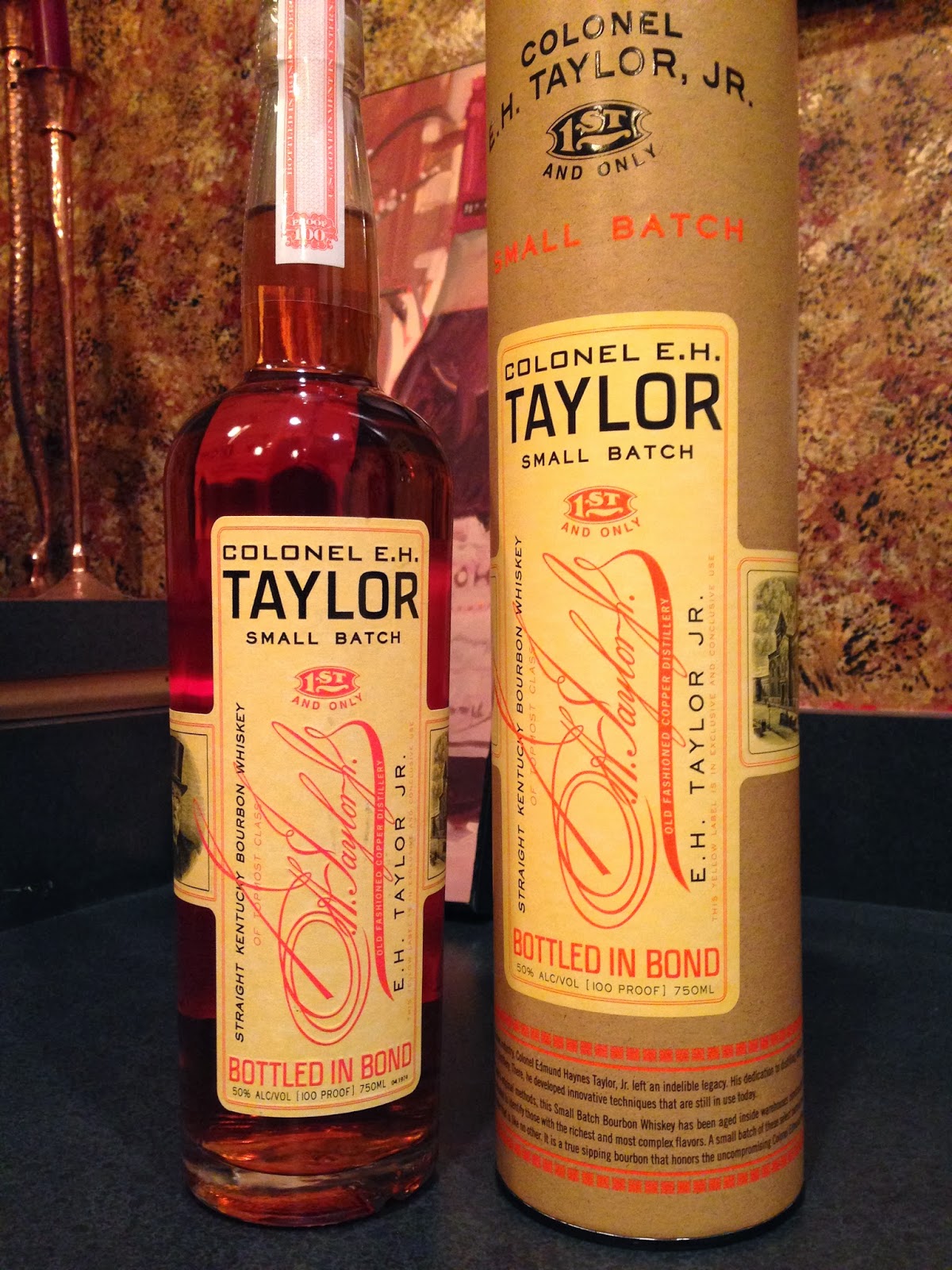
Sipp’n Corn Bourbon Review – E. H. Taylor, Jr. Small Batch Bottled in Bond
Bourbon: E. H. Taylor, Jr. Small Batch Bottled in Bond, 100 Proof
Distillery: Buffalo Trace
Cost: $39.99
Color:
Reddish-amber; darker than many other bourbons of this approximate age.
Nose:
Initial alcohol sting on the nose, but followed by caramel, corn grain, and oak. The nose opens up with a splash of water (and loses the sting) and brings lots of vanilla.
Taste:
Caramel, burnt sugar, clove, and tobacco. With a splash of water the clove came out even more, along with black licorice. I didn’t really detect any fruit, corn or hot spices. The clear focus is on earthy flavors, but there’s great balance with sweeter candy flavors like butterscotch, caramel and toffee. Great warmth without being hot.
Finish:
Medium finish, with medium warmth, caramel, oak and more clove.
Rating:
If any brand deserves a mention about “Bottled in Bond,” E. H. Taylor, Jr. is it. Col. Taylor, who was a politician and banker in addition to being the father of the industrialization of Bourbon, was instrumental in passing the Bottled-In-Bond Act of 1897, meant primarily to protect the public against the “horrors” of whiskey rectifiers. The act required that any spirit labeled as “Bottled-in-Bond” be the product of one distiller at one distillery during one distillation season, and aged in a federally-bonded warehouse under federal government supervision for at least four years and bottled at 100 proof.
I’ve been researching Col. Taylor and his penchant for litigation (new post coming soon), so I thought that the least I owed to the brand and this history was a bottle. Thankfully, there’s no representation that this Bourbon is the same recipe as Col. Taylor used; in fact, it uses the standard Buffalo Trace mash bill #1, which is shared with the Buffalo Trace brand, Eagle Rare, George T. Stagg, Old Charter, and Benchmark. And this bourbon gets extra style points for being aged in the very same warehouse (Warehouse C) built by Col. Taylor in 1881, despite all of ownership changes of the old “O.F.C.” Distillery and the ownership of the Taylor brand over the years.
Despite the legitimate history of this brand, taste is still subjective, and I’m not particularly a fan of bourbons that focus on the earthy flavors to the exclusion of fruit and spice. I was also hoping for more from the finish. E.H. Taylor, Jr. Small Batch is extremely drinkable, but overall I thought that the clove and earthy tones overpowered the other flavors that I wanted to find (although it was certainly nicely balanced with butterscotch, caramel, and toffee flavors). It’s still unseasonably warm and muggy here in Louisville, so maybe that’s why my palate was looking for more fruit or spice, but I can’t wait to try E.H. Taylor, Jr. Small Batch again in a few months when it’s 20 degrees outside and I’m sitting next to a warm fire.
Score on The Sipp’n Corn Scale: 3.0
The Sipp’n Corn Scale:
1 – Wouldn’t even accept a free drink of it.
2 – Would gladly drink it if someone else was buying.
3 – Glad to include this in my bar.
4 – Excellent bourbon. Worth the price and I’m sure to always have it in my bar.
5 – Wow. I’ll search high and low to get another bottle of this.
Sipp’n Corn Bourbon Review – Hirsch Selection Small Batch Reserve
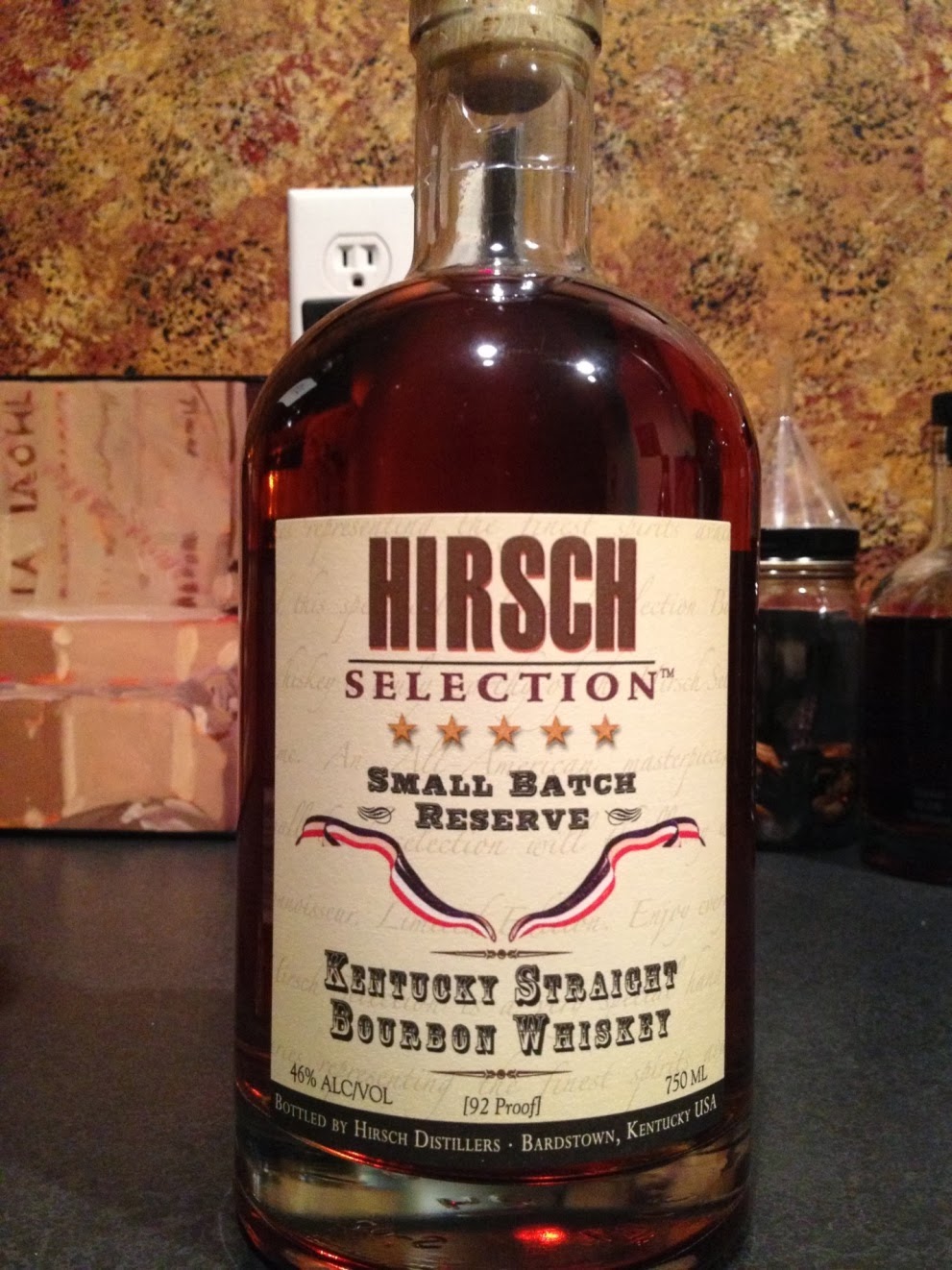
Bourbon: Hirsch Selection Small Batch Reserve, 92 Proof
Distillery: Who knows? It’s sourced. When it comes to Hirsch, Anchor Distilling Company is a Non-Distiller Producer (“NDP”). And Anchor isn’t telling. (Style points deduction.)
Cost: $35.99
Color:
Light amber.
Nose:
Smooth and subtle.
Taste:
Balanced vanilla, cinnamon and caramel.
Finish:
Medium and very pleasant, but not complex.
Rating:
The older offerings with a Hirsch label – the real thing labeled “A.H. Hirsch” and which you can’t find or afford – get all of the attention. And so far as I can tell, when the Hirsch Selection Small Batch Reserve does get attention, it has ranged from lukewarm to outright pummeling, with the notable exception being the recent review from my friends at Fork & Stave (which gave it a 3 out of 5; read it at Fork & Stave Review).
No doubt the Hirsch Selection Small Batch Reserve can’t hold a candle to the fabled A.H. Hirsch 16-year and older releases that I’ve only read about. It’s simply not the same bourbon that was distilled in the spring of 1974 at the Pennco Distillery in Schaefferstown, PA by Adolph Hirsch, a former Schenley executive.
Many of the reviews that I’ve read on Hirsch Selection Small Batch Reserve criticize it for not being up to par with the older genuine A.H. Hirsch bourbons. But what is? And should anyone really expect it to be when Hirsch Selection Small Batch Reserve sells for about $35.00, compared to the reported astronomical prices for whatever is left of the A.H. Hirsch? I can’t compare it to the A.H. Hirsch bourbon, so hopefully my clean slate helps.
Or maybe Hirsch Selection Small Batch Reserve is criticized because it’s from a NDP which happens to own a famous name brand, and is trying to make a buck from heritage that it doesn’t really have. Fair enough. (See the Old Pogue story from 100 years ago where this would have been considered fraud.) But as many others have proven, sourced bourbon can be awesome.
When you look at Hirsch Selection Small Batch Reserve against its price-range peers, it’s a top-contender. It also, somewhat to my surprise, was the unanimous favorite in the very first Sipp’n Corn blind tasting event when paired with Four Roses Small Batch and Maker’s Mark, and it tied with Four Roses Single Barrel in the second blind tasting event.
Overall, Hirsch Selection Small Batch Reserve really strikes me as a beginner’s bourbon. Maybe that’s what some aficionados really find offensive about it. It’s smooth, very drinkable, and not overly complex. There are plenty of other less expensive bourbons that new bourbon fans should try (like Maker’s Mark, Four Roses “Yellow Label” and the terrific W.L. Weller 12-Year, just to name a few), but Hirsch Selection Small Batch Reserve is also a fine place to start, and it’s great to keep in your home bar for a relaxing drink or for friends who don’t consider themselves bourbon fans (yet).
Score on The Sipp’n Corn Scale: 3.5
The Sipp’n Corn Scale:
1 – Wouldn’t even accept a free drink of it.
2 – Would gladly drink it if someone else was buying.
3 – Glad to include this in my bar.
4 – Excellent bourbon. Worth the price and I’m sure to always have it in my bar.
5 – Wow. I’ll search high and low to get another bottle of this.
Country Distillers v. Samuels – the rise of Maker’s Mark.
Maker’s Mark declared September 14, 2013 “Ambassador Day.” The Ambassador program, of course, is the ingenious rewards/loyalty program of Maker’s Mark. (Disclaimer: I’ve been an Ambassador since 2005.) Was September 14 just a date picked out of thin air, or did it have some significance?

Knowing Maker’s Mark, I figured that it meant something, so I did a little investigating, and I found a perfect topic for my “bourbon as told through the rich history of American lawsuits…” bit.
Maker’s Mark touts its history with its trademark “SIV” to honor four generations of distillers in the Samuels family (or is it six? http://www.makersmark.com/sections/75-whoops). Everyone also knows about the unique dripping red wax seal, and many people are aware of the relatively recent litigation against a tequila brand that infringed on that trademark. But long before there were any disputes about wax seals, Bill Samuels, Sr. was embroiled in litigation when he broke from former corporate ownership and sought to make a new beginning in the 1940’s.
Country Distillers Products, Inc. v. Samuels, Inc., 217 S.W.2d 216 (Ky. 1948) tells the background story of what became the current-day Maker’s Mark. The Court began by noting that the Samuels family had been making whiskey for over one-hundred years at the time of this lawsuit, but had not incorporated their distillery until 1933, when they formed T. W. Samuels Distillery (named after the original Samuels distiller) with other corporate investors. The name was changed to Country Distillers Products, Inc. in January 1942, and the distillery continued to produce the “T.W. Samuels” and “Old Jordan” brands.

About 1½ years after the official name change, on July 30, 1943, T. William Samuels (a/k/a, Bill, Sr., the great-grandson of T. W. Samuels) resigned and sold all of his shares. But Bill, Sr. apparently didn’t plan on retiring; he wanted to make a better bourbon. A mere six weeks later – on September 14, 1943 – he incorporated Old Samuels Distillery, Inc. and T. W. Samuels, Inc. This is where Maker’s Mark was eventually born, and that explains why Maker’s Mark picked the 70th anniversary as its “Ambassador Day.”

Bill, Sr. still had a fight on his hands, though. Country Distillers sued Old Samuels Distillery, Inc. and T. W. Samuels, Inc. to prevent them from using the Samuels name. The trial court sided with Country Distillers and ruled that while Bill, Sr. could use the name “T. W. Samuels, Inc.” as a company name, the Samuels name could not be emphasized on labels, nor could he use “Samuels” or “Old Samuels” as brand names, and that he also had to include the phrase “not connected with Country Distillers, Inc.” on each label.
In a 1948 decision, the Court of Appeals of Kentucky (at the time, the highest court in the Commonwealth) mostly agreed with the lower court. While the court recognized that so long as a person does not create confusion in the market, he always has the “undeniable right” to use his own name in his own business, in this case the name “T. W. Samuels” did create confusion. So the court affirmed the restriction on the font size of using the corporate names on labels and against using “T. W. Samuels” as a brand name, and the disclaimer that it was “not connected with Country Distillers.” On the other hand, Country Distillers had never used the name “Old Samuels,” so Bill, Sr. was permitted to use that brand name.
In any event, during these years Bill, Sr. was still perfecting his new recipe that used wheat instead of rye as the secondary grain. As legend has it, he even ceremonially burned the old Samuels recipe. And it wasn’t until 1953 that Bill, Sr. bought the distillery in Loretto, Kentucky, then known as Star Hill Farm (and formerly known as the Burks Mill & Distillery, where distilling started in 1805), so that he could start distilling and aging. So Bill, Sr. had some time, but the Country Distillers lawsuit might explain why his wife came up with a new name we now all know and love. (http://www.makersmark.com/sections/70-behind-every-good-man). Whatever the reason for Bill, Sr.’s split from Country Distillers, we should all be thankful that he struck out on his own and that he persevered despite the lawsuit.
Sipp’n Corn Bourbon Review – W.L. Weller 12 Year Old
Bourbon: W.L. Weller 12 Year Old
Distillery: Buffalo Trace, Frankfort, Kentucky
Age: 12-Year Age Statement
Proof: 90 proof
Cost: $25.99
Tasting Notes
Color:
Deep bronze.
Nose:
The nose of Weller 12 is unmistakably sweet with caramel and butterscotch notes. Do I smell cereal because I know it’s a wheated bourbon or because it’s really there? It’s hard to tell. But the nose is definitely smooth and subtle.
Taste:
The sweetness of the nose continues on the palate with flavors of caramel, butterscotch and vanilla, but with excellent balance and depth of wheat, oak and almond, which prevents it from tasting syrupy. This is very rich and smooth bourbon with great warmth. It didn’t open up much with a drop of water, so I prefer my Weller 12 neat or with minimal ice.
Finish:
Medium-to-long finish, but maybe medium when compared to more complex bourbons. The finish was warm and smooth with honey-wheat grain flavors.
Bottom Line
The Weller brand touts itself as the original wheated bourbon, using wheat instead of rye as its secondary grain. This bourbon is named after William Larue Weller (1825-1899) and in its heyday, it was part of the famed Stitzel-Weller Distilling Company. It’s now owned by Sazerac and produced at Buffalo Trace in Frankfort, Kentucky.
Using wheat as the secondary grain gives it a different profile than bourbons that use the more traditional rye mash bill. Wheat also tends to give the bourbon a much smoother taste. Other examples of terrific wheated bourbons include Maker’s Mark and the Pappy Van Winkle line, which, as most people know by now, is made from the same mash bill as Weller (Buffalo Trace distills both brands from the same mash bill with no distinction on the front end for what brand will ultimately be used). Instead of hunting down Pappy and paying a small fortune, I’m happy with Weller 12.
Weller 12 could be the price-performer of all bourbons, and it’s definitely better than many bourbons twice its price. What it lacks in complexity, it more than makes up for in its balance and drinkability. I highly recommend Weller 12.
Score on The Sipp’n Corn Scale: 4.25
The Sipp’n Corn Scale:
1 – Wouldn’t even accept a free drink of it.
2 – Would gladly drink it if someone else was buying.
3 – Glad to include this in my bar.
4 – Excellent bourbon. Worth the price and I’m sure to always have it in my bar.
5 – Wow. I’ll search high and low to get another bottle of this.

One hundred years ago, secret sourcing was considered fraud.
The recent proliferation of new bourbon brands has included many brands distilled and aged by existing distilleries but sold under new, often “historic,” names. Of course, a new brand seeking to capitalize on the bourgeoning bourbon market wouldn’t have time to create a recipe and age for the minimum years, let alone the ten to twenty-plus years of these super-premium brands. That reality makes “sourcing” bourbon common today, and it gives bourbon enthusiasts a chance to play detective where the new brands aren’t upfront. (Many are upfront about it.)
Diageo’s Bulleit Bourbon is one of my favorites, but it’s also one of the better-known current-day examples of undisclosed sourcing. Bulleit claims to be a product of the “Bulleit Distilling Company, Lawrenceburg, Kentucky.” It’s widely accepted that Bulleit is really made by Four Roses in Lawrenceburg, but last month my Four Roses tour guide insisted that Four Roses can’t possibly make all of the Bulleit, so at least there’s some mystery.

It turns out that sourcing bourbon is not a new practice, however. Litigation between an Ohio wholesaler and the H.E. Pogue Distillery in the early 1900’s provides an example of an early sourcing contract. The court in H.E. Pogue Distillery Co. v. Paxton Bros. Co., 209 F. 108 (E.D. Ky. 1913) was faced with claims by Pogue that Paxton Bros. had breached its contract to purchase a large quantity of Pogue bourbon.
Paxton Bros. was a Cincinnati-based spirits wholesaler. By the late 1800’s, Paxton Bros. had found success with its Edgewood Whiskey blend, and there was wide recognition of its trademark rotund, tuxedo-and-fez-wearing man, known simply as the “Edgewood Man.”

Pogue, of course, is one of the more significant historical names in Kentucky bourbon. After suspensions in operations during prohibition and changes in ownership and closure after World War II, the Pogue family is back in business again. http://www.oldpogue.com/history/#. Located in Maysville, Kentucky, near the legendary site where many say bourbon was born (the old Bourbon County), the Pogue distillery was one of the top bourbon distilleries in the late 1800’s and early 1900’s.
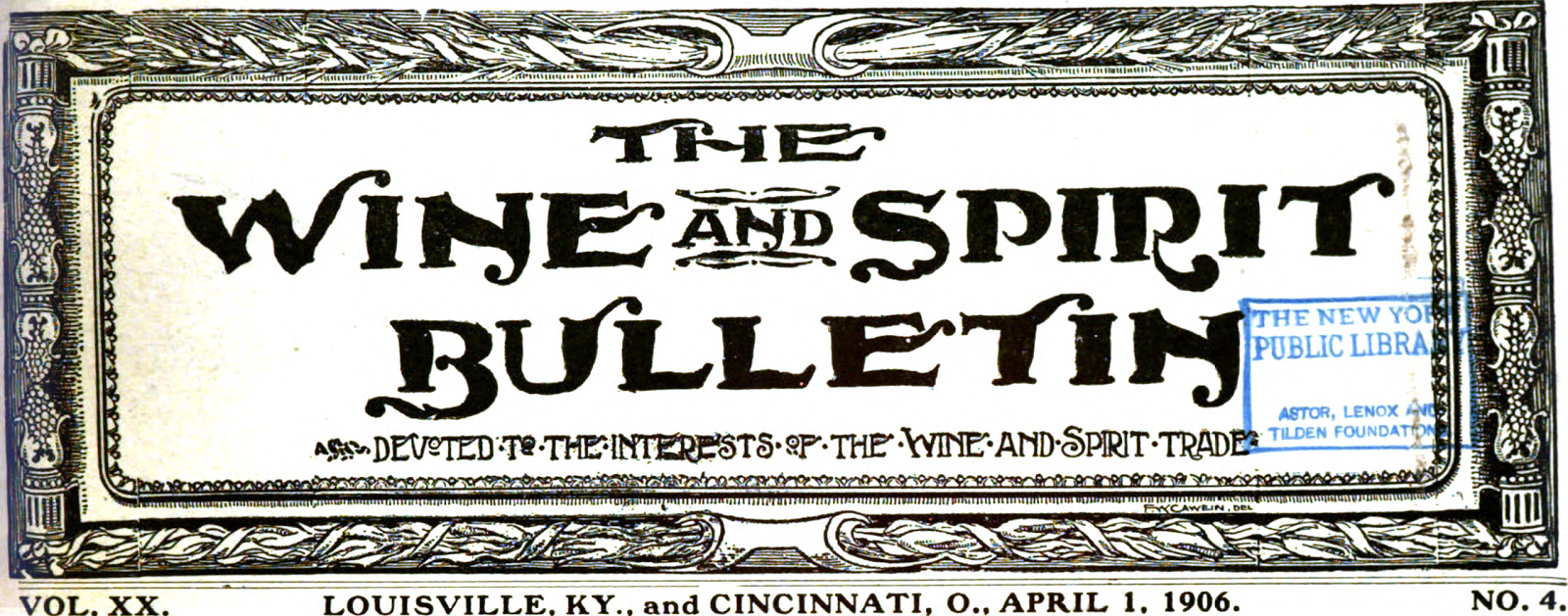
The Wine and Spirit Bulletin reported in its April 1, 1906 edition that Pogue had sued Paxton Bros. for $30,000 because the alleged breach of contract by Paxton. The U.S. District Court’s 1913 opinion (by Judge Andrew McConnell January Cochran, who like the Pogues, was a Maysville native) recites that Paxton Bros. contracted to purchase 12,500 barrels of bourbon from Pogue, which Pogue was to distill and then age in its warehouse.
But these 12,500 barrels were to be labeled not with the Pogue name, but instead as having been distilled by Paxton Bros. or possibly under its Edgewood trade name. The parties tried to find a way under their contract for bottling the bourbon under the Paxton or Edgewood name, which certainly would have been difficult given the tight government regulations of the time. In fact, federal law at the time would not have allowed the distillery to be operated as the H.E. Pogue Distillery and, at the same time, stamp and label the bottles showing another’s name. Recognizing this dilemma, Pogue and Paxton apparently agreed that even though Pogue was in fact going to produce the bourbon and sell it to Paxton, the Pogue distillery would be leased to its namesake, H.E. Pogue, who would operate it as “H.E. Pogue as the Paxton Bros. Company.”
This maneuver, they believed, would allow the bourbon to be labeled as having been distilled by Paxton. Judge Cochran found this arrangement to be “the perpetuation of fraud on the public” by representing that Paxton “had made the whisky, which in fact [Pogue] had made.” Because of this “fraudulent” purpose, the court held that the contract was void and it dismissed Pogue’s claims.
So the fat man in the fez got out of his contract to buy Pogue’s bourbon, but H.E. Pogue would be happy to see that his family is still making bourbon, while Edgewood is barely remembered in history. Even so, it’s too bad that, 100 years later, in some cases there is less transparency among some brands who try to hide their sourcing.
 Brian Haara