Brian Haara
Bourbon. Law. Author.
Remnants of Prohibition Still Sting Kentucky Grocers.
The United States Court of Appeals for the Sixth Circuit on Wednesday upheld a post-prohibition-era statute that prohibits grocers and gas stations from selling liquor. In Maxwell’s Pic-Pac, Inc. v. Dehner, Nos. 12-6056/6057/6182, (6th Cir. Jan. 15, 2014) (available at http://www.ca6.uscourts.gov/opinions.pdf/14a0015p-06.pdf), the court reversed the local federal district court’s decision which had invalidated the statute.

States might be expected to protect their laws from challenges. In this case, however, it appears as if the real source of the effort to save the regulation was a direct competitor of grocers that stood to lose market share if grocers were allowed to sell liquor and wine – Liquor Outlet d/b/a The Party Source. The named defendant, Tony Dehner, is the Commissioner of the Kentucky Department of Alcoholic Beverage Control, and he represented the interests of the Commonwealth. Just as ministers and bootleggers enjoyed a conspiracy of convenience in Kentucky in the 1930’s (90 of Kentucky’s 120 counties outlawed the sale and consumption of alcohol under local option laws), Liquor Outlet allied with ABC to prevent grocers from selling liquor.
In reading the court’s file, it became clear that the history of pre-Prohibition corruption and depravity, lawlessness during Prohibition, and relative peace under regulation after Repeal all played a significant role in the parties’ arguments and in the court’s decision. Many of us are aware that state liquor control laws vary widely, but we’re often unaware that our respective state’s liquor control laws arose out of the remnants of Prohibition.
In the 1800’s, in Kentucky and elsewhere, “anybody had the right to sell liquors anywhere, to anybody, and at any time.” Bd. of Trs. of Town of New Castle v. Scott, 101 S.W. 944 (Ky. 1907). This lack of regulation helped fuel the temperance movement and led to a perception of liquor as a societal evil, so by 1891 Kentucky’s Constitution allowed its counties to regulate (or even ban) liquor sales.
Liquor Outlet hired an expert witness to testify that before Prohibition, liquor had led to political corruption, prostitution, gambling, crime, poverty and family destruction. Prohibition created its own problems, though, which were often worse. The district court noted that Prohibition left Kentucky “infested with bootleggers … corruption and crime, no revenue, no control, disrespect for law and general demoralization.” It was an unmitigated disaster.
Along with the repeal of Prohibition, the Twenty-First Amendment allowed states to regulate the sale of alcoholic beverages. John D. Rockefeller, Jr. financed a major study used by the states in developing their respective regulations. Initially, Kentucky’s regulatory framework did not restrict the types of premises that could sell package liquor. But in 1938, Kentucky enacted a new statute that, in essence, still exists today. Kentucky decided on a regulatory structure that required licensure (and limited the number of licenses), and it prohibited licenses for “any premises used as or in connection with the operation of any business in which a substantial part of the commercial transaction consists of selling at retail staple groceries or gasoline or lubricating oil.” So, grocers and gas stations have been prohibited from selling wine and liquor for over 75 years.
A small grocer, Maxwell’s Pic-Pac, decided that Kentucky’s regulatory structure discriminated against grocers without any reasonable or justifiable basis. Under Kentucky’s regulatory framework, for example, a grocery-selling drugstore (like CVS or Walgreens) can sell liquor, but a pharmaceutical-selling grocery store cannot. Similarly, a big-box “party store” can sell grocery items along with liquor, but a grocery store still cannot sell liquor. The district court agreed and in August 2012 it ruled in favor of Pic-Pac.
Predictably, Kentucky and Liquor Outlet appealed. The Sixth Circuit concluded that it is reasonable for Kentucky to choose to prohibit the sale of liquor in certain places, such as places where “the community must come together.” Sounding like the temperance-movement activists, Liquor Outlet argued that grocery stores and gas stations posed a greater risk of “exposing” citizens to alcohol, and that more minors work at grocery stores, so they too would be “exposed” to alcohol.
Liquor Outlet (and its expert) also argued that Kentucky must be allowed to use regulations to steer society to lower-alcohol beverages and to reduce exposure of alcohol to impressionable or abstinent citizens, and that limiting the types of places that sell alcohol plausibly satisfies that public policy. Still, overly-broad alcohol control laws have been struck down previously in Kentucky and in other states. For example, in Commonwealth of Ky. ABC Bd. v. Burke, 481 S.W.2d 52 (Ky. 1972), the court invalidated a provision of the Alcohol Beverage Control Act that prohibited women from being bartenders and from drinking at a bar. The Sixth Circuit did not discuss Burke, and rejected Pic-Pac’s challenge.
This regulation is partly just academic since many national chain grocers in Kentucky have separate adjacent liquor stores. Of course, this really results in the law only being applicable to small or independent grocers like Pic-Pac. In those stores, the temperance movement still has a foothold.
False Advertising and the Legacy of Duffy’s Pure Malt Whiskey.
The history of bourbon is full of legends, boasts, puffery and even outright lies, all in an effort to promote a brand and make a sale in a highly competitive craft. Today’s false advertising and consumer protection laws have largely eliminated the lies, but who takes the all-time prize for false bourbon advertising? James Pepper certainly seemed to stretch the truth; Paxton Bros. and the H.E. Pogue Distillery entered into a sourcing contract that a federal court held was “the perpetuation of fraud on the public;” and some unscrupulous whiskey rectifiers routinely defrauded the public until reined in by the Bottled-In-Bond Act and the Pure Food and Drug Act.
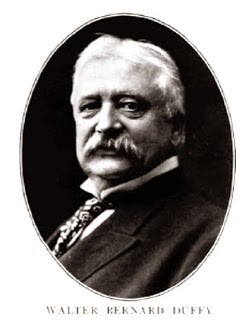
But one brand stands far above the rest as the ultimate fraudulent advertiser: The Duffy Malt Whiskey Company. To quote Lionel Hutz, Duffy’s advertising may be “the most blatant case of false advertising since … The NeverEnding Story.” The Simpsons, Episode 67 (“New Kid on the Block”). Nov. 12, 1992.

Walter B. Duffy (1840-1911) took over his family’s distillery, The Rochester Distilling Company, in the 1870’s. By the early 1880’s, Duffy was advertising his Duffy’s Malt Whiskey not only as a tonic that “Makes The Weak Strong,” but also as a cure for all sorts of diseases. Consumption, influenza, bronchitis, indigestion, and practically old age itself were claimed to be no match for Duffy’s Malt Whiskey.
Duffy quickly over-extended his company, and he was forced into bankruptcy in November 1886. The collapse of the Duffy Malt Whiskey Company and the appointment of a prominent Receiver were widely reported The New York Times and other established newspapers, and lawsuits were filed as debts were resolved. But just as James Pepper and Col. E. H. Taylor, Jr. emerged stronger from their own financial troubles, Duffy turned his company around, albeit with more false advertising. Here are a few samples:


This last example led to litigation because Duffy’s sent The Chicago Sunday Tribunethe wrong picture (it’s unclear whether intentionally, or not, or whether the testimonial was fabricated, or not). In Peck v. Tribune Co., 214 U.S. 185 (1909) (written by none other than Justice Oliver Wendell Holmes, Jr.), the Supreme Court of the United States reversed two lower court decisions that had dismissed the libel claims of the plaintiff – the subject of the photograph – who claimed that she was not a nurse, and, moreover, she never drank Duffy’s Malt Whiskey (nor any spirit), and she never, under any circumstances, would recommend its use.
The opinion of the Seventh Circuit to some extent, but more so Justice Holmes’s opinion, give insight into the growing temperance movement as the country grew closer to national prohibition. For a much better account of Duffy’s outlandish advertising and how it contributed to the eventual success of the temperance movement, be sure to read Whiskey Women: The Untold Story of How Women Saved Bourbon, Scotch, and Irish Whiskey, by Fred Minnick, at pp. 57-58.
In the meantime, Duffy’s revitalized company was so strong that he was able to withstand and prosper during the Panic of 1893, and by 1900 he had formed the New York and Kentucky Company which acquired the George T. Stagg Company and the Kentucky River Distillery (previously, and better, known as The Carlisle Distillery) in Frankfort, which together are now the Buffalo Trace Distillery. Col. E. H. Taylor, Jr., in particular, was disgusted that someone who he considered to be a disreputable rectifier had come to own Taylor’s former prized distilleries.
While owning these historical Kentucky sites, Duffy continued to market his Duffy’s Malt Whiskey for its claimed medicinal benefits. Through the early 1900’s, the challenge to Duffy’s false advertising was building. Samuel Hopkins Adams wrote an exposé of so-called “patent medicines” (elixirs sold as medical cures, but without any actual curative benefit) in 1905 entitled “The Great American Fraud” in Collier’s Weekly.
While Adams stated that it was “impossible” for him to name all of the patent-medicine frauds, and that he “can touch on only a few,” Duffy’s Malt Whiskey was egregious enough that he identified it by name: “Duffy’s Malt Whiskey is a fraud, for it pretends to be a medicine and to cure all kinds of lung and throat diseases.” Adams acknowledged that “[f]rom its very name one would naturally absolve Duffy’s Malt Whiskey from fraudulent pretense” because, at the time, the word “malt” conveyed medicinal qualities, so he was sure to reference a ruling by the Supreme Court of New York that Duffy’s Malt Whiskey was not a medicine.
The New York court had been considering whether or not Duffy’s was a medicine or a whiskey due to certain tax issues, and in Cullinan, as State Commissioner of Excise of the State of New York v. Paxon (1905), it heard expert testimony on that issue. Experts noted the alcoholic content of Duffy’s and testified that a “search was made for added medicinal ingredients with negative results.” Instead, they concluded that Duffy’s “is simply sweetened whiskey.” Accordingly, the court declared that Duffy’s Malt Whiskey was a liquor, not a medicine.
Adams also refuted some of Duffy’s ringing endorsements, such as the “Clergymen Endorse” advertisement above. Adams uncovered that one of the clergy pictured simply ran a “Get-Married Quick Matrimonial Bureau” and was paid $10.00 for his picture; another was a “Deputy Internal Revenue Collector” and racehorse owner, whose actual photograph was not used in the advertisement; and the third clergy was forced to resign by his congregation after they learned of his endorsement. Adams also discovered that Duffy’s employees tricked some physicians into providing testimonials, for example by misrepresenting that they would not be used in advertising. Ultimately, “The Great American Fraud” helped lead to the passage of the Pure Food and Drug Act in 1906. This movement, along with the temperance movement and growing sophistication in medical knowledge, spelled eventual doom for Duffy’s.
Today’s claims of false advertising are tame by comparison. Some people believe that Diageo’s product placement of Bulleit Bourbon on Deadwood (the HBO western series set in the 1870’s) constitutes false advertising because Bulleit was not introduced as a brand until 1999.

Others contend that bourbon brands that don’t distill or age their own bourbon engage in false advertising when they hide the true nature of their business and tout their Master Distillers (who don’t actually oversee any distillation). Michter’s is often on the receiving end of this criticism.

However these recent criticisms are viewed, at least we’re not being sold snake oil, and at least mendacious rectifiers adding things like tobacco juice, pepper sauce or potentially harmful adulterations to simulate age, color and flavor in our bourbon is a thing of the past (remember, some rectifiers had scruples and were simply blenders, or only added safe products, like brown sugar, prune juice, honey, tea and wintergreen). So Cheers to Walter B. Duffy for his outrageously false advertising, which helped set the wheels in motion for bourbon we can enjoy today.
Sipp’n Corn Bourbon Review – “The Woodford Challenge” – Woodford Reserve Distiller’s Select vs. Woodford Reserve Double Oaked vs. Woodford Reserve Master’s Collection Four Wood
For this Bourbon Review, we compared three Woodford Reserve bourbons from three price-points. The entry-level Woodford Reserve is generally well-liked, but it has its share of critics for essentially being expensive or for being too soft. The Woodford Double Oaked generally gets some better reviews, while the Four Wood has a few supporters but mostly detractors. I wanted to see whether – even within the Woodford family – it’s best to stick to basics.
Bourbons in order of blind tasting:
· Woodford Reserve Distiller’s Select
Age: NAS
Proof: 90.4
Cost: $31.99
· Woodford Reserve Single Barrel Double Oaked
Age: NAS
Proof: 90.4
Cost: $59.99 (the more typical non-single barrel costs $53.99)
· Woodford Reserve Master’s Collection Four Wood
Age: NAS
Proof: 94.4
Cost: $95.99
1st Glass (Woodford Reserve Distiller’s Select):
The first glass had a clear amber appearance and a light nose of caramel and fresh herbs and corn. It was followed by a sweet taste of corn, caramel, vanilla and slight fruit, and it was immediately recognizable by the tasters; so much for the blind tasting. The finish was moderate, with more light and sweet flavors, and not much warmth. Given the proof and the light flavors, this is a bourbon to drink neat, although the chill of a single large ice cube or sphere works as well.
2nd Glass (Woodford Reserve Double Oaked):
The second glass was slightly darker in color, more of a deep copper, with a more complex nose, taste and finish. It was recognized as being related to the first glass, but it filled in many of the gaps of the first glass. The nose had more earthy tones like leather and walnut, along with new hints of brown sugar. The taste still had similar caramel sweetness, but added new oak flavors and spicy warmth, with honey and spiced apple cider. The finish was smoky and slightly warm with a balance of rich caramel, with moderate length, although a little longer than the first glass. This bourbon was best with the slow melt of large ice. Water or too much ice seemed to give it a medicinal finish.
3rd Glass (Woodford Reserve Four Wood):
The third glass was the darkest of the three in appearance, but what really stood apart was the nose. The nose was as complex as we’ve experienced. It was very sweet with toffee, floral tones (roses?) and berries, but to me, it smelled like the sweet corn of a bubbling fermentation tank. The taste, unfortunately, was harsh and the numerous flavors of corn, maple, oak, leather, spice and vanilla seemed to be competing instead of complementing each other. Plus, the taste was nothing like the nose predicted. Similarly, the finish had the same disjointed flavors.
Winner:
Double Oaked was narrowly preferred by the tasters, but Distiller’s Select seemed to be the comfortable choice, and when taking value into account, Double Oaked really loses ground. The safest bet is to call a draw. The Four Wood was a distant third with most tasters – except one who rated it first. While the nose of the Four Wood was truly remarkable, most of us thought that the rest of it just fell apart.
Bottom Line:
Those in the know say that Woodford Reserve and Old Forester share the same mash bill (72% corn; 18% rye; 10% malted barley) and yeast strain, and that Distiller’s Select contains bourbon distilled at both Versailles and Louisville. So while the standard Distiller’s Select is certainly popular, many people stick with the very affordable “Old Fo” (sometimes known as Louisville’s house bourbon). It’s hard to argue with that logic. Either bourbon is a comfortable option, but make no mistake, they are different Bourbons. The blending of Bourbon distilled at Brown-Forman and Bourbon distilled in Versailles was the subject of a lawsuit in 2003 that I’ll write about later, and it has also been confirmed by Chris Morris.
Double Oaked improves Distiller’s Select in a few areas. Double Oaked starts with the Distiller’s Select when it is matured and ready for bottling, but instead it is dumped and re-barreled into new oak barrels that have first been “deeply toasted” and then “lightly charred.” It is aged in these second barrels for some undisclosed length of additional time to pick up more sweet oak flavors “without aggressive charred notes.” The result is bourbon with much deeper sweet flavors than Distiller’s Select, but it’s still primarily a sweet bourbon, and I wished that it would have picked up some “aggressive charred notes” to better distinguish itself from Distiller’s Select.
Master Distiller Chris Morris is known to take some chances, and thankfully Brown-Forman encourages this, but the latest in the “Master’s Collection” is a miss. The shtick this time is that standard Woodford Reserve was aged in four types of wood – American White Oak, where it is aged to maturity, then followed by maple barrels, Sherry barrels and Port barrels for finishing. Brown-Forman should keep trying these innovative finishing expressions, but selling an iffy product for $100 is just going to give this series a bad name.
My final recommendations:
Distiller’s Select: Despite its softer flavors, Distiller’s Select ran close to Double Oaked, and at $20+ less than Double Oaked, that really increases its score. While Distiller’s select lacks many of the complexities found in comparably-priced bourbons, always keep a bottle of Distiller’s Select in your home bar because it has so many fans that your guests are likely to request it. Have Old Forester on the side if your guests want to compare the two so they can see the differences.
Double Oaked: It’s priced high for a NAS bourbon barely over 90 proof (I’d expect to see it in the low-$40’s), but especially if you already have your other bourbon staples, Double Oaked is still a high recommendation for your home bar. The price really keeps Double Oaked from scoring higher.
Four Wood: Completely avoid Four Wood, especially at this price. Hopefully you can avoid it since it is a limited edition. I’ll pay for experiments and innovations that turn out well, but nearly $100 for this NAS bourbon at 94.4 proof is way too much. There were certainly other 2013 limited editions that retailed for similar prices, but were vastly superior.
Scores on The Sipp’n Corn Scale
Double Oaked: 3.5
Distiller’s Select: 3.0
Four Wood: 1.5
The Sipp’n Corn Scale:
1 – Wouldn’t even accept a free drink of it.
2 – Would gladly drink it if someone else was buying.
3 – Glad to include this in my bar.
4 – Excellent bourbon. Worth the price and I’m sure to always have it in my bar.
5 – Wow. I’ll search high and low to get another bottle of this.

Sipp’n Corn Bourbon Review – “The High Octane Challenge” – Elijah Craig 12 Year Barrel Strength vs. Stagg Jr. vs. Knob Creek Single Barrel
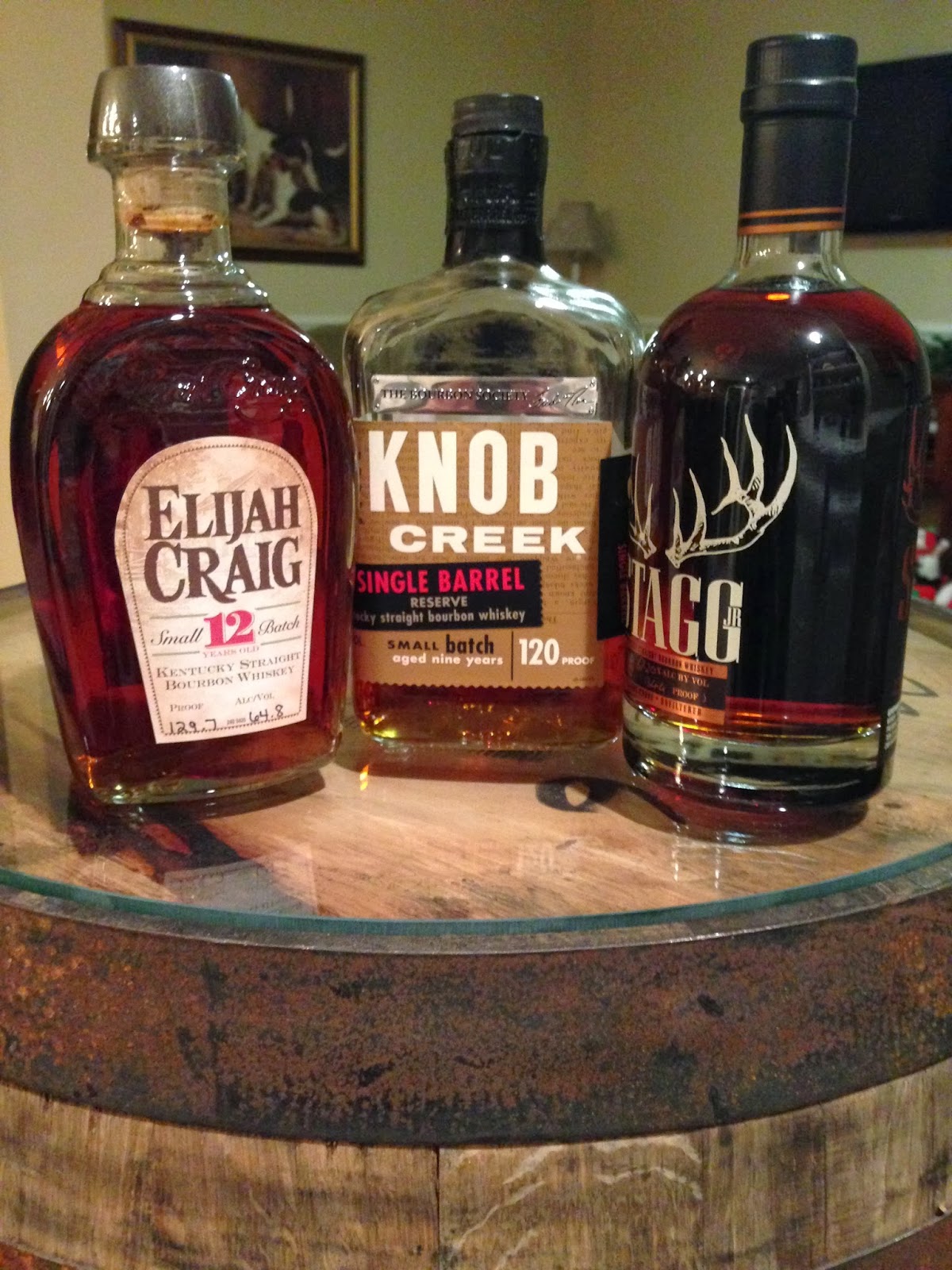
For this Bourbon Review, I wanted to pay tribute to the recent trend of releasing barrel strength bourbons, so we compared these three high-proof premium bourbons from different distilleries, in order of blind tasting:
Knob Creek Single Barrel Reserve
Distillery: Jim Beam, Clermont, Kentucky
Age: Nine Years
Proof: 120
Cost: $39.99
While not barrel strength, Knob Creek Single Barrel is almost there, and it otherwise fits the profile of the other two choices. Plus, in light of the extremely strong following for the standard Knob Creek, I wanted to see how it fared with another 10% ABV over the standard issue. Barrel strength would have been 132.4 proof (according to my private selection barrel), and I’m betting that soon we’ll see a true barrel strength version of Knob Creek.
Elijah Craig 12 Year Barrel Strength
Distillery: Heaven Hill, Bardstown, Kentucky
Age: Twelve Years
Proof: 129.7
Cost: $54.99
The Elijah Craig 12 Year Barrel Strength is the barrel proof version of the popular Elijah Craig 12 Year Small Batch, distilled by Heaven Hill and named after one of the (or so the legend goes) first Kentucky bourbon distillers who accidentally discovered the benefits of using charred oak barrels. I found my bottle at the new Evan Williams Bourbon Experience in downtown Louisville.
Stagg Jr.
Distillery: Buffalo Trace, Frankfort, Kentucky
Age: NAS, but the bottle claims “nearly a decade”
Proof: 134.4
Cost: $54.99
The Stagg Jr. Barrel Proof is an unfiltered limited release from Buffalo Trace. Stagg Jr. doesn’t need to include “barrel strength” in its name because everyone knows that you’re getting it straight from the barrel. As “Jr.” indicates, this is not the acclaimed George T. Stagg of the Buffalo Trace Antique Collection fame, but instead it is meant to be a younger, “more accessible” version of GTS.
1st Glass (Knob Creek Single Barrel):
The color of the first glass was on the brown side of amber; definitely darker than typical bourbons. The high proof was evident in the nose, but it was balanced by nuts and vanilla. The high proof was also immediately evident in the taste, but after an initial burn, extremely rich flavors of pepper, vanilla, oak and maple emerged. A splash of water or ice (highly recommended) helped reduce the burn and helped open more nutty flavors. The finish was robust and long. Overall, the only thing that the first glass seemed to be missing was some balance on the fruit side, but it was still an incredible in-your-face experience.
2nd Glass (Elijah Craig 12 Year Barrel Strength):
The second glass was darker in color, pretty much passing the amber standard and embracing brown; it’s dark. The nose was much more complex than the first glass – blending caramel, oak and apple – with only a slight burn from the high proof. But the taste blew us away with more sweetness of caramel, vanilla and butterscotch, along with pepper and cinnamon spice and hints of oak and almonds, with some slight dark chocolate bitterness. The finish featured these same flavors too, along with a hint of mint, and it was really long and warm. Despite the high proof, ethanol was never predominant in the nose or taste. Try this one sparingly neat for the experience, but then drink it with a large ice cube.
3rd Glass (Stagg Jr.):
The third glass was not as dark as the second, but was darker than the first (it looks darkest in the bottle because of a black back label). The nose was the hottest of the three, with alcohol burn, pepper and oak predominating, but also with a hint of rich toffee. The heat kicks you on the taste too; plan ahead to drink this one with ice and a splash of water. Water and ice really opened up bold flavors of oak and finally some vanilla, along with raisins, while maintaining its spice. It was still hot and lacked complexities that come with fruit and candy flavors, but this bourbon clearly isn’t aiming at the sweet crowd. As expected from the nose and the taste, the finish had extreme warmth reminding you that you’re experiencing pure bourbon.
Winner:
This was a challenge of some heavy-hitters, not just because of the high proof, but because of the robust flavors. Still, the Elijah Craig 12 Year Barrel Strength was the unquestionable winner. It had the best nose, we were stunned that it was drinkable neat (which is questionable with the Knob Creek and highly inadvisable with the Stagg Jr.), and it had the best balance of flavors. You’ll remember this one for a long time.
Bottom Line:
None of these bourbons are for the timid or for mixing. I’m also sure that they all cure ancient ailments, and they just might make you grow hair, maybe even in places you don’t need it. But wow, they’re good. The quality of these three bourbons makes them hard to rate, and it’s really hard to give Stagg Jr. third place, but that’s where it lands. I’d be interested to see how the BTAC George T. Stagg compares to the Elijah Craig 12 Year Barrel Strength; I hear that big brother is pretty hard to top in this category.
All three are still recommended, but your real problem is going to be finding anything except the Knob Creek, so the Knob Creek Single Barrel warrants an immediate purchase. The hardest to find will be the Stagg Jr., and you might just leave that to the collectors who seem to sniff it out fast. With just a little luck, you’ll still be able to find the Elijah Craig 12 Year Barrel Strength, and if you’re looking for a truly robust bourbon experience, buy it quickly. I wish that I had bought two when I had the chance.
Scores on The Sipp’n Corn Scale
Stagg Jr.: 3.0
Knob Creek Single Barrel: 4.0
Elijah Craig 12 Year Barrel Strength: 4.5
The Sipp’n Corn Scale:
1 – Wouldn’t even accept a free drink of it.
2 – Would gladly drink it if someone else was buying.
3 – Glad to include this in my bar.
4 – Excellent bourbon. Worth the price and I’m sure to always have it in my bar.
5 – Wow. I’ll search high and low to get another bottle of this.
Maker’s Mark v. Diageo – The Fight Over Bourbon’s Most Recognizable Trademark.
Until now, all of my posts about history-making lawsuits between distillers have involved really old cases. Some have dated back practically to the birth of bourbon, like my post on the lawsuit between James Pepper and Labrot & Graham (How Woodford Reserve got to keep the (old) name of its Distillery), which traced events beginning in the late 1700’s. The “newest” lawsuit discussed in my posts (the origin story of Maker’s Mark: The Rise of Maker’s Mark) still dealt with events occurring 70 years ago. History is usually old by definition, but a decision not even two years ago helps show how the bourbon industry is still at the forefront of trademark law. Even though it’s not old, it is already part of bourbon lore.
This new history, of course, was the lawsuit between Maker’s Mark and Diageo over trademark rights to the iconic dripping red wax seal. Bill Samuels, Sr. broke from Country Distillers and struck out on his own, and ever since Maker’s Mark began production in 1958, it has capped its bottles with a red dripping wax seal that partially covers the neck of the bottle and drips down to the bottle’s shoulder. As noted by the District Court in Maker’s Mark Distillery, Inc. v. Diageo North America, Inc., 703 F. Supp. 2d 671 (W.D. Ky. 2010), “That design was the brainchild of Margie Samuels, mother of Maker’s Mark’s current president Bill Samuels, who was still at home when his mother perfected the dripping wax in their family’s basement.”
Maker’s Mark registered this trademark in 1985, describing it as the “wax-like coating covering the cap of the bottle and trickling down the neck of the bottle in a freeform irregular pattern.” This coincided with an extensive marketing push by Maker’s Mark, and through even more marketing ($22MM annually in 2010) Maker’s Mark eventually reversed its ratio of selling 90% of its bourbon in Kentucky to selling 90% of its bourbon outside of Kentucky.
Problems arose in 2001 when Diageo marketed “Jose Cuervo Reserva de La Familia,” which used a red freeform wax-like seal cap. Here are the two competing products:
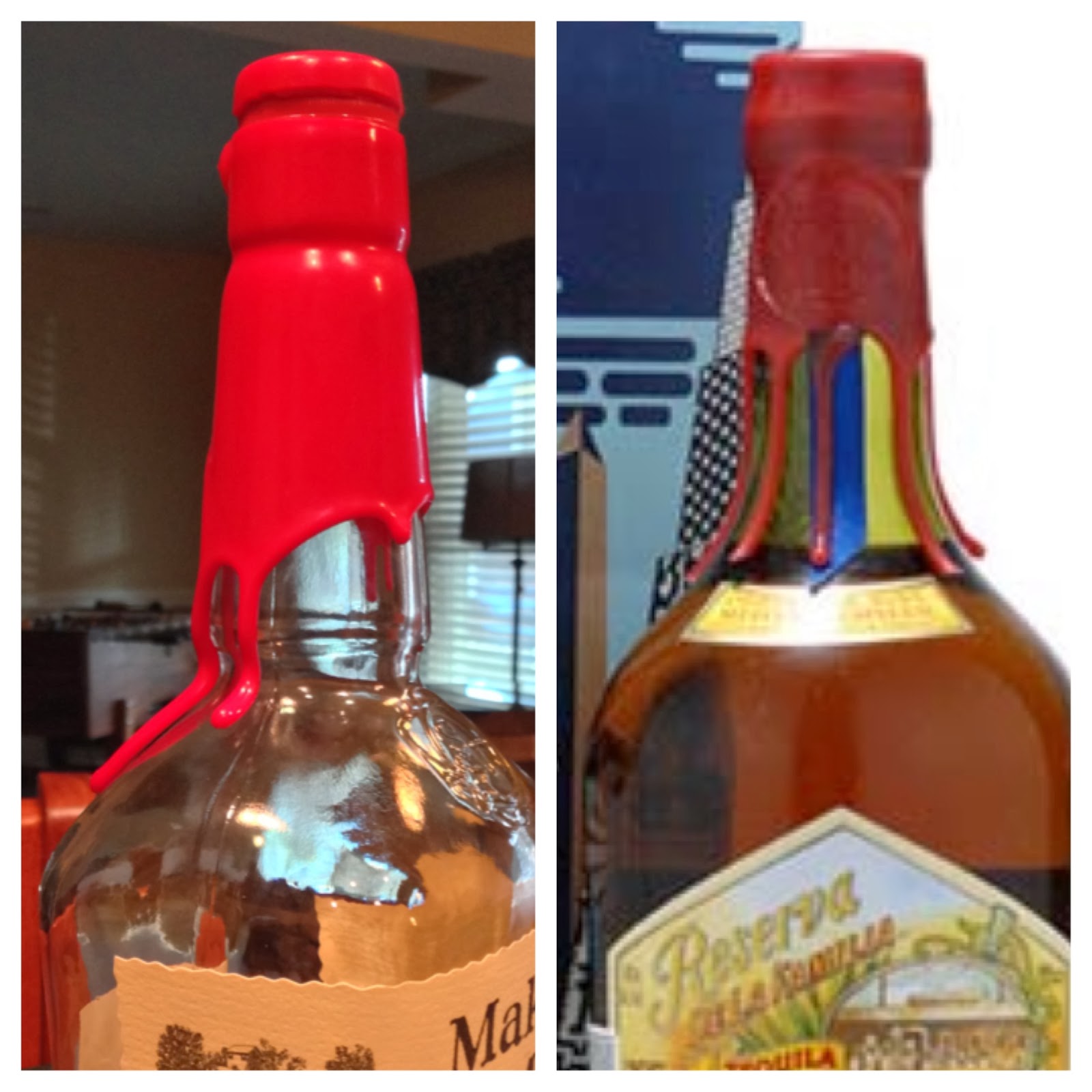
Maker’s Mark filed its Complaint in 2003 and that was enough for Jose Cuervo to start snipping the wax tendrils, although it continued to use a red wax seal and it used the lawsuit to ask the court to cancel the trademark registration on the ground that it was functional and because other alcoholic beverages were already being sealed in colorful wax. A six-week trial was held beginning in November 2009. Bill Samuels testified, along with then-Master Distiller Kevin Smith, company finance and marketing officers, and even experts on issues like markets and consumer recognition of brands, damages, wax composition, Maker’s Mark memorabilia and a bottle closures.
On April 2, 2010, the District Court ruled that Diageo infringed on Maker’s Mark’s trademark, and therefore it issued an injunction in favor of Maker’s Mark. However, the District Court refused to award any damages because Maker’s Mark did not prove that anyone was actually confused or that it lost any sales. But because Maker’s Mark won on the injunction claim, the Court awarded nearly $67,000.00 in costs to Maker’s Mark.
The case was far from over, however. Diageo appealed to the United States Court of Appeals for the Sixth Circuit. Maker’s Mark Distillery, Inc. v. Diageo North America, Inc., 679 F.3d 410 (6th Cir. 2012). On appeal Diageo argued that purchasers of Jose Cuervo Reserva de la Familia – “a $100 per bottle luxury tequila” – were unlikely to ever be confused that their prized tequila was affiliated with an inexpensive bourbon like Maker’s Mark, especially Cuervo consumers, who “generally are tequila connoisseurs who spend more than $100 for a bottle of tequila, or $16-20 for a drink in a bar.” Reading the brief, I could feel the pretentiousness dripping from those words.
Plus, Diageo argued that Maker’s Mark was hardly the first company to use a dripping wax seal on a bottle. Wax seals have been used for centuries, and Diageo emphasized that Bill Samuels admitted that the inspiration for the Maker’s Mark freeform wax coating was old cognac bottles that had wax seals with an irregular or uneven edge. Maker’s Mark’s experts admitted that numerous other bourbons and other spirits have used red wax seals or dripping wax seals. Wines and even beers have also used wax seals, many of them red, and many with tendrils. Non-alcoholic products such as olive oil and vinegar have also used red dripping wax seals. So why should Maker’s Mark get special protection?
You could have guessed the answer to that question by reading just the opening lines of the Sixth Circuit’s May 9, 2012 ruling, which followed with a veritable history lesson about bourbon, discussing:
· the origin and history of bourbon;
· the difference between “whiskey” and “bourbon;”
· the different spelling between “whiskey” and “whisky;”
· bourbon mash bills and Dr. James Crow’s perfection of the sour-mash method;
· early marketing of bourbon and early fans, like Ulysses S. Grant and Henry Clay;
· the rise and fall of rectifiers and President William Taft’s 1909 interpretation of the 1906 Pure Food and Drug Act;
· distiller consolidation after the repeal of National Prohibition;
· more name-dropping of bourbon fans, like President Harry S. Truman and Ian Fleming, who reportedly switched from martinis to bourbon;
· the action of Congress, in 1964, to designate bourbon as a distinctive product of the United States, and Federal Regulations prescribing restrictions on which distilled spirits may be called “Bourbon;”
· the Samuels family’s important role in the history of bourbon (“Maker’s Mark occupies a central place in the modern story of bourbon.”), including having been distillers since 1783; and
· Maker’s Mark’s rise, especially after now-legendary 1980 Wall Street Journal front-page article.
Despite spending four pages on this significant history, the Circuit Court did not discuss any of the even longer history of tequila (16th Century) or Jose Antonio de Cuervo’s purchase of a blue agave farm from King Ferdinand VI of Spain (1758), and instead wrote a mere three sentences, only to reference the name of the Cuervo brand, its initial use of a straight-edged wax seal, and its transition in 2001 to a “red dripping wax seal reminiscent of the Maker’s Mark red dripping wax seal.” Then the Circuit Court went on to affirm the injunction and the award of costs to Maker’s Mark, protecting Maker’s Mark’s exclusive use of its red dripping wax seal.
Other bourbon brands still use wax seals, like my bottles of Evan Williams Single Barrel, Michter’s 10-Year Single Barrel and Knob Creek (like Maker’s Mark, also owned by Beam, Inc.), among many others.
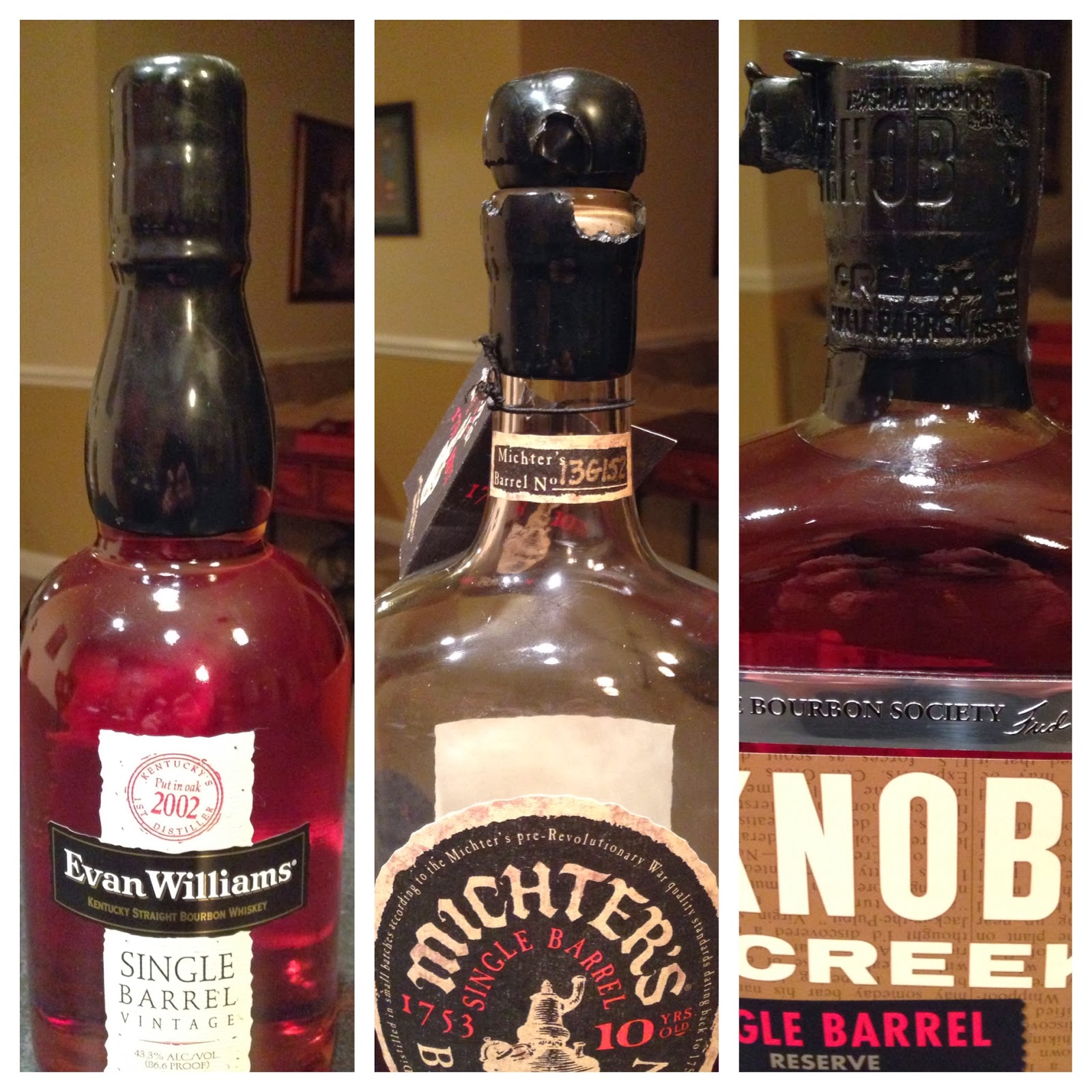
But these are all black wax, and all neatly trimmed. My guess is that no other current bourbon brand is willing to use red wax at all, and that we won’t see freeform tendrils of any color. And that seemed to be part of the District Court’s reasoning for imposing an injunction: the Court recognized that its ruling “also protects Maker’s Mark from other competitors or quasi-competitors in the industry, in that it may serve to discourage them from treading too closely on the mark.” Mission accomplished.
Update:
Here’s a picture with retired federal Circuit Court Judge Boyce F. Martin, Jr., the author of the Court of Appeals opinion, when Judge Martin and I were filmed in January 2015 for the upcoming documentary Straight Up: Kentucky Bourbon from Beard Force Films.