Brian Haara
Bourbon. Law. Author.
Sipp’n Corn Bourbon Review – Old Grand-Dad vs. Henry McKenna Single Barrel vs. E. H. Taylor, Jr. Small Batch – the “Bottled in Bond Challenge”
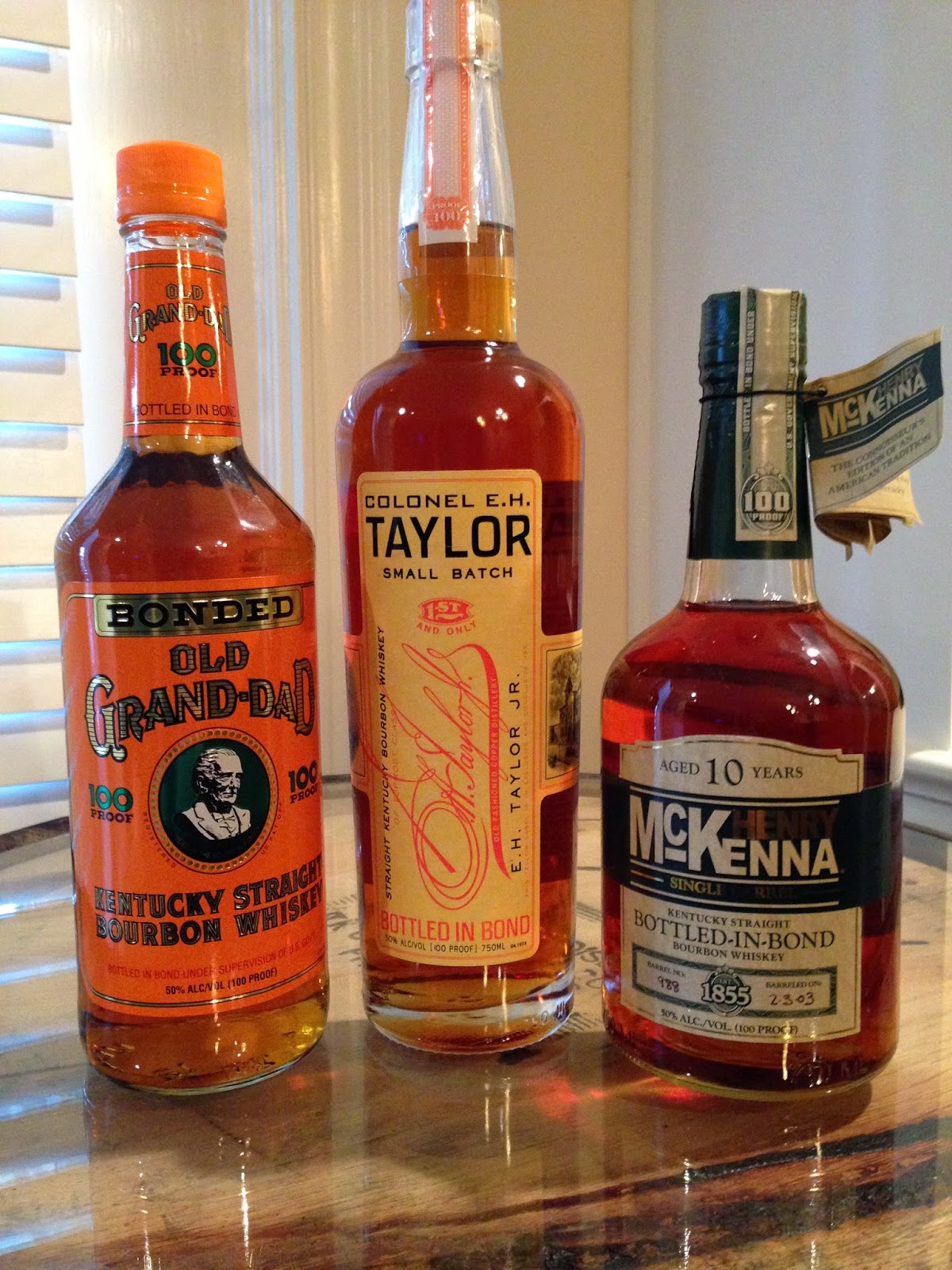
My post earlier this month gave details about the origin and passage of the Bottled-In-Bond Act of 1897, why it was needed, and what’s left of it today (“Bottled in Bond” — Bourbon Propels Early Consumer Protection Law). Now it’s time to put the books down and celebrate the 117th anniversary of the Bottled-in-Bond Act with a comparison of three BIB bourbons in three price ranges – under $20, under $30 and under $40. Here is the order, arranged by price:
Old Grand-Dad Bottled In Bond
Distillery: Jim Beam, Clermont, Kentucky
Age: NAS
Proof: 100
Cost: $16.49
Yes, that’s Basil Hayden pictured on the front of the bottle. Old Grand-Dad reportedly uses Jim Beam’s high rye mash bill (27% rye), and it is also offered in lower and higher-proof versions.
Henry McKenna Single Barrel 10 Year Old Bottled In Bond
Distillery: Heaven Hill Bernheim Distillery in Louisville, but aged in Bardstown
Age: 10 Years
Proof: 100
Cost: $28.99
Heaven Hill produces the most BIB brands, and this Henry McKenna is unique among BIBs because it contains an age statement. My bottle for this tasting is a private barrel selection.
E. H. Taylor, Jr. Small Batch Bottled In Bond
Distillery: Buffalo Trace, Frankfort, Kentucky
Age: NAS
Proof: 100
Cost: $39.99
It wouldn’t do a Bottled in Bond review justice to exclude Col. E. H. Taylor, Jr., the architect of the Act who got his politician buddies to push it through.
1st Glass (Old Grand-Dad):
The color of Old Grand-Dad has an orange tint to a slightly-light amber. The nose didn’t hide the high rye, although there are also nice flavors of sweet corn, butterscotch and cinnamon, with a little orange citrus. The nose isn’t hot. The taste is robust and really balanced for this price range. Spicy rye dominates, and brown sugar, corn and char make this a heavy hitter. Sweetness also comes from a little caramel, and overall Old Grand-Dad is very well balanced between spice, sweetness and earthy flavors. The finish is warm and medium in length and while it starts a little earthy and dark, it lightens up with a welcoming mint refresher.
2nd Glass (Henry McKenna Single Barrel):
The Henry McKenna was deeper amber than the Old Grand-Dad, and the nose told us this was going to be hot, but after getting past that kick, there were great scents of caramel, vanilla, corn and plums. The taste was very different than the first glass. First, it was much hotter on the tongue, while still having more of a buttery feel. Additionally, spicy rye and darker sweetness were replaced with light caramel, candy corn, vanilla and fruit, before moving to cinnamon and pepper spice. It finished evenly with these same flavors, with a medium length.
3rd Glass (E. H. Taylor, Jr. Small Batch):
The color of the E. H. Taylor was almost identical to the Henry McKenna, except for a little reddish tone to the amber. After an initial alcohol sting, caramel and vanilla dominate the nose, but there’s a great balance with spice, cocoa, nuts and rye. The taste was very robust – and the deepest of the three – with brown sugar, clove and tobacco. There was still a great caramel flavor too, but it transitioned to more of a black licorice flavor. The finish was longer than the other two, with very nice warmth, and flavors of caramel and clove. The only complaint was that the earthy tones overpowered some of the other flavors.
Bottom Line:
Old Grand-Dad is the clear price-performer of this group. It is one of the few lower-shelf bourbons that really stand up to the brands that are perceived to be premium, either legitimately or through silly marketing. At under $20.00, Old Grand-Dad absolutely deserves some space on your shelf. Price aside, the Henry McKenna had a lot of great characteristics, but the heat distracted from the other flavors. Try it chilled, with water or on ice to reduce the heat and open up those other flavors. The E. H. Taylor, Jr. Small Batch will be your favorite if you like robust bourbons with plenty of earthy flavor to go with sweetness, although the price lowers its score on my scale. You’re not going to go wrong with any of these options.
Scores on The Sipp’n Corn Scale
Old Grand Dad: 3.5
Henry McKenna Single Barrel: 3.0
E. H. Taylor, Jr. Small Batch: 3.0
The Sipp’n Corn Scale:
1 – Wouldn’t even accept a free drink of it.
2 – Would gladly drink it if someone else was buying.
3 – Glad to include this in my bar.
4 – Excellent bourbon. Worth the price and I’m sure to always have it in my bar.
5 – Wow. I’ll search high and low to get another bottle of this.
Sipp’n Corn Bourbon Review – TX Blended Whiskey by Firestone & Robertson
*Updated March 26, 2014 after discussing with Leonard Firestone. Many thanks to Leonard for taking the time to talk with a fellow whiskey fanatic. Check out their story at www.frdistilling.com.
Ok, this time this is not a bourbon review, but TX Blended Whiskey is made partly with bourbon. Maybe I’m branching out. Plus, the American history of rectifying is fascinating. Certainly some rectifiers like Walter Duffy gave blending a bad name (False Advertising and the Legacy of Duffy’s), and no doubt some of the bourbon giants, like Col. E. H. Taylor, Jr., made it a priority to drive blenders to the bottom of the food chain (Kentucky Wasn’t Big Enough for Two Col. Taylors). But blending has been a time-honored tradition – and art – in Scotland, Ireland and Canada, resulting in some extremely popular whiskies. Blending barrels at bourbon distilleries is an everyday occurrence, too, but there seems to have always been a prejudice against blending American whiskies from various sources. That’s where Firestone & Robertson steps in with TX Blended Whiskey.
Whiskey: TX Blended Whiskey.
Whiskey: TX Blended Whiskey.
Distillery: Firestone & Robertson Distilling Co., Fort Worth, Texas, but this is a blend sourced from other distilleries, which have not been disclosed.
Age: NAS, but at least four years old
Proof: 82
Cost: About $40.00
Tasting Notes
Color:
Light amber with just a bit of a reddish-orange hue.
Nose:
The nose is very subtle, with mostly honey and baked apple notes.
Taste:
Definitely not like the bourbon I’m used to. There’s no spice to speak of, with sweet flavors predominating, like honey, chess pie and slight caramel. It’s very mild without the characteristic bourbon bite, but if F&R was shooting for sweet, they nailed it. At only 82 proof this is a whiskey to drink neat, and because of its low proof, sweetness and lack of bite, it’s an extremely drinkable whiskey. A splash of water or even ice seemed to wash away the slight complexities, and for the same reasons, I would not use this as a mixer. Maybe it would be better chilled on a hot day in the summer.
Finish:
TX Blended Whiskey is warm on the finish, with more sweet flavors, but it’s really short.
Background Story
Firestone & Robertson is the first bourbon distillery in North Texas. F&R has Vendome stills and has been aging bourbon (with wheat as a secondary grain) since March 2012. In addition to setting its sights on bourbon, though, F&R thought that other American blended whiskeys weren’t up to par with Scottish, Irish and Canadian blends, so they spent a few years experimenting. According to an F&R press release, TX Blended Whiskey is a blend of straight bourbon whiskey (with mash bill containing rye as the secondary grain), plus “mature premium whiskey aged in used bourbon casks,” plus “distilled grain spirit.”
While this press release and information contained on the bottle don’t tell us nearly enough, the contents of TX Blended Whiskey can be deciphered a little with help from the federal regulations that govern labeling of American whiskies:
· For example, by use of the word “straight,” in describing the bourbon contained in TX Blended Whiskey, we know that this portion of the blend met the standards for “bourbon whisky” and was aged for two or more years.
· By use of the phrase “blended whisky” (and not “blended light whisky”) we know that TX Blended Whiskey contains at least 20% straight bourbon whisky.
· However, because it’s not called “blended bourbon whisky,” we know that TX Blended Whiskey contains less than 51% straight bourbon whiskey. So for those keeping track of the math, TX Blended Whiskey must contain somewhere between 20% and 50.99% straight bourbon whiskey.
· Additionally, from the lack of designation of any percentage of Canadian or other foreign whiskies, we know that TX Blended Whiskey contains only spirits produced in the U.S.
· Finally, by the lack of an age statement, we know that TX Blended Whiskey contains neutral spirits (F&R has confirmed that TX Blended Whiskey contains “grain spirits,” which are defined as “neutral spirits distilled from a fermented mash of grain and stored in oak containers”) and that the straight bourbon and other whiskey contained in TX Blended Whiskey must be at least four years old, because that makes age statements optional.
(For anyone with too much time on their hands, you can see my backup for these assumptions in the Code of Federal Regulations, 27 C.F.R. § 5.22(b)(1)(iii); 27 C.F.R. § 5.22(b)(3); 27 C.F.R. § 5.22(b)(4); 27 C.F.R. § 5.22(l)(1); 27 C.F.R. § 5.22(a)(2); 27 C.F.R. § 5.40(a)(1), (2).)
Understandably, Leonard Firestone was pretty tight about his whiskey recipe, but he wouldn’t deny any of my conclusions. He very graciously told me that the actual percentages of bourbon, “mature whiskey” and neutral spirits, the ages of the bourbon and whiskey, and the source of their bourbon (the one thing I knew he’d never tell me) were all proprietary. Fair enough; once you get into blended whiskey, unknown is part of the gig.
Bottom Line
F&R embraces its craft niche with great details like unique handmade caps topped with boot leather. But F&R added credentials to shtick last year when TX Blended Whiskey was voted the “Best American Craft Whiskey” and received a “Double Gold” award at the World Spirits Competition in San Francisco. Still, personally I’d like to see at least 90 proof and a higher percentage of straight bourbon (definitely with the rye mash bill that TX Blended Whiskey already uses) to give it some bite and some much-needed spice. F&R blended a fine whiskey if you like the sweet stuff, but it’s too sweet without a balanced kick for me. I’ll be looking forward to F&R’s bourbon in few years to see if they still focus on the sweet profile, or (hopefully) balance it with spice.
I knew that TX Blended Whiskey really reminded me of something on my shelf, and after a few comparison tastings I found it. Try TX Blended Whiskey alongside Corner Creek. They’re very similar, although TX is sweeter and Corner Creek has black pepper notes (something I hadn’t really noticed on my review last year of Corner Creek (Sipp’n Corn Corner Creek Review), and a better nose and finish. Maybe they’re sourced from the same distillery. If I had been drinking TX Blended Whiskey while I was reviewing Corner Creek – instead of being in the middle of a big Elmer T. Lee obsession – I likely would have scored Corner Creek higher than I did.
Score on The Sipp’n Corn Scale: 2.5
The Sipp’n Corn Scale:
1 – Wouldn’t even accept a free drink of it.
2 – Would gladly drink it if someone else was buying.
3 – Glad to include this in my bar.
4 – Excellent bourbon. Worth the price and I’m sure to always have it in my bar.
5 – Wow. I’ll search high and low to get another bottle of this.

Wild Turkey Private Barrel Selection – Tasting Russell’s Reserve Out of the Barrel in Warehouse A.
Private barrel selection is nothing new for bourbon in general, but it is new for Wild Turkey. Last week I had the pleasure of selecting a barrel of Russell’s Reserve “Small Batch Single Barrel” (yes, that’s either redundant or self-contradictory). You’ll find it in stores bottled at 110 proof, with no age statement (but reportedly aged for 8-9 years), at a cost just under $50.00. I helped some new friends from Hard Water (http://hardwaterbar.com/), which is Charles Phan and Olle Lundberg’s San Francisco whiskey destination, narrow down the barrel selection.
We started with lunch with Eddie Russell at a local Lawrenceburg, Kentucky country buffet called Tonya’s Hometown Buffet, just a few minutes from Wild Turkey. I had to explain to our San Francisco guests that macaroni and cheese really is part of a vegetable plate in the south, but mostly we listened to Eddie’s stories and got to know him. We learned about Wild Turkey and bourbon legends like Eddie’s father, Jimmy Russell, and Ed Foote (who we all had just met the night before at the Kentucky Derby Museum event moderated by Fred Minnick), but we were spared all of the marketing stories that you typically hear.
After lunch, Eddie treated us to a behind-the-scenes tour of the distillery and new bottling facility. I’ve taken the regular tour, and there you only see some areas through glass. But with Eddie, we went into the still room, the control room and the sensory lab where Jimmy, Eddie and their team taste all varieties of Wild Turkey, and where we were excited to see some of the components for the upcoming special release of “Wild Turkey Diamond Anniversary” to celebrate Jimmy Russell’s 60 years at the distillery.


Our anticipation had been building throughout the tour, so we were all ready for the short drive to Warehouse A, built in 1890 on a bluff overlooking the Kentucky River. The weather outside was in the low 60’s, but on the first floor of Warehouse A it was at least 20 degrees cooler. Eddie had pre-selected a group of barrels for our tasting and had them moved down to the first floor. His goal was to present barrels that were different from the precise profile sought out in the standard Russell’s Reserve.
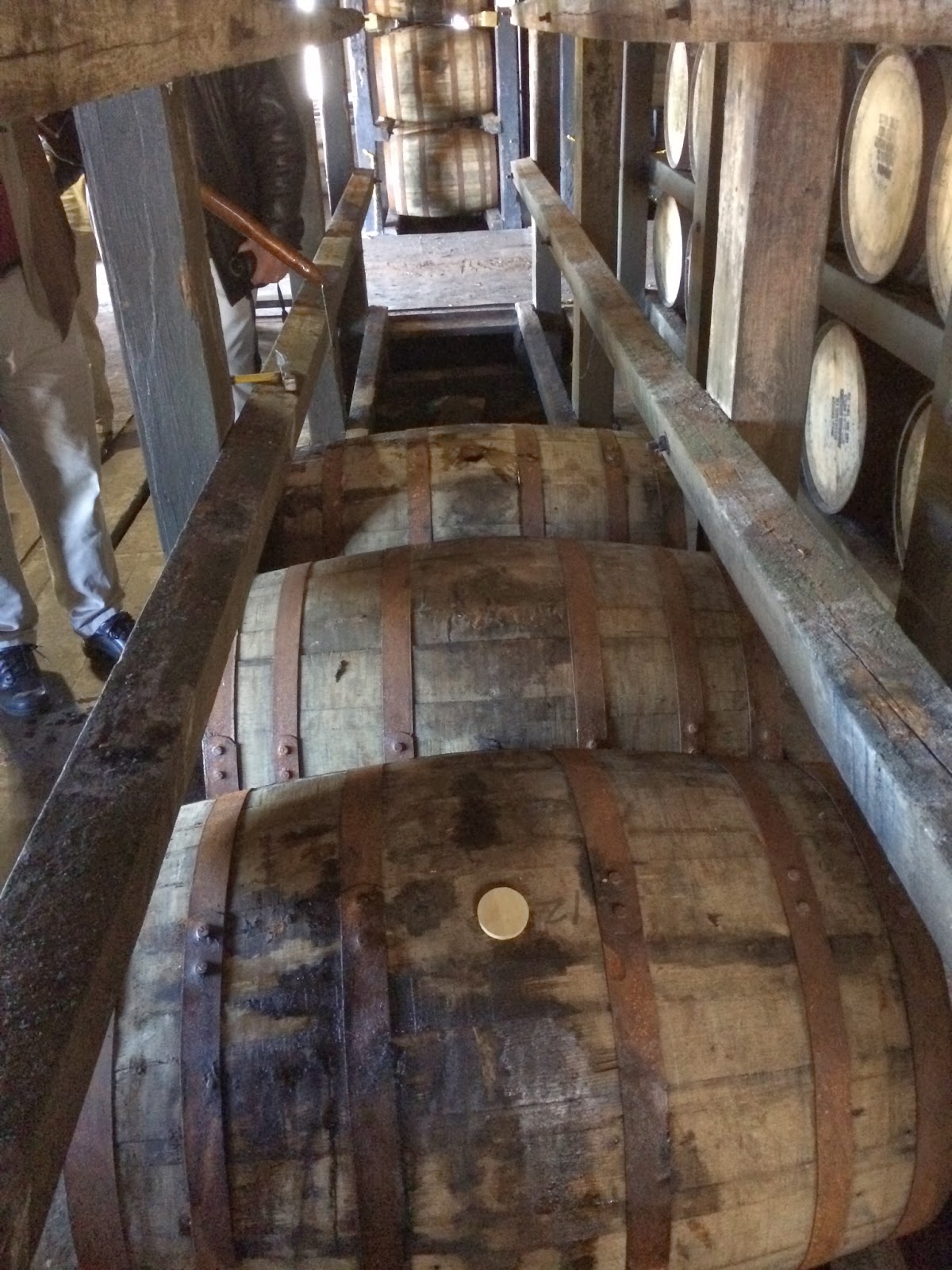
Russell’s Reserve and the other Wild Turkey brands go into the barrel at lower proof than many other distilleries – usually around 110 proof – which results in lower barrel proof upon maturation. We tried 6 barrels, all just shy of 10 years, and all about 113 proof.
1. The flavor of the first barrel was very subtle, almost delicate. It was alright, but we wanted more, especially for a whole barrel.
2. The second barrel was much spicier, and we thought it would be a contender.
3. The third barrel left the first two in the dust, especially if Hard Water planned on using its barrel for any signature cocktail, because it would really shine through.
4. The next barrel was very different – less spicy and perfectly tuned for sipping neat. We were the first outsiders to ever try this barrel.
5. Our fifth barrel was similar to the fourth in that it would be best sipping neat. It had a very similar profile, but was more complex and had a longer finish. The #4 alligator char really came through on the color, especially.
6. We thought we had our barrels narrowed down and then Eddie said “let’s try one more.” We were glad he did. The last barrel had incredible flavors with complexity of caramel sweetness plus spice. It only had a small hint of wood, and the finish was smooth and long.
Russell’s Reserve is not chill-filtered, so we won’t lose anything from what we tasted in the private barrel. Wild Turkey will bring the proof down to 110, so we’re losing about 1.5% ABV, but that won’t be enough to change the experience. This is going to be worth a road trip to San Francisco. While we’re all waiting though, I highly recommend a purchase of the 110-proof standard version of Russell’s Reserve.
Russell’s Reserve Private Barrel Selection
Distillery: Wild Turkey, Lawrenceburg, Kentucky
Average Age: 9 years, 9 months
Average Proof: 113 Barrel Strength, lowered to 110 for bottling
Color:
Deep amber (although the first barrel was a much lighter than the others).
Nose:
Some barrels were pretty subtle, but our top three had rich caramel sweetness and rye spice.
Taste:
Given the temperature on the ground floor of Warehouse A, we essentially tasted chilled bourbon. Because all barrels age differently, two rose to the top has having great spice if that’s your preference, but also meaning that they would hold up great in a signature cocktail. Two others rose to the top as a more mellow bourbon to sip neat. They were all creamy on the palate with bold, complex flavors of caramel and cinnamon, and very drinkable despite the proof.
Finish:
The finish was long and smooth, with noticeable but comfortable heat.
Score on The Sipp’n Corn Scale: 4.0
The Sipp’n Corn Scale:
1 – Wouldn’t even accept a free drink of it.
2 – Would gladly drink it if someone else was buying.
3 – Glad to include this in my bar.
4 – Excellent bourbon. Worth the price and I’m sure to always have it in my bar.
5 – Wow. I’ll search high and low to get another bottle of this.


“Bottled in Bond” – Bourbon Propels Early Consumer Protection Law.
The Bottled-In-Bond Act was passed this week in 1897. But now, nearly 120 years later, is “Bottled in Bond” just an archaic designation? Does it ensure that your bourbon is better than without the designation? Why doesn’t every 100-proof bourbon carry this designation? All good questions to ponder over a glass of “BIB” bourbon.
The Bottled-In-Bond Act of 1897 (29 Stat. 626, Comp. St. § 6070 et seq.) was drafted to protect the public and to give assurances about the actual spirits contained in a bottle. Among other requirements, the Act required that any spirit labeled as “Bottled-in-Bond” identify and be the product of one distiller at one distillery during one distillation season, be aged in a federally-bonded warehouse under federal governmental supervision for at least four years, have no additives, be bottled at exactly 100 proof and be sealed with an engraved strip stamp.
As noted in earlier posts (Kentucky Wasn’t Big Enought for two Col. Taylors and E. H. Taylor, Jr. Review), Col. E. H. Taylor, Jr. was the driving force behind the Act While Col. Taylor, George T. Stagg, and many other Kentucky distillers were making true straight bourbon whiskey, rectifiers, blenders and charlatans were blending neutral spirits (and sometimes bourbon or other whiskey) with additives, and passing off these much cheaper spirits as bourbon.
The Kentucky Court of Appeals, in E. H. Taylor, Jr. & Sons Co. v. Marion E. Taylor, 27 Ky.L.Rptr., 124 Ky. 173, 85 S.W. 1085 (1905), noted the difference between blended whiskey and straight bourbon:
Rectified or blended whisky is known to the trade as “single-stamp whisky,” while bonded whisky is known as “double-stamp goods.” The proof shows that the rectifiers or blenders take a barrel of whisky, and draw off a large part of it, filling it up with water, and then adding spirits or other chemicals to make it proof, and give it age, bead, etc. The proof also shows that from 50 to 75 percent of the whisky sold in the United States now is blended whisky, and that a large part of the trade prefer it to the straight goods. It is a cheaper article, and there is therefore a temptation to simulate the more expensive whisky.
Blenders and rectifiers could make their product in hours or days, compared to the years of aging required for bourbon. Lower distillation costs, zero barreling and aging costs, and the speed of getting their product to the market gave blenders and rectifiers a tremendous competitive advantage. To make matters worse, no law prevented them from still calling their product “bourbon.”
The real bourbon distillers needed to protect their brands and profits, and the politically-acceptable way to accomplish this was to sell it as a consumer-protection law. Not all blenders and rectifiers were bad, but there were reports of hazardous additives, and consumers had a right to know what was in their bottles.
So E. H. Taylor, Jr. – who was himself an extremely well-connected politician – helped push through the Bottled-in-Bond Act of 1897 with the help of then U.S. Secretary of the Treasury, John G. Carlisle (a former U.S. Congressman and Senator from Northern Kentucky). Perhaps not coincidentally, the second distillery built in 1880 next to the O.F.C. was named the Carlisle Distillery.
As an added benefit to bourbon distillers, they got a tax break. Normally, distillers would pay taxes on the bourbon aging in their warehouses, but under the Act, they would not pay taxes until it was bottled, and only on what they bottled (thus avoiding taxation on the angel’s share). The consumers received the government’s solemn guarantee that the contents of the bottle was exactly as stated on the label, and that there were no additives. As explained by the Sixth Circuit Court of Appeals in W. A. Gaines & Co. v. Turner-Looker Co., 204 F. 553 (6th Cir. 1913), this was not a guarantee of quality, but it was a guarantee of the purity and authenticity of the contents.
Since 1897, the restrictions have been loosened, but it took over eighty years. In the de-regulation climate of the 1980’s, BIB no longer required a tax stamp with the season and year made and bottled, so now brands no longer have to disclose the age. The current restrictions are found in the Federal Regulations, requiring the contents to be a single type of spirit, produced in the same distilling season by the same distiller at the same distillery, aged at least four years, unaltered (except that filtration and proofing is permitted), and proofed with pure water to exactly 100 proof. 27 C.F.R. § 5.42(b)(3).
Not all 100-proof bourbons meet these criteria, so they’re not all labeled BIB. Some that could seemingly meet the criteria (like Four Roses Single Barrel or Rock Hill Farms) aren’t labeled BIB, but they certainly stand on their own merits without any governmental assurances. In the end, the BIB label doesn’t ensure that you’re buying good bourbon, but it does tell you more information about what you’re drinking.
To celebrate the 117th anniversary this week of the Bottled-in-Bond Act, soon I’ll be posting the results of the “Bottled in Bond Challenge,” which compared three BIB bourbons in three price ranges – under $20, under $30 and under $40 – Old Grand-Dad Bottled in Bond; Henry McKenna Single Barrel 10-Year Bottled in Bond; and E. H. Taylor, Jr. Small Batch Bottled in Bond. Stay tuned!

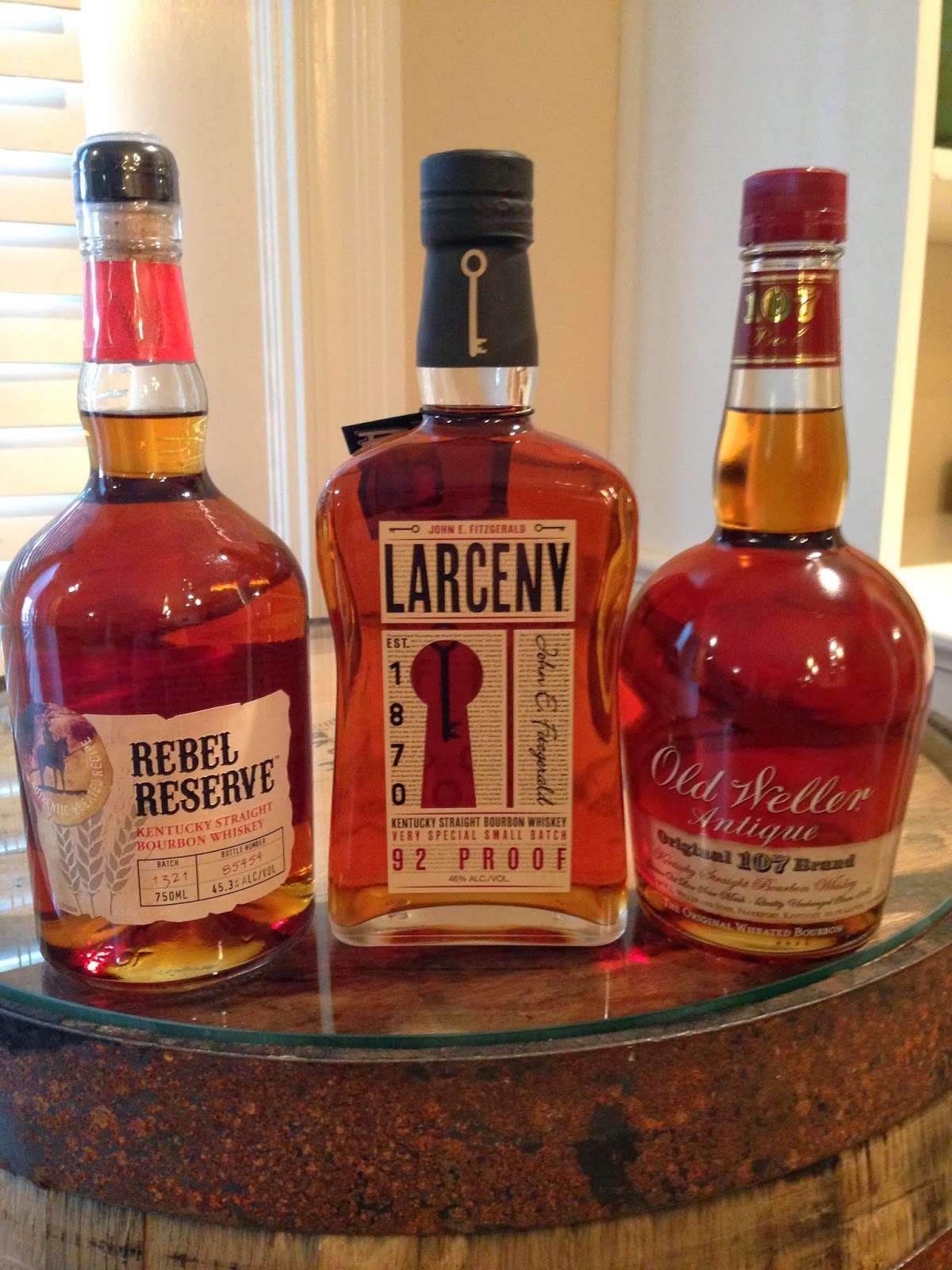
Sipp’n Corn Bourbon Review – Rebel Reserve vs. John E. Fitzgerald Larceny vs. Old Weller Antique 107
There’s often too much focus in bourbon reviews on inaccessible bourbon. While those reviews can be intriguing and can help narrow your focus for bourbon hunting, the lower shelves could use some attention too. There are more than plenty low-priced bourbons to choose from, but the vast majority use rye as their secondary grain. To narrow the choices I decided to compare only bourbons that use wheat as the secondary grain (by far the minority), giving them a different profile than bourbons that use the more traditional rye mash bill.
So for this review, we compared three wheated bourbons that can be found readily at all stores for about $20.00. I didn’t actually go to the very bottom of the shelf. In fact, for each bourbon, the respective brand offers an even less-expensive version. Here is the order of blind tasting:
Rebel Reserve
Distillery: Bernheim Distillery (Heaven Hill), Louisville, Kentucky
Age: NAS (but longer than Rebel Yell)
Proof: 90.6
Cost: $20.99
Real bottom shelf version: Rebel Yell ($12.99)
Thanks to the mayor of Louisville in 1949, Charles Farnsley, the name “Rebel Yell” refers to the battle cry of the Confederacy. Perhaps recognizing the riskiness of that name, Stitzel-Weller originally only distributed this brand in the deep-south, but it soon was more widely distributed and later gained recognition as a favorite of Keith Richards. While the Rebel Yell brand is distilled at Heaven Hill’s (new) Bernheim Distillery in Louisville, Heaven Hill sold the Rebel Yell brand to Luxco, Inc.
John E. Fitzgerald Larceny Bourbon
Distillery: Heaven Hill Bernheim Distillery (for some reason the bottle only discloses “bottled by…”)
Age: NAS
Proof: 92
Cost: $21.49
Real bottom shelf version: Old Fitzgerald ($11.99)
Larceny is the newest brand in this comparison, making its debut in 2012, with the marketing department going hog-wild on the backstory for this reinvention of the Fitzgerald line. Despite the claim on the bottle, Larceny was not established in 1870. In a bit of marketing misdirection, that date really only applies to the date that Old Fitzgerald was released as a private brand. While not containing an age statement, Larceny is advertised as a small batch of 100 or less barrels and “hand selected by the Master Distillers to have a taste profile of a six-year-old Kentucky Straight Bourbon Whiskey.”
Old Weller Antique 107
Distillery: Buffalo Trace, Frankfort, Kentucky
Age: NAS (but used to be seven years)
Proof: 107
Cost: $19.99
Real bottom shelf version: W. L. Weller Special Reserve ($14.99)
Old Weller Antique 107 is part of the famed Weller line, named after William Larue Weller (1825-1899), who is the grandfather of all wheated bourbon. After the repeal of National Prohibition, the Stitzels and Wellers built the Stitzel-Weller Distillery, opening on Derby Day in 1935. Big corporate acquisitions and mergers followed, Stitzel-Weller closed in 1992, and after moving distillation to New Bernheim, the brands were sold off to other distilleries. Without William Larue Weller, we would not be having this tasting at all, because Rebel Yell and Larceny wouldn’t exist.
1st Glass (Rebel Reserve):
The nose clearly gave away that this was a wheated bourbon. The alcohol scent was a little strong on the nose, but the caramel and brown sugar notes were enticing. Unfortunately, there was also an unfavorable scent of medicinal cherry (like cherry cough drops). The taste was not complex, mostly hot and sweet, with hints of caramel, grain and corn. Not much to it. The finish was short-ish, and predictably sweet and not complex. It was still mostly inoffensive just until it started to fade, when the cherry cough drops come back for an unwelcome reprise.
2nd Glass (John E. Fitzgerald Larceny):
The second glass was brighter in color, with more of a copper tone. The nose had a butterscotch aroma, with other sweet notes like toffee, but also a lot of cinnamon. The taste was sweet, with flavors of caramel, honey and sweet corn, with some spice and nice bite, but it turned a little bitter. Like the first glass, there was not much complexity, but there were more slight hints of fruit and spice. There was a bit of harshness when drinking the second glass neat, but it improved dramatically with ice. A splash of water helped too, but the sweet flavors opened up better just with ice. The finish was quick to medium, and slightly warm.
3rd Glass (Old Weller Antique 107):
The third glass had a hint of orange to its amber color. The nose revealed its higher proof right away, but after adjusting for the alcohol, the predominant note was caramel – lots of caramel – but also strong vanilla. Caramel was also the predominant taste, just as predicted by the nose. But there was also a nice balance of other sweet flavors like vanilla, apple, honey and toffee, along with some spicier flavor of cinnamon. It was actually remarkably balanced for a bourbon lacking rye, but for anyone who really favors rye as the secondary grain, you’ll still miss the spiciness of rye. The higher proof gives a nice bite that compensates somewhat for the lack of true spice flavors. The finish was a little longer than the others and it was a more balanced, satisfying finish of caramel, cinnamon and vanilla.
Winner: Old Weller Antique 107.
Bottom Line:
Practically all wheated Kentucky bourbons are related, and these three are no exception. They all have lineage in William Larue Weller and the Stitzel-Weller distillery, and they all tout that history. Rebel Reserve mentions Weller by name on its back label (“created from a time-honored Weller family recipe…”). Similarly, Larceny’s marketing story obviously relies prominently on Fitzgerald, but maybe because of the general perception of that name as a transitioning to a bottom-shelf brand over the past decades, the deft marketers refer to the Van Winkle family and the Stitzel-Weller distillery.
All three also claim to be made from their original recipes and methods. If true, that should mean that the mash bills, yeast strain, distillation techniques and char level should all be the same, with the only differences being barrel location and age. The variances between Rebel Reserve, Larceny and Old Weller Antique either disprove the entire story about each using the old Weller recipe, or they emphasize the incredible differences that can be imparted by the barrel, age and aging conditions. Remember also that if Rebel Yell and the Fitzgerald line are made from the same Weller recipe, they start the same as Pappy. Everybody wants to ride the coattails of Pappy, so expect more comparisons.
Despite their family origins, these three bourbons are not in the same league. None of the three were going to have peppery or spicy notes due to the lack of rye, but Old Weller Antique did the best job out of the three in delivering a well-rounded profile. Not only was Old Weller Antique the hands-down winner, we added W.L. Weller Special Reserve after the reveal, and it was preferred over Rebel Reserve too.
Keith Richards doesn’t need to be your role model for bourbon, and you don’t need to pay for new marking of old Fitzgerald. So be sure to try Old Weller Antique, although it has become rare ever since the disappearance of W.L. Weller 12 Year Old (if you see Weller 12, ignore everything written here and buy a bottle for about $26.00). If both of those are missing, grab a bottle of W.L. Weller Special Reserve and save $5.00 instead of getting Rebel Reserve, or splurge and try Larceny.
Scores on The Sipp’n Corn Scale
Rebel Reserve: 1.5
Larceny: 2.5
Old Weller 107: 3.5
The Sipp’n Corn Scale:
1 – Wouldn’t even accept a free drink of it.
2 – Would gladly drink it if someone else was buying.
3 – Glad to include this in my bar.
4 – Excellent bourbon. Worth the price and I’m sure to always have it in my bar.
5 – Wow. I’ll search high and low to get another bottle of this.