Brian Haara
Bourbon. Law. Author.
Sipp’n Corn Bourbon Review – Elmer T. Lee Single Barrel
*Updated July 11, 2014 after a private barrel selection at Buffalo Trace where we selected barrels of Elmer T. Lee and Blanton’s, among many other Buffalo Trace Brands, and where I learned the typical ages of Elmer T. Lee and Blanton’s.
Bourbon: Elmer T. Lee Single Barrel
Distillery: Buffalo Trace Distillery, Frankfort, Kentucky
Age: NAS, but typically nine years
Proof: 90 proof
Cost: $31.99
Color:
Amber gold.
Nose:
Light spice, mostly sweet cinnamon apples, vanilla and caramel.
Taste:
More spice comes through than indicated from the nose, but sweetness still predominates, although not overpowering. Mostly honey, caramel and toffee flavors, but with an interesting balance of oak, cinnamon and spice. Not overly spicy or hot, but comforting warmth. A splash of water opened up some more fruit and sweetness, but it lost complexity, so I prefer this one neat. This was really a wonderful balance.
Finish:
Extremely pleasant and smooth finish, finally transitioning to more spices than sweetness; water really shortened it, so again, drink it neat.
Rating:
For starters, I can’t believe this is a low-$30’s bourbon. Also, while I’m a huge fan of Blanton’s, I’m not sure why I’d spend the extra money on it. ETL uses the same mash bill as Blanton’s Single Barrel (the Buffalo Trace mash bill #2, maybe about 15% rye, used for all Ancient Age bourbon), and ETL is aged for about nine years compared to around six years for Blanton’s, although Blanton’s is aged in Warehouse H, said to have been Col. Blanton’s favorite. Regardless, ETL is deep and rich, but at the same time so drinkable without a drop of pretentiousness. This can really be your go-to bourbon.
On top of its outstanding balance, ETL has the legitimate history of the legendary Elmer T. Lee (1919-2013) himself, who has an incredible story starting with being hired (but initially rejected) by Col. Blanton when Buffalo Trace was called the George T. Stagg Distillery, and working his way up through the ranks . (Please check out the University of Kentucky Louie B. Nunn Center for Oral History interview of Elmer T. Lee posted here: http://www.nunncenter.org/buffalotrace/category/people/elmer-t-lee-interviews/along with the short bio posted here: http://www.buffalotracedistillery.com/craftsmen/lee ). With so many bourbons having fake histories and “master distillers” who are blenders at best, it’s comforting to know that Elmer T. Lee is about real history.
Between Elmer T. Lee Single Barrel, the Weller line (also Buffalo Trace) and Four Roses, I really don’t think that there’s a reason to pay top-shelf prices. I definitely need to do a blind tasting between Elmer T. Lee Single Barrel and Blanton’s Single Barrel to see if I’m right, but however that might end, I highly recommend Elmer T. Lee Single Barrel.
Score on The Sipp’n Corn Scale: 4.0
The Sipp’n Corn Scale:
1 – Wouldn’t even accept a free drink of it.
2 – Would gladly drink it if someone else was buying.
3 – Glad to include this in my bar.
4 – Excellent bourbon. Worth the price and I’m sure to always have it in my bar.
5 – Wow. I’ll search high and low to get another bottle of this.
Kentucky Wasn’t Big Enough for Two Colonel Taylors.
I mentioned earlier that Col. Edmund Haynes (“E. H.”) Taylor, Jr. was one of the most litigious distillers of his era (see http://sippncorn.blogspot.com/2013/10/the-origin-of-col-e-h-taylor-jrs.html). In addition to his lawsuits, E. H. Taylor was also instrumental in passing the Bottled-In-Bond Act of 1897, meant primarily to protect the public against the “horrors” of whiskey rectifiers. The act required that any spirit labeled as “Bottled-in-Bond” be the product of one distiller at one distillery during one distillation season, and aged in a federally-bonded warehouse under federal government supervision for at least four years and bottled at 100 proof.
E. H. Taylor also focused his efforts against a prominent Louisville businessman, another Colonel with the same surname, Col. Marion E. Taylor. E. H. Taylor sued Marion Taylor alleging that Marion Taylor was misrepresenting his blended whiskey as “straight” bourbon whiskey, and that Marion Taylor was trying to defraud the public by using a brand name similar to E. H. Taylor’s bourbon.
Marion Taylor was a well-known Louisville businessman, and his name still fits prominently in downtown Louisville with the Marion E. Taylor Building,

and the Wright & Taylor Building.

Marion Taylor formed Wright & Taylor with John J. Wright in 1886, and together they sold Kentucky Taylor, Pride of Louisville and Cain Spring Whiskey, and by 1892 Wright & Taylor had added Fine Old Kentucky Taylor, which became their most popular brand. In 1896 Marion Taylor bought and expanded the Old Charter Distillery and brand, which allowed him to distill and sell Old Charter straight bourbon, but he also continued to sell his very popular blended Fine Old Kentucky Taylor brand.
E. H. Taylor’s straight bourbon was the similarly-named “Old Taylor.” He complained that Marion was creating confusion between the “inferior” blended whiskey and the “superior” (and much more expensive) straight bourbon whiskey. E. H. Taylor sought an injunction and $100,000.00 in damages (in today’s dollars, about $2.7MM). The Jefferson County Circuit Court dismissed E. H. Taylor’s claims, finding that Marion Taylor was not infringing on any trademarks, nor unfairly competing.
E. H. Taylor appealed to the Kentucky Court of Appeals, and in E. H. Taylor, Jr. & Sons Co. v. Marion E. Taylor, 27 Ky.L.Rptr., 124 Ky. 173, 85 S.W. 1085 (1905), the court ruled partially in his favor by granting an injunction that required Marion Taylor to specify in advertising that Old Kentucky Taylor was a blended whiskey. However, Marion Taylor did not have to pay any damages, and he was still allowed to use his brand name.
While the Court’s ultimate ruling might seem might seem like only a slap on the wrist, the Court was more critical of Marion Taylor in explaining the basis for its ruling. First, the Court noted the difference between blended whiskey and straight bourbon:
Rectified or blended whisky [*the Court used the traditional Scotch spelling throughout its ruling] is known to the trade as “single-stamp whisky,” while bonded whisky is known as “double-stamp goods.” The proof shows that the rectifiers or blenders take a barrel of whisky, and draw off a large part of it, filling it up with water, and then adding spirits or other chemicals to make it proof, and give it age, bead, etc. The proof also shows that from 50 to 75 percent of the whisky sold in the United States now is blended whisky, and that a large part of the trade prefer it to the straight goods. It is a cheaper article, and there is therefore a temptation to simulate the more expensive whisky.
After establishing this distinction and comparing the advertisements used by E. H. Taylor and Marion Taylor, the Court concluded that consumers who were “not familiar with the whisky trade would understand that ‘Old Kentucky Taylor’ was a straight whisky.” The Court further concluded that Marion Taylor intentionally misled consumers through his advertising by trying to pass off his blended product as E. H. Taylor’s straight bourbon, “which had attained a very high reputation as a pure Kentucky distilled whisky.”
Marion Taylor’s blended whiskey “was a cheaper article, and could be sold at prices at which [E. H. Taylor] could not afford to sell his whisky,” and because his deceptive advertising could confuse consumers, the Court ruled that Marion Taylor had to be truthful in his advertising:
[Marion Taylor] may properly sell his brand of “Old Kentucky Taylor,” provided he so frames his advertisements as to show that it is a blended whisky, but he cannot be allowed to impose upon the public a cheaper article, and thus deprive [E. H. Taylor] of the fruits of its energy and expenditures by selling his blended whisky under labels or advertisements which conceal the true character of the article, for this would destroy the value of the [E. H. Taylor’s] trade.
In the end, Marion Taylor seems to have complied with the Court’s order, as can be seen by comparing this Wright & Taylor add in the Wine and Spirit Bulletin from May 1, 1904 (before the court’s 1905 ruling):

with this add in the Wine and Spirit Bulletin from June 1, 1906 (after the court’s ruling):
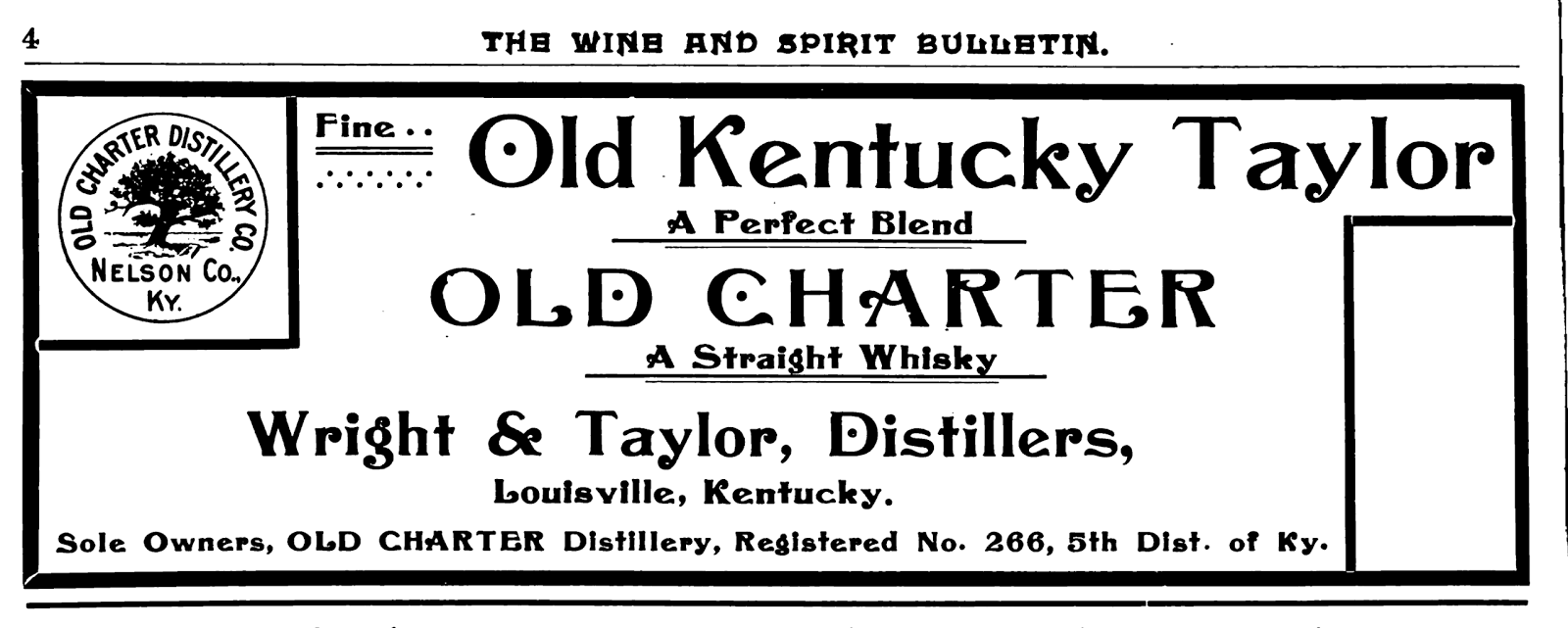
In compliance with the Court’s ruling, Marion Taylor made clear that his Fine Old Kentucky Taylor was a blended whiskey, and distinguished it from his Old Charter brand, which was a straight whiskey. But E. H. Taylor still couldn’t let go, and in 1913 he published this over-the-top full-page letter in the Pacific Wine, Brewing and Spirit Review(double-click on the letter and enlarge it; it’s a funny read):

In the same edition, E. H. Taylor also published this full-page “Important Notice” which slightly exaggerated the Court’s ruling:
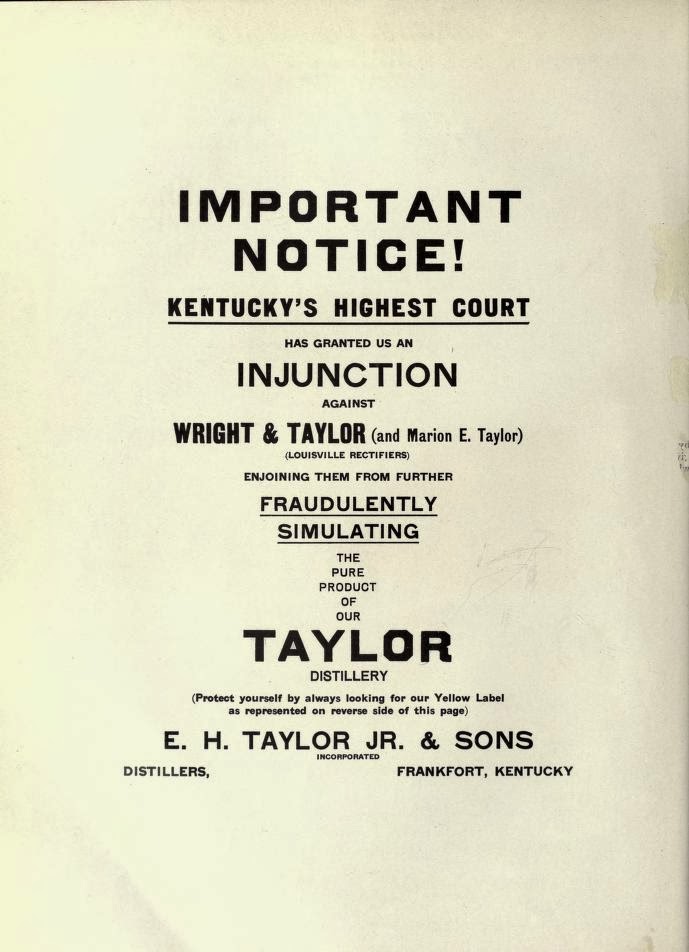
Marion Taylor’s Old Charter Distillery and the Old Charter brand continued to thrive (and E. H. Taylor could have no legitimate complaint about Old Charter), but “Fine Old Kentucky Taylor” has been lost to history, probably due in part to E. H. Taylor’s persistence. There just wasn’t enough room for two Col. Taylors.
Sipp’n Corn Bourbon Review – Four Roses Single Barrel
Bourbon: Four Roses Single Barrel, 100 proof, NAS.
(GE-17-1P = Warehouse G (East side); 17th rack; tier 1; 16 barrels deep in the row)
Distillery: Four Roses Distillery, Lawrenceburg, Kentucky.
Cost: $33.99
Color:
Amber with deep orange tint.
Nose:
Spice balanced with sweetness of fruit and vanilla.
Taste:
Balanced honey, vanilla, toast and cinnamon, with heat – not just warmth. A splash of water or a single large ice cube (my preference) opens up new layers of fruit, grains and oak.
Finish:
Long, complex and satisfying.
Rating:
You can’t go wrong with Four Roses. One of the many unique facts about Four Roses (although this is old news for anyone who knows about Four Roses) is that they have two different mashbills and five yeast strains, which therefore allows Four Roses to make ten distinct bourbons under one roof. Four Roses “Yellow Label” uses all ten recipes, Four Roses Small Batch uses just a few, and because it’s “single barrel,” Four Roses Single Barrel is just one recipe.
Here’s how Four Roses describes its five yeast codes:
V – Delicate Fruitiness
K – Slight Spice
O – Rich Fruitiness
Q – Floral Essence
F – Herbal Essence
The standard Four Roses Single Barrel uses the “B” mashbill and the “V” yeast strain, but with a little bourbon hunting you can find and compare it with private selection single barrels that are cask strength and that often use different recipes.
Early this Fall I had the pleasure of participating in Four Roses Single Barrel Private Selection where, contrary to the standard OBSV Single Barrel, all ten barrels used the “E” mashbill (75% Corn – 20% Rye – 5% Malted Barley). We of course tasted these ten selections cask strength, and the bottling will be at cask strength. Whichever barrel we selected, it was guaranteed to be distinctive when compared to the standard Four Roses Single Barrel.
Here are my most memorable notes from each of the ten barrels:
OESV; 9 years, 5 months
- Big nose, great warmth, nice balance of spice and fruit.
OESV; 9 years, 5 months
- Hotter at first, spicy nose, really long finish, opened up nicely with a splash of water.
OESQ; 9 years, 6 months
- Spicy long finish.
OESQ; 9 years, 5 months
- Unexpected flavors. Sweeter than the others.
OESK; 9 years, 8 months
- Light nose but spicy, also a spicy finish.
OESK; 9 years, 8 months
- Best of the group. Started sweet, finished spicy and opened up great with a splash of water.
OESO; 11 years
- Similar nose and taste to #6, and I was surprised to see that it was a different yeast strain and different aging. Less sweet and longer finish that #6, however.
OESO; 11 years
- Spicy nose followed by great taste of spice and fruit. Opened up with a splash of water.
OESF; 10 years, 3 months
- Soft nose followed by heat on the front mellowing out to candy sweetness.
OESF; 10 years, 3 months
- Strong nose and really hot, spicy taste and finish.
All ten of these barrels had similarities to the standard Four Roses Single Barrel, but I was happy that we were limited to the “E” mashbill because I knew that we were trying something different. On the other hand, I can’t say enough good things about the standard Four Roses Single Barrel. It’s a bargain in the mid-$30 range (and I recently found it on sale under $30), and I prefer it over many $40-$50 bourbons out there. I’ll keep buying the OBSV Single Barrel, although I can’t wait for our OESK to be bottled, and I have another private barrel selection bottle of OBSF (10 years, 8 months and 117.4 Proof) that I’ll open and compare to the OBSV and OESK, and for good measure I’ll include the highly-praised 2013 Limited Edition Small Batch. I can’t wait…
In the meantime, my recommendation is that you look for private barrel selections and buy that along with a standard OBSV Single barrel, and compare the two. If you can’t find a private selection at your local store, I’d still recommend that you buy two bottles of OBSV, making sure that you get bottles from two different barrels. Open both and enjoy the subtle differences found from each barrel.
Score on The Sipp’n Corn Scale: 4.0
The Sipp’n Corn Scale:
1 – Wouldn’t even accept a free drink of it.
2 – Would gladly drink it if someone else was buying.
3 – Glad to include this in my bar.
4 – Excellent bourbon. Worth the price and I’m sure to always have it in my bar.
5 – Wow. I’ll search high and low to get another bottle of this.

Sipp’n Corn Bourbon Review – Corner Creek Reserve
Bourbon: Corner Creek Reserve Bourbon Whiskey. 88 Proof; NAS.
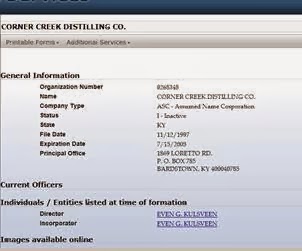
Distillery: Who knows? The label states “Corner Creek Distilling Co.,” but that’s just one of the many assumed names of Kentucky Bourbon Distillers, Ltd. Worse, this assumed name has been inactive since 2003. Does KBD have so many assumed names that it can’t keep track of them and renew the certificates as needed?
Cost: $25.99
Color:
Light amber.
Nose:
Not complex. Soft nut and vanilla flavors. It lost any discernable nose with a splash of water.
Taste:
No heat or bite, which I missed. Smooth and sweet, and no complexity. The lower proof was noticeable. Definitely drink Corner Creek neat; it’s already watered-down enough.
Finish:
A dry finish that was only slightly warm and pretty short. Oak flavors dominated, with a little medicinal flavors at the very end.
Rating:
While bourbon hunting I struck up a conversation with the owner of a small liquor store in LaGrange, Kentucky. Of course he didn’t have what I was looking for, but he went on and on about Corner Creek. He has family in from Pennsylvania every Thanksgiving and they make special requests for him to be sure to have Corner Creek. Then he told me a story about how Corner Creek was started by guys from the wine business who are now distilling in Bardstown. I hoped that he was just misinformed instead of lying to me, because I knew that Corner Creek was part of the KBD portfolio.
Maybe he was just relying on the label, which claims Corner Creek is produced “in the tradition of the great wine importers,” or maybe it was the wine-styled bottle (with the Bob Ross landscape art). Or maybe it was just a sales pitch. But he was extremely friendly so I didn’t challenge him. Not only that, I decided to buy a bottle.
My final recommendation is that Corner Creek is fine, but it’s under-powered and it left me wishing for more complexity and bite. Additionally, there are so many other options in this crowded price range (or lower) that you should try first, like Four Roses “Yellow Label” and Small Batch, Elijah Craig 12, anything in the Weller lineup, Maker’s Mark or Bulleit. As a bonus, we know where each of those are distilled and aged (even Bulleit, at least for the time being). I would prefer all of these over Corner Creek.
Score on The Sipp’n Corn Scale: 2.5
The Sipp’n Corn Scale:
1 – Wouldn’t even accept a free drink of it.
2 – Would gladly drink it if someone else was buying.
3 – Glad to include this in my bar.
4 – Excellent bourbon. Worth the price and I’m sure to always have it in my bar.
5 – Wow. I’ll search high and low to get another bottle of this.

Sipp’n Corn Bourbon Review – Eagle Rare vs. Bulleit vs. Michter’s: “The 10-Year Challenge”
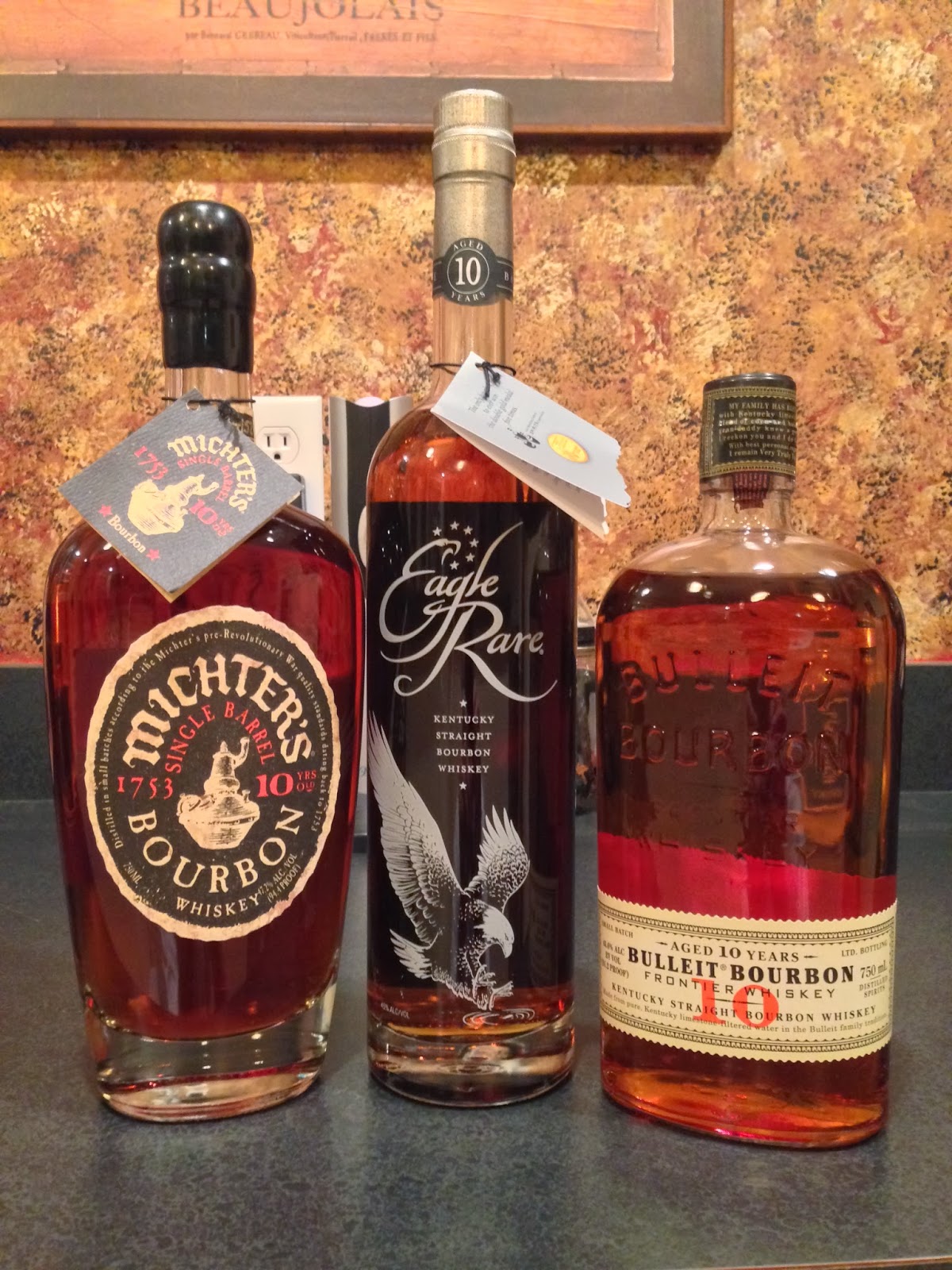
For this Bourbon Review, I wanted to find three bourbons aged exactly the same number of years, all with rye as the secondary grain, and all with similar Proof, but priced very differently. Three bourbons meeting those criteria are Eagle Rare Single Barrel 10-Year, Bulleit Bourbon 10-Year Small Batch and Michter’s Single Barrel 10-Year, so “The 10-Year Challenge” was born. Would the hard-to-find, expensive bourbon come out on top? Or would the readily-available $30 bottle teach us all a valuable lesson?
Bourbons in order of blind tasting:
· Eagle Rare Single Barrel 10-Year (90 proof; $29.99);
· Bulleit Bourbon 10-Year Small Batch (91.2 proof; $39.99);
· Michter’s Single Barrel 10-Year (94.4 proof; $85.99).
1st Glass (Eagle Rare):
The first glass was a favorite of many of our tasters right away. The nose was light and not particularly complex, but pleasant. Common tasting notes included a nice balance of oaky and sweet flavors. The finish was dry and short to medium.
2nd Glass (Bulleit):
Two of the tasters had an immediate negative reaction to the second glass. But overall, reviews were good (ultimately just not better that the first and third glasses). The second glass had a much more fragrant nose than the first, which was followed by a bolder taste and more complex and longer finish. Caramel, vanilla, oaky, citrus and aggressive spice were all common tasting notes.
3rd Glass (Michter’s):
The third glass was noticeably darker in appearance, a rich caramel compared to the lighter amber of the first two glasses. Like the second glass, the nose was much more prominent and bold, but it differed from the second glass by having more of a smoky, earthy nose. Tasting notes were dominated by comments about its complexity. Licorice, oak, caramel, vanilla, sweet corn, buttery, and warm spices were all noticeable. The tasters liked the comparatively longer and warmer finish, too.
Winner:
Out of eight tasters, our results were all over the board. All three received 1st, 2nd and 3rd place votes, but Michter’s slightly nudged out Eagle Rare with one more 1st place vote. Michter’s also only received a single 3rd place vote, while Eagle Rare received two. Bulleit only received one 1st place vote, and received a stunning five 3rdplace votes. So Michter’s won by a nose, with Eagle Rare very close behind, and Bulleit a distant third.
Bottom Line:
I had some initial hesitancy about including two NDP (non-distiller producer) bourbons compared to just one bourbon, Eagle Rare, where the distillery, Buffalo Trace, is known. I even received some immediate Twitter feedback from my post on the night of this event for including two NDPs. But I got over this hesitancy pretty quickly because Bulleit and Michter’s fit the theme, popular belief is that this Bulleit is a Four Roses recipe, and good bourbon is good bourbon, no matter what liberties marketers take.
I was pleased to see that, despite their similarities, these three bourbons were all very different from each other and that no one bourbon stood out from the others. That lack of separation, however, requires consideration about price. The Eagle Rare is the clear price-performer of the three, and given its results at the tasting, Eagle Rare 10-Year is a no-brainer to add to your shelf.
But personally, I scored the Bulleit higher than anyone else (then again, I’m also a big fan of Four Roses). I think that the tasters who preferred Eagle Rare would probably prefer Bulleit in a cocktail because its bolder flavors don’t get lost, so depending on how you plan to drink these bourbons, my recommendation would change.
Finally, even though it was the overall winner and even though I really liked it, I expected the Michter’s to completely wow me (it didn’t). For anyone else who expects an almost $90 bourbon to wow them, then you may be better off sticking with Eagle Rare and Bulleit, which are readily available everywhere. Still, Michter’s won The 10-Year Challenge, and its profile is very different than the other two options, so if you’re splurging and can find it, it’s worth a look.
My final recommendation is that while Eagle Rare 10-Year, Bulleit 10-Year and Michter’s 10-Year may be better than each other on different occasions, all three are great buys that deserve room on your shelf.
Scores on The Sipp’n Corn Scale
Eagle Rare Single Barrel 10-Year: 4.0
Bulleit 10-Year Small Batch: 3.0
Michter’s Single Barrel 10-Year: 4.0
The Sipp’n Corn Scale:
1 – Wouldn’t even accept a free drink of it.
2 – Would gladly drink it if someone else was buying.
3 – Glad to include this in my bar.
4 – Excellent bourbon. Worth the price and I’m sure to always have it in my bar.
5 – Wow. I’ll search high and low to get another bottle of this.