Brian Haara
Bourbon. Law. Author.
Sipp’n Corn Tasting Notes: Four Gate Batch 6—The Kelvin Collaboration II.

Four Gate is back at it, leading the way with the most creative barrel finishes of any brand. For Batch 6, Four Gate used 12-year old high-rye (18% rye grain) Kentucky Straight Bourbon Whiskey and finished some of it in Cognac barrels and some of it in dark rum barrels.
Batch 6—The Kelvin Collaboration II
Bourbon: Kentucky Straight Bourbon Whiskey finished in Cognac and Dark Rum Casks
Distillery: Undisclosed
Age: 12 years
ABV: 63.2% ABV (126.4 Proof)
Cost: $199.99
Appearance:
Deep amber-brown.
Nose:
There’s a lot going on here—the spice and dark fruits mingle together with a slight hint of barrel finishing and plenty of intensity.
Taste:
I’m not sure that I’m finding the Cognac influence, but the rum casks are there with sweetness and tropical fruit. It’s far more than that though; beyond additional sweetness as expected from caramel and vanilla, there are soft, warm, dark flavors of maple syrup and dark fruit, followed by baking spice as its creaminess coats the palate. There’s some heat here, but resist the temptation to add a few drops of water.
Finish:
Warmth that lasts with sweet creamy caramel chocolates and dries as it fades.
Bottom Line
Distribution is limited like Four Gate’s other releases (2,500 bottles just for Kentucky, Tennessee, and Seelbachs.com), so you’ll need to do a little work to find a bottle of The Kelvin Collaboration II. But like first five releases, it’s worth the extra effort.
Disclaimer: The brand managers kindly
sent me a sample for this review,
without any strings attached.
Thank you.
Sipp’n Corn Tasting Notes: Larceny Barrel Proof Batch B520.
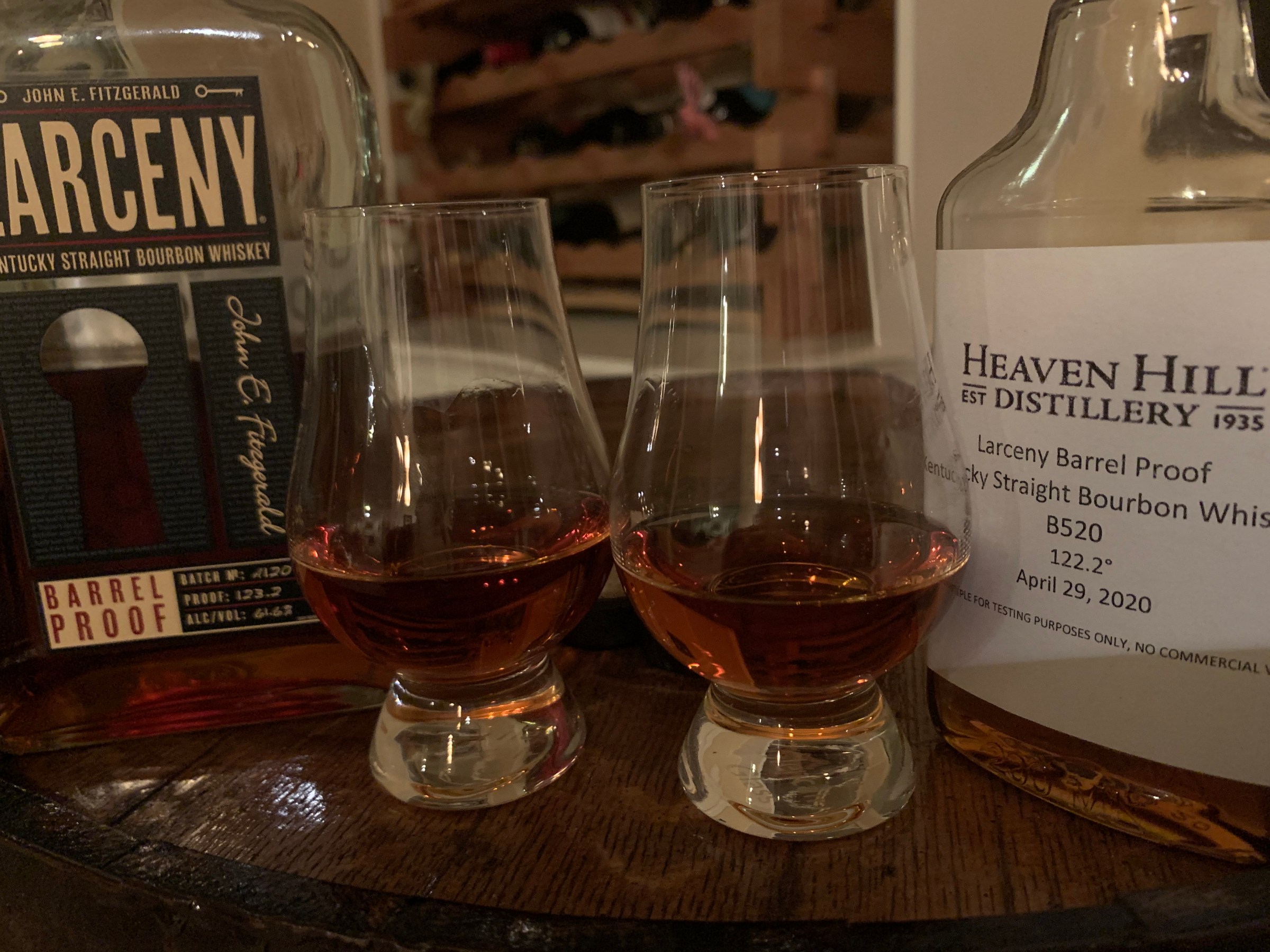
I was so happy to see that Heaven Hill decided to release a barrel proof version of its popular Larceny wheated bourbon, and I enjoyed its first release, Batch A120. I received a sample of Batch B520 last month and right off the bat it was impressive. After my standard three separate tastes and then a blind taste against some peer rivals, I’m saving the last pour to taste blind against this fall’s limited releases; it’s that good.
Larceny Barrel Proof B520 Tasting Notes
Bourbon: Larceny Barrel Proof Kentucky Straight Bourbon Whiskey
Distillery: Heaven Hill
Age: NAS, but probably 6-8 years
ABV: 61.1% (122.2 proof)
Cost: $49.99
Appearance:
Dark amber. Very similar to Larceny Barrel Proof batch A120.
Nose:
Wonderfully sweet butterscotch with elegant herbal aromas, blackberry, and oak char. It’s mouthwatering like a wheated bourbon should be.
Taste:
The first sip seals the deal. It’s creamy with caramel, oak, honey, and vanilla driving the sweetness and the right amount of spice for balance.
Finish:
Medium in length with a fantastic swell.
Bottom Line
Larceny Barrel Proof continues to fire on all cylinders with B520 outshining A120. Larceny can really position itself as a market leader with its readily available standard Larceny and three regular releases per year of the Barrel Proof version. After completing my review, I tried batch B520 blind against two other wheated bourbons of similar age—one at 107 proof and the other at a cask strength of 113.3 proof. Larceny Barrel Proof crushed them.
Disclaimer: The brand managers
kindly sent me a sample for this review,
without any strings attached.
Thank you.
Sipp’n Corn Tasting Notes: Elijah Craig Barrel Proof Batches A120 and B520.
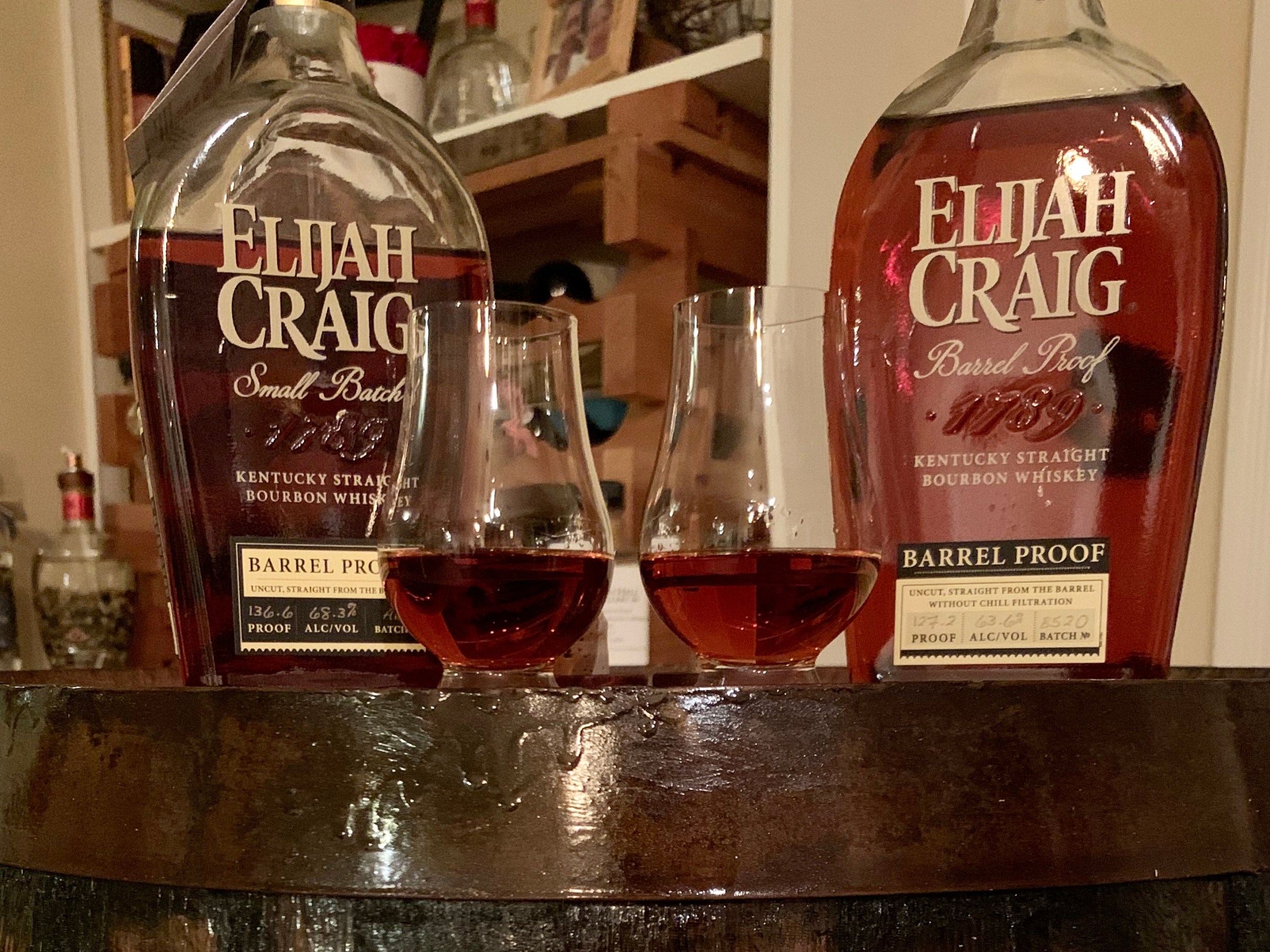
The first Elijah Craig 12-year Barrel Proof of 2020 was released in January and received immediate praise. My first tastes of it couldn’t quite get past the heat, and then with the distraction of recent world events, I never made it back for my third taste. Then I received the second batch of the year and the timing was perfect to compare the two.
Elijah Craig Barrel Proof A120 Tasting Notes
Bourbon: Elijah Craig Barrel Proof Kentucky Straight Bourbon Whiskey
Distillery: Heaven Hill
Age: 12 years
ABV: 68.3% (136.6 proof)
Cost: $60.00
Appearance:
Deep brown with a copper glint.
Nose:
Hot aromas that ease back with a little time to more pleasant caramel, brown sugar, and oak.
Taste:
Brown sugar and cherry drive this bourbon, along with some dried dark fruit, cinnamon, black pepper, and char.
Finish:
Long, warm finish with caramel taking the lead.
Elijah Craig Barrel Proof B520 Tasting Notes
Bourbon: Elijah Craig Barrel Proof Kentucky Straight Bourbon Whiskey
Distillery: Heaven Hill
Age: 12 years
ABV: 63.6% (127.2 proof)
Cost: $60.00
Appearance:
Practically identical to A120—both have the same beautiful deep brown and copper.
Nose:
Really hides the high proof. Aromas are subtle compared to A120, but it has very inviting caramel, apple butter, brown sugar, and leather.
Taste:
Creamy sensation—caramel, cocoa, vanilla, slight cinnamon, and black pepper. There’s some heat, of course, and it does great with a splash of water. There’s a little less oak than A120, but I don’t miss it because of the wonderful balance.
Finish:
I loved the second wave on the finish. Sustained warmth with balance of caramel, coca, baking spice, and oak—oh the oak!
Bottom Line
A120 marked back-to-back super-high proofs—the final batch of 2019 (C919) weighed in at 136.8 proof, so at a tenth of a percentage lower ABV, Batch A120 is essentially the same proof. Batch C919 got some high accolades but it was too hot for me. Batch A120 shares some of those characteristics and it received even greater accolades, but for my tastes I need to tame this one down with water too. And with just a splash, Batch A120 roars to life. It retains its robustness and adds creaminess and complexity.
B520 is more in the proof range that I tend to like for cask strength and overall between the two, I preferred it. It’s balanced, creamy, and finishes strong. These are both such solid pours and they maintain the Elijah Craig Barrel Proof series easily on top of the regular-release barrel proof options. It’s the oldest regular barrel-proof release, yet it’s priced the lowest, and it routinely is a top-5 bourbon of the year. I always pick one up whenever I see it.
Disclaimer: The brand managers kindly
sent me a bottle for this review,
without any strings attached.
Thank you.
Book Review—Tar Heel Lightnin’: How Secret Stills and Fast Cars Made North Carolina the Moonshine Capital of the World

Criminal Law and Criminal Justice Books is a joint project of the Rutgers School of Law and the Rutgers School of Criminal Justice that features concise reviews of significant books with a connection to the law, and they asked me to review Tar Heel Lightnin by Daniel S. Pierce. Here’s a link to the Rutgers book review website, or just keep reading:
Tar Heel Lightnin’: How Secret Stills and Fast Cars Made North Carolina the Moonshine Capital of the World.
Author: Daniel S. Pierce
Publisher: The University of North Carolina Press (2019)
Tar Heel Lightnin’ proves that moonshine is the key to understanding North Carolina’s history. In doing so, author Daniel Pierce succeeds in treating moonshiners historically with the necessary caveats and without romanticizing criminals into wholesome heroes. Additionally, Tar Heel Lightnin’ discusses the context of moonshine’s role in history by addressing southern poverty, southern justice, and southern pride.
Those southern characteristics might not have been enough on their own to propel moonshine into such a significant historical position, so Tar Heel Lightnin’ goes to the root: activists and politicians who tried to mandate a certain view of paternalistic morality while eroding our rights systematically through unfair taxation and prohibition. Rebellion is a time-honored way of reacting to taxation and prohibition, and with North Carolina’s economic conditions and southern virtues, rebellion took the form of moonshining. As moonshine became part of the culture, Pierce shows one way in which the human spirit can overcome adversity, while, as is often the case, creating a different kind of adversity. Explaining the context of what created, expanded, and sustained moonshine in North Carolina is the real gift of Tar Heel Lightnin’.
Understanding that context doesn’t necessarily need North Carolina to be the “Moonshine Capital of the World,” and that declaration probably falls into the same bucket as the exaggerations of the North Carolina tourist traps that Pierce describes cropping up in the 1920’s. Indeed, moonshining is nothing new to the United States, let alone unique to North Carolina.
The first tax on Irish Whiskey in the early 1660’s drove distillation into the hills as moonshiners. Our young nation experienced the same pushback when we instituted our first internal revenue statute in 1791, which of course taxed distillers. Each time that our nation imposed a new tax or increased the tax rate, moonshining grew, not just in North Carolina, but in every countryside, holler, and swamp where making whiskey was a way of life. That area was predominantly in the southeast, bounded by the Ohio and Mississippi Rivers. And Kentucky—which has long been the epicenter of legal whiskey distilling—is claimed in earlier works to also be the center of illegal distilling.
As if it were a race worth winning, authors want their home state to wear the dubious crown. But the story can be told without declaring any particular state to have been “The Moonshine Capital.” Instead, Tar Heel Lightnin’ won me over with the personalities and with context woven artfully through the stories of real people. Commentary on the moonshiners of The Andy Griffith Show and the influence on NASCAR and The Dukes of Hazzard helped to show the reach and influence of North Carolina moonshiners to mainstream culture.
Even more detail is provided by breaking up the chapters with inset summaries of significant characters—part of Pierce’s “North Carolina Hall of Fame (and Shame)”. Occasionally I was torn by these insets when they seemed too repetitive or ran on, causing a disruption in the flow of the main text. More often, though, the tidbits in these insets brought the characters to life by telling more stories, perhaps the best way to build an understanding of context and the next step of interpreting causality. And in the end, Pierce convinces me that moonshine is indeed the key to understanding the history of North Carolina.
Whiskey From Home!

Whiskey From Home—a free worldwide virtual event with seminars, tastings, food pairings, and cocktails—is this coming Saturday, May 2, starting at 12 noon eastern. Join us for 5 ½ hours of livestreamed whiskey-soaked entertainment on all of your favorite platforms! I’ll be presenting on “E.H. Taylor Despised George T. Stagg (And Other Stories of Bourbon Justice).” Find out everything here: Whiskey From Home
Register on Eventbright and then get your code to receive a 50% discount on Bourbon Justice direct from Potomac. Use this link: Bourbon Justice
Whiskey From Home includes bourbon history, the best bourbons to buy right now, craft whiskey exploration, how to host a kick-ass tasting, and blind flights. Viewers can purchase bourbon, food, and cocktail ingredients from their local stores to follow along with cocktail breaks, a virtual food pairing with Peggy Noe Stevens, and a virtual bourbon tasting with Fred Minnick. With an integrated live chat, participants can interact with each other and with the presenters—giving everyone social distancing at home the chance to attend a CDC-approved whiskey conference.
I hope to see you there!

