Brian Haara
Bourbon. Law. Author.
Sipp’n Corn Opinion: Sazerac Tries to Erase History by Suing the Owner of the Historic Old Taylor Distillery.
When George T. Stagg and Col. Edmund H. Taylor, Jr. parted ways effective January 1, 1887, Col. Taylor left behind the O.F.C. and Carlisle distilleries. After many changes in ownership and names, that property is now Buffalo Trace, owned by Sazerac. Col. Taylor, in the meantime, built the monument of a distillery known ever since as “The Old Taylor Distillery” in Millville, Kentucky. The Old Taylor Distillery closed in 1972, but it kept its name (including the sign), and it certainly kept its spirit and legendary status. While the brand name “Old Taylor” was bought and sold, eventually winding up with Sazerac, and the whiskey was made elsewhere, the property always remained The Old Taylor Distillery.
After decades of falling into serious disrepair, as noted in an earlier post and countless other articles, Peristyle LLC and Master Distiller Marianne Barnes came to its rescue and have been in the process of returning The Old Taylor Distillery to its former glory. The new entrepreneurs were very careful to not call their business “The Old Taylor Distillery,” likely because Sazerac was claiming rights to the Taylor brand name. A geographic location, however, does not follow a brand name that is bought and sold.
This week, months of negotiations and proceedings before the U.S. Patent & Trademark Office Trademark Trial and Appeal Board came crashing down with Sazerac’s filing of a federal lawsuit against Peristyle. In its new lawsuit, Sazerac claims that it owns the trademarks “Old Taylor” and “Col. E. H. Taylor,” and that Peristyle is offering “event-hosting services” using Sazerac’s brands “and confusingly similar variations thereof.”
But all Sazerac could point to in its Compliant is Peristyle’s use of the true geographic name of the property – a name Sazerac could not bring itself to mention. In fact, when referring in the Complaint to the historic site known as “The Old Taylor Distillery,” Sazerac ignored that name, and instead called it the “Frankfort Distillery.” The only time Sazerac used the real name of the property in its Complaint was when it included a photograph showing the old sign still standing above the front door:
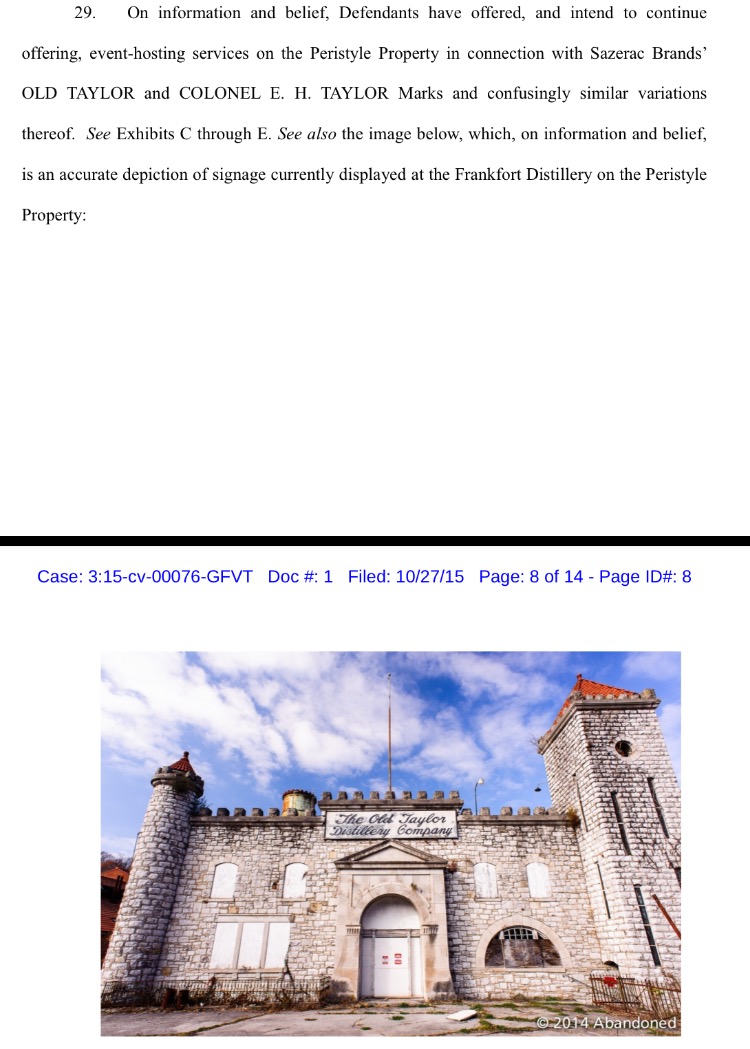
Sazerac should know that “The Old Taylor Distillery” is the name of the property, and that using a historically accurate geographic name is allowed. In the 1880’s, a former ward and protégé of Col. Taylor, James E. Pepper, tried to prevent Labrot & Graham from using “Old Oscar Pepper Distillery” as the name of the distillery that is now Woodford Reserve. The case of Pepper v. Labrot, 8 F. 29 (C.C.D. Ky. 1881) describes how the distillery built by Oscar Pepper in 1838 became known as the “Old Oscar Pepper Distillery.” Oscar Pepper died in June 1865, and the distillery was leased to Gaines, Berry & Co. (a partnership that included Col. Taylor), and the distillery continued to be known as the Old Oscar Pepper Distillery.
James gained control of the distillery, but lost it in bankruptcy, and the property was acquired by Labrot & Graham, which continued to call it the “Old Oscar Pepper Distillery.” James sued Labrot & Graham because he believed that only he should be able to use the “Pepper” name. Labrot & Graham won the case, however, because they owned what was actually called the “Old Oscar Pepper Distillery.” The court ruled that reference to “Old Oscar Pepper’s Distillery” meant the place of production, and was not a trademark.
Here, Sazerac seems to be attempting exactly what James Pepper failed to do – it’s trying to lay claim to all of Col. Taylor’s history and anything named after him. While Col. Taylor certainly made a lasting impression with the O.F.C., he failed there in 1877. It was after he moved to The Old Taylor Distillery that he became truly legendary through the passage of the Bottled-In-Bond Act of 1897 and through the brand he built at his castle. That history cannot be suppressed by Sazerac.
My posts have recounted over 100 years of litigation between Kentucky Bourbon distillers, but there has also been a tremendous history of cooperation. Bringing life back to an important, historic distillery, such as The Old Taylor Distillery, is one of those occasions when producers should have banded together and cheered on Peristyle. Sazerac took the bully approach instead, and should be ashamed for trying to erase history.
Sipp’n Corn Bourbon Review – Four Roses 2015 Limited Edition Small Batch.
I was seated next to Jim Rutledge at this past Bourbon Affair while we blended our own small batch from half-pints of an 11-year OBSV, an 8-year OESO, a 6-year OESK, and a 15-year OBSO. We learned how different recipes can complement each other, can do surprising things to each other, or can be difficult to fine-tune. My first few blends were mostly unremarkable. Then, when I landed on a blend that I thought was fantastic, I got a little cocky and traded with Jim, who had put together a blend that was practically the opposite of my components. As you might imagine, Jim’s batch tasted like it could have been in the running for a Limited Edition bottling and mine had a long way to go in comparison.
That’s how the Four Roses Limited Edition process works. They start with a test blend, tinker with it, refine it, experiment with it, and keep trying it until they reach a consensus. The 2014 Limited Edition Small Batch took upwards of 70-100 test blends (depending on who you ask) before it was finally selected. This year, however, the 2015 Limited Edition Small Batch was set after only 16 test blends. Jim and his team knew that that landed on gold.

|
Whiskey:
|
Four Roses 2015 Limited Edition Small Batch Kentucky Straight Bourbon Whiskey
|
|
Total Bottles:
|
12,672
|
|
Age:
|
16-year OBSK, a 15-year OESK, a 14-year OESK, and an 11-year OBSV
|
|
ABV:
|
54.3% (108.6 proof)
|
|
Cost:
|
$127.00 (gift shop price) or $109.00 retail
|
Tasting Notes
Color:
Deep amber with that reddish hue that comes with nice age (before turning the corner to brown).
Nose:
Despite being barrel proof, there’s no singe here. Feel free to soak up the aromas, and enjoy the “K” yeast shining through as I had hoped. It has sweet scents of caramel, dark chocolate, brown sugar, honey, and dark fruit, balanced with a great punch of spice from the high-rye mash bills, and subtle cinnamon and clove. Not as much oak as might be expected, but a great deep oak added to the balance. I love this nose.
Taste:
Creamy – please try the “Kentucky Chew” with this one, and let it coat your mouth. I don’t usually find the flavor of cherries in Four Roses, but here it is, with just a bit of orange citrus. The spice is just right, and then transitions to rich sweetness like dark chocolate I detected in the nose, along with honey, cinnamon apples, and more caramel, and a perfect balance of oak and leather. It’s such a treat when a Bourbon can be multi-dimensional, and this Limited Edition nails it. Add a drop or two of water if that’s your thing (making it a little sweeter in this case), but this Limited Edition is best enjoyed neat and slow.
Finish:
The finish doesn’t quite keep up with the expectations created by the nose and the taste, but I’m not complaining. It’s moderate in length, lingering, and warming, ultimately being dry with oak and leather, with just enough vanilla to provide balance, and mint to provide some flare.
Bottom Line:
After two years of winning “American Whiskey of the Year,” with the 2012 and 2013 Limited Edition Small Batch releases, 2014 could not “three-peat.” This 2015 release should have Four Roses back in the running, and thus far based on what I’ve been able to try this year, it’s firmly in contention.
I knew going into this that I’m a sucker for the “K” yeast. Private barrels of OBSK and OESK have been some of my all-time favorite bottles, so the heavy use of those recipes had me excited from the second that I first learned about this year’s batch. Beginning with a fantastic nose (as in hands-down best nose of the year), this Limited Edition does not disappoint. The balance of flavors is phenomenal too. The high bar set by Four Roses probably contributed to my wanting more out of the finish – expectations are stratospheric – and with a slightly more robust and longer finish, it would have already been crowned American Whiskey of the Year. This just means that I’ll have to try it blind alongside other contenders.
While there’s some sentimental value attached to the 2015 Limited Edition because it’s the last with Jim at the helm, this Bourbon blows past sentiment and will be remembered on its own merits as one of the best Bourbons of 2015.
Scores on The Sipp’n Corn Scale: 4.5
The Sipp’n Corn Scale:
1 – Wouldn’t even accept a free drink of it.
2 – Would gladly drink it if someone else was buying.
3 – Glad to include this in my bar.
4 – Excellent Bourbon and even worth its high price.
5 – Wow. I’ll search high and low to get another bottle of this.
Sipp’n Corn Review – Alberta Premium Dark Horse (“Dark Batch” in U.S.)
Thanks to some friends north of the border, I was able to get a bottle of two Canadian Whiskies, one of which is only available in Canada (Canadian Club Chairman’s Select 100% Rye Whisky), and Alberta Premium Dark Horse Canadian Whisky, which was released this past spring in the U.S., but called “Dark Batch.”
Some people have wondered why the name “Dark Horse” would be abandoned in this land where horses are featured on so many whiskey labels. The answer probably involves the new craft distillery in Kansas, Dark Horse Distillery (http://www.dhdistillery.com/), or maybe the existence of the Dark Horse Wines in Modesto, California, or perhaps Dark Horse Brewing Company in Marshall, Michigan. Either way, it’s “Dark Batch” to those in the U.S.
Dark Horse is a bit hard to explain, even before getting to tasting notes, so maybe this table describing its four components will help:
|
45.5%
|
100% Rye Whisky distilled in a pot still, aged 6 years in new #4 char American Oak barrels
|
|
45.5%
|
100% Rye Whisky distilled in a column still, aged 12 years in used Bourbon barrels
|
|
8%
|
Old Grand-Dad Bourbon (age and proof undisclosed, though)
|
|
1%
|
Oloroso Sherry
|
Dark Horse hasn’t followed the trend of finishing barrels, and instead it goes right to blending in a small percentage of fortified wine. As you might imagine, even at 1%, the Sherry notes are much stronger than merely being Sherry finished.

Details
|
Whisky:
|
Alberta Premium Dark Horse Canadian Whisky
|
|
Distillery:
|
Alberta Distillers, Ltd.
|
|
Age:
|
Undisclosed on label
|
|
Bottled:
|
Beam Suntory
|
|
Proof:
|
90 proof
|
|
Cost:
|
$29.99 – $34.99 locally for U.S. version
|
Tasting Notes
Color:
As the name suggests, it’s dark, but it still hangs on to a glint of amber and reddish tones. It looks darker in the bottle because (at least the Canadian version) uses the Stagg Jr. trick of a big black back label.
Nose:
The nose was more herbal than I expected, along with sugary-syrupy sweetness, honey, dark fruit, pine nuts, and dark, earthy aromas. But there’s more than just that; there’s enough going on that I found new scents on each re-taste (cinnamon, clove, furniture polish), and I expect to find more every time that I go back to it. I’m not exactly sure that I like the roller coaster ride, however.
Taste:
This is complex and coating: root beer immediately, and then honey, vanilla, cherry syrup, and rounded out with coffee, oak and smokiness. The Sherry is prominent, and sometimes it’s tough to grasp. Some of the favors complement each other, but others compete. It never quite hooked me.
Finish:
Peppery but sweet flavors linger and fade softly for a moderate finish.
Bottom Line
I enjoy my whiskey neat, or sometimes on ice, but that’s not where Dark Horse necessarily shines. In fact, it’s a little puzzling neat. I’m also puzzled in trying to decide whether to give bonus points for innovation and originality, or deduct points for blending scraps together. Dark Horse grew on me through my initial course of tastings, but after later tastings I’m pretty much done with it.
I’m perfectly pleased to have this bottle as a gift, but glad that I did not buy it. I’ll be experimenting with cocktail recipes, hoping that the rye shines through. I won’t go back to it neat right away, but I will eventually. As perhaps the true test, I don’t really think that I will replace my bottle when it’s gone.
Score on The Sipp’n Corn Scale: 2.5
The Sipp’n Corn Scale:
1 – Wouldn’t even accept a free drink of it.
2 – Would gladly drink it if someone else was buying.
3 – Glad to include this in my bar.
4 – Excellent Bourbon and even worth its high price.
5 – Wow. I’ll search high and low to get another bottle of this.

Woodford v. Ridgewood – A Court-Ordered Label Change for Barton’s 1792 Bourbon.
There’s no shortage of lawsuits in bourbon history over brand names and images. Many of those have dealt with using a family surname (link here), or calling a brand “Millwood” and trying to pass it off as “Mellwood” (link here). While “Millwood” and “Mellwood” might be an obvious case of misappropriation, yet another Bourbon case helped make the gray line a little wider.
In the past year, consumers have noticed that Barton’s 1792 Ridgemont Reserve (owned by Sazerac) received an updated label design and name change. Now “Ridgemont Reserve” has been abandoned and replaced with the words “Small Batch Bourbon.” Sazerac explained the name change as being designed to emphasize “small batch” (which of course has no legal meaning) and because they wanted a “modern, sophisticated, and stylish package” so that it would “appeal to consumers who have a discerning taste for premium bourbon, and want a glamorous package too.”
I’ve seen this referenced as 1792’s first label update since it was introduced, but there was actually an earlier label with a slightly different name – “RidgewoodReserve” – that allegedly tried to misappropriate Woodford Reserve’s logo, trademarked label design and flask-shaped bottle.

The evolution of 1792
Brown-Forman (the owner of Woodford Reserve in Versailles, Kentucky) took exception to Barton’s new brand that had the look, feel and sound of Woodford Reserve, and it sued Barton in federal court in Louisville in October 2003. After only about six months (which is ludicrously fast for lawsuits) a trial was held and the court issued its ruling: Barton had infringed on Woodford Reserve’s trademarks.
In Brown-Forman Corp. v. Barton Inc., No. 3:03-cv-00648-JBC (W.D. Ky.), the evidence showed that the marketers for Barton decided the best way for Barton to launch a new premium brand would be by “tying the product to geographic locations, historical figures or to bourbon history.” Since the word “Ridgewood” was pulled straight out of thin air, the marketers “named” the existing still at the Barton Distillery the “Legendary Ridgewood Still.” That’s right – overnight the still became “legendary” and had a name, all for the purpose of “legitimizing the Ridgewood Reserve name.”
Additionally, instead of creating a new and distinctive bottle or label, Brown-Forman found proof that the marketers were going for the “Woodford feel,” “with a goal of having a design equal to or better than Woodford Reserve or Jefferson Reserve.”
A company faced with a trademark infringement claim has a few options; Barton chose to go on the offensive with a countersuit. While denying all along that it had infringed upon any Woodford Reserve trademarks, Barton decided to make its own claims which upped the ante and threatened the very essence of Woodford Reserve. Barton brought to light a fact that it alleged was hidden from Woodford’s website or other marketing efforts: the real source of the Bourbon in your Woodford bottle.
Barton alleged that Woodford Reserve had been touting its three copper pot stills, its cypress vats, its local limestone spring water, and its historic location, but that those marketing efforts were false, in violation of the Lanham Act (a federal law which prohibits any “false or misleading description of fact, or false or misleading representations of fact which … in commercial advertising or promotion, misrepresent the nature, characteristic, [or] qualities … of goods, services, or commercial activities.”). Barton argued that these marketing efforts were exponentially worse than the “puffery” of Barton calling its still “legendary” or naming it the “Ridgewood Still” just before the launch of its new premium Bourbon.
Barton based its allegations on testimony from a Brown-Forman executive that Bourbon sold as “Woodford Reserve” was actually a blend containing someBourbon distilled in pot stills at the historic Woodford Reserve Distillery, but mostly Bourbon distilled in a column still at Brown-Forman’s distillery in Louisville, using Louisville water, and also aged in Louisville before being relocated to Versailles for additional aging. Moreover, Barton alleged that until May 2003, every single drop of Woodford Reserve actually originated from Brown-Forman’s distillery in Louisville. Basically, Barton alleged that Woodford Reserve was Old Forester in disguise.
It was true then – just as it is still true today – that Woodford Reserve and Old Forester share the same mash bill (72% corn; 18% rye; 10% malted barley) and yeast strain, and that Woodford Reserve Distiller’s Select contains Bourbon distilled both in Versailles and Louisville. Chris Morris has acknowledged this many times (although, in my personal experience, some tour guides at Woodford Reserve have been evasive about the subject).
Even though Barton alleged that regular consumers were misled about “the true facts regarding the making of Woodford Reserve,” Brown-Forman was able to come up with enough proof of its disclosures to fight back against Barton. For instance, the side label on Woodford Reserve at the time disclosed that Woodford Reserve is “distilled for, aged and bottled by Labrot & Graham Distillers Co., Versailles, Kentucky.” The “distilled for” disclosure is yet another lesson in closely reading Bourbon labels.

“Maturedin the heart of Kentucky’s horse county”
doesn’t mean that it was distilled there.
Brown-Forman was so successful in its defense that Barton ultimately dropped its countersuit against Woodford. And then Brown-Forman refocused on its own claims. After trial, the Court entered an injunction against Barton for violating Woodford Reserve trademarks, it barred Barton from selling, shipping, advertising, or marketing Ridgewood Reserve, it ordered Barton to stop distributors and retailers from selling Ridgewood Reserve, and only allowed bottles currently in stock at retailers to be sold for 60 days. “Ridgewood” became “Ridgemont” and the old name and legend vanished.
That’s the real story of the first label change for Barton 1792, and the so-called “Legendary Ridgewood Still.”
Sipp’n Corn Bourbon Review – Willett Family Estate Single Barrel Kentucky Straight Bourbon Whiskey (22 yr. wheated)
The Willett Distillery has gradually become a favorite of Bourbon enthusiasts, even creating some genuine fan boys of the distillery and Drew Kulsveen. Unfortunately, the demand from Bourbon enthusiasts played right in to the existing secondary market where flippers (i.e., people who buy purely to profit on an immediate resale) buy as much Willett Family Estate as possible and then list it online for 2 or 3 times an already high retail price. Willett has even had to take steps to counter this practice, such as limiting the number of bottles it releases at any given time.
Luckily, my timing was perfect at the Gift Shop on several occasions, and I was able to buy multiple bottles from two different 22-year old barrels, both with wheat as the secondary grain. I tend to think that wheated Bourbons often take extra aging better, so I was very excited for these purchases, despite the retail price. Were they worth it?
Details
Willett Family Estate
Single Barrel Kentucky Straight Bourbon Whiskey
Distillery: Undisclosed
Age: 22 years
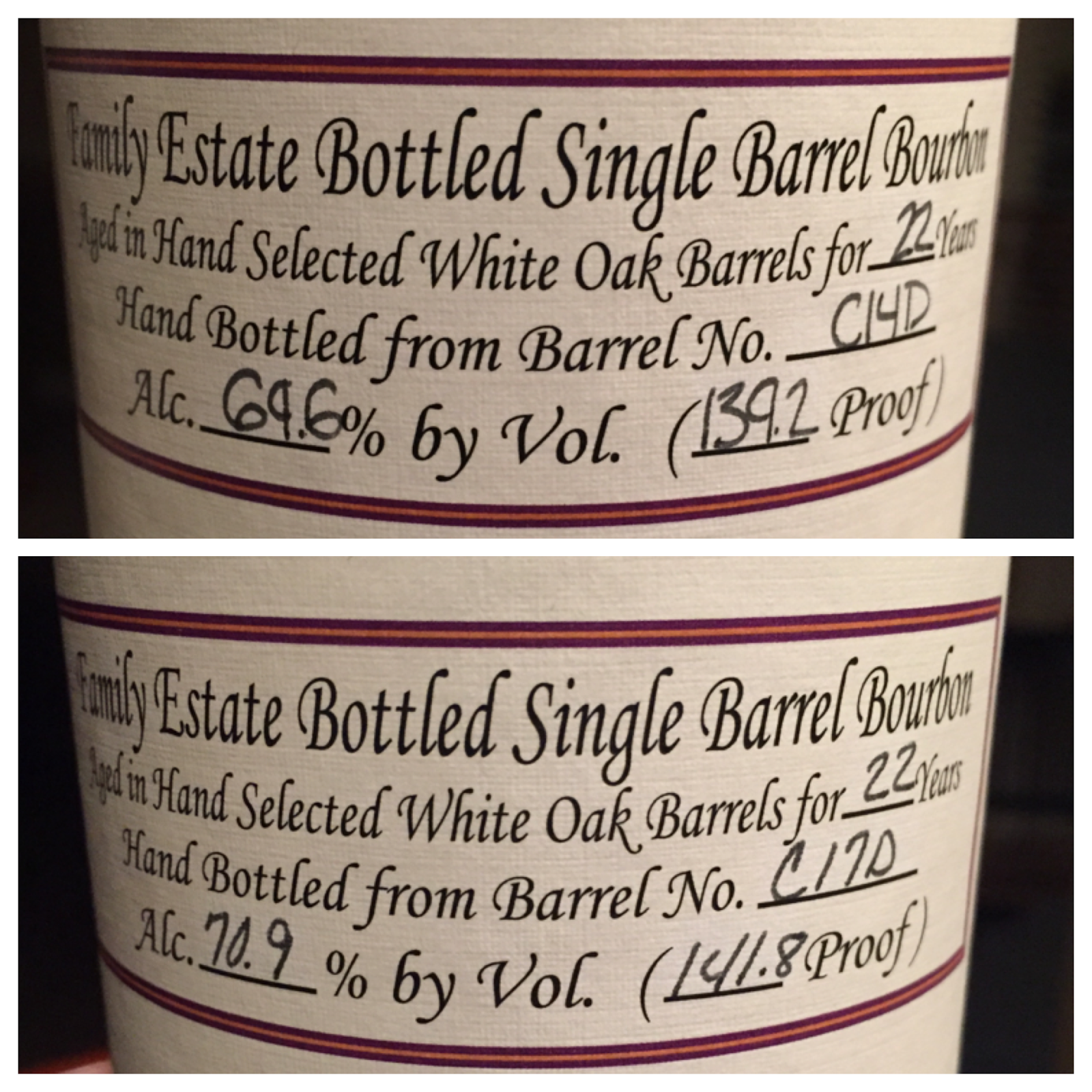
Proof: 139.2 proof
Cost: $315.00 (gift shop)
Barrel No.: C14D
Total Bottles: 108
Willett Family Estate
Single Barrel Kentucky Straight Bourbon Whiskey
Distillery: Undisclosed
Age: 22 years
Proof: 141.8 proof
Cost: $315.00 (gift shop)
Barrel No.: C17D
Total Bottles: 112
Tasting Notes
Color:
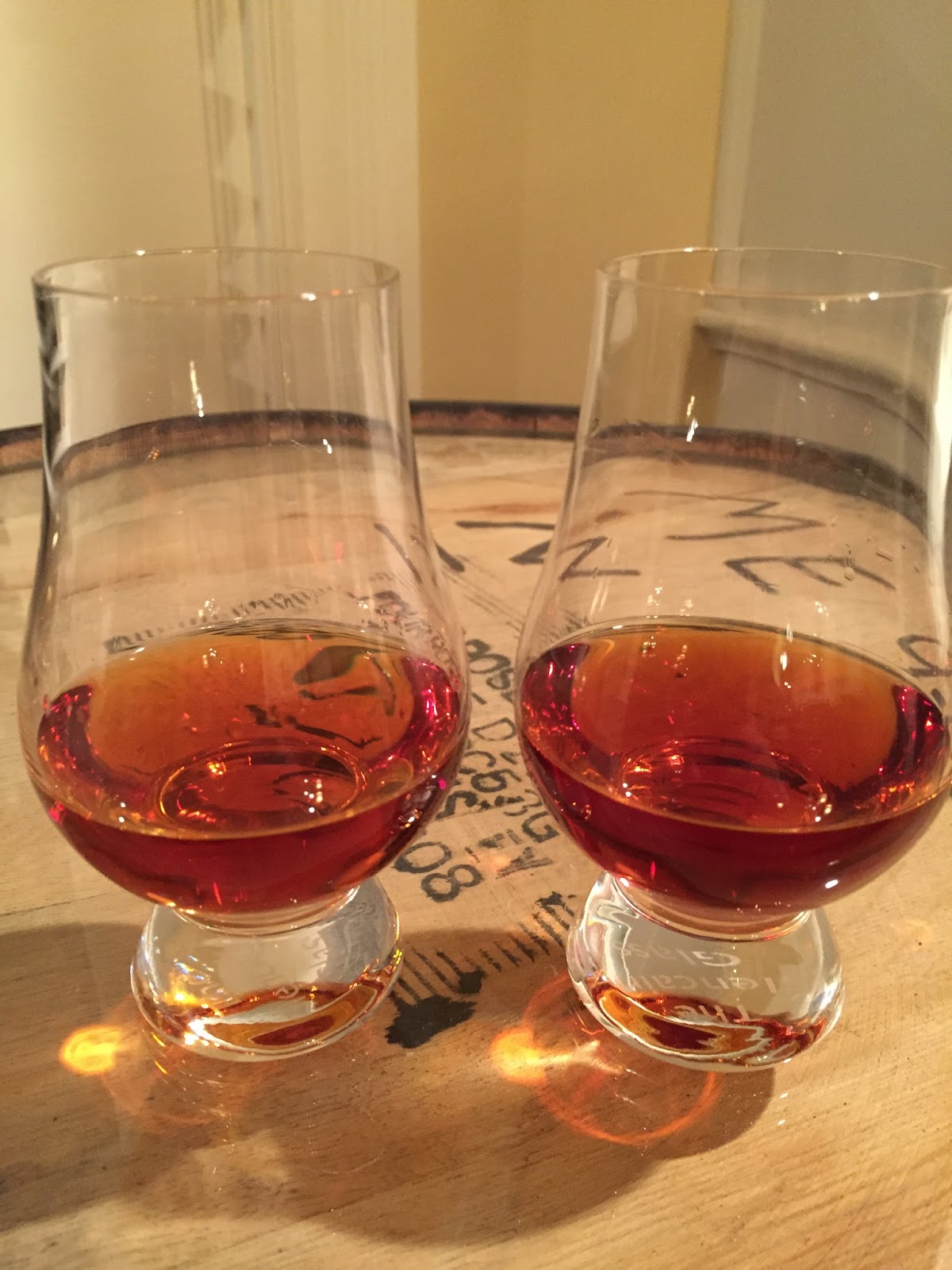 Both are age-appropriately dark, and for both that means silky brown with rich reddish hues. C17D might be slightly darker, but they’re essentially the same color.
Nose:
I could sit down and smell C14D all day long; it’s fantastic. The high ABV is not distracting in the slightest, so you can enjoy polished wood, leather, old barn, dark chocolate, and dark plums. It’s definitely oaky, but there’s also a rich sweetness (instead of candy sweetness, think about that triple-chocolate desert that is so rich you have to share it).
C17D has more heat evident in the nose; don’t inhale aggressively with this one. The nose has a sharper oakiness, so instead of polished wood and old barn, it’s more of a peppery oak. It’s also a bit sweeter, but otherwise, it’s very similar to C14D.
Taste:
In previous Bourbons, I’ve certainly tasted flavors of cocoa, dark chocolate, and milk chocolate. But with C14D, I was in for a surprise of an unmistakable specific cocoa flavor: tootsie rolls. It’s really incredible. The tootsie roll flavor, along with other rich sweetness, adds a nice balance to the otherwise dominant oaky flavors. There’s no discernable cherry (which I get in another older wheated Bourbon that shall remain nameless). Water opens it nicely to lush caramel, buttery toffee, and increases the creaminess, although leather and oak are still the backbone. Even neat, C14D is warm but not hot, never revealing that it’s 139.2 proof. Still, after trying C14D neat, you need drink it with a splash or two of water, or better yet, a single large ice cube or ball in order to experience its progression with slow melt.
C17D doesn’t have as strong of cocoa notes when drank neat, but water brings out fantastic dark chocolate and rich salted caramel. C17D also has plenty of oak, and even less dark fruit. The oak reminds me of leather and an old library (mahogany walls and leather-bound books on hardwood shelves). Additionally, whereas C14D masks its high ABV, the very slightly higher ABV of C17D slaps you in the face. Proof this high is bound to make itself known, but it’s magical when it sooths instead of hits. Air and adding a splash of water to C17D really helps tame the beast, so like C14D, take the proof down with water or ice, and be patient after a pour.
While oak characteristics should be expected in any extra-aged Bourbon, it’s rare after all these years to not have a one-dimensional “oak bomb” that causes a major drying pucker. Those old barrels usually need the life filtered out of them before they can be concealed in a large batch. So it’s unique here for Willett to have several barrels offered as non-chill filtered barrel strength single barrels; there’s absolutely no hiding here.
Finish:
C14D has a fantastic, long oaky, dry finish, with some nice remnants of the tootsie rolls and dark fruit. Surprisingly, the finish seemed to last longer with a few drops of water. C17D was long in a slightly different way, leaving a lasting impression of heat, while still delivering robust flavor (again, especially oak, but not overbearing). A little water cut the oakiness of the finish in both, and helped bring out black tea, cinnamon, caramel apples, and dark chocolate, so again, take the proof down.
Bottom Line
A valid question here is “why review bottles that most people are unlikely to ever be able to try?” As opposed to many of my reviews, which in the best case scenario might actually help people decide to try a new Bourbon, or might help people choose between two similarly-priced Bourbons, I hope that my occasional reviews of hard or impossible to find Bourbons can help narrow the hunt for some people, help others decide if they’re really tempted to spend this kind of time or money, or at least give credit where credit is due.
Additionally, tasting single barrels is fascinating to me. I’ve had private barrels that were from the same distillation run and were aged literally right next to each other for the same amount of time, that turned out pretty different. And now with Willett, some lucky people have been able to get C14D, C16D, C17D, and C18D, which have all been 22-year wheated Single Barrel Bourbons with typical similarities and differences.
Buying and reviewing these types of Bourbons reminded me of another lesson: price and hype won’t always give me a Bourbon that I subjectively believe was worth the cost. That’s C17D for me; it’s a fantastic Bourbon that I’m excited to have, and which I don’t have any regrets for purchasing, but I would not pay $315 for a second bottle, much less the $650 I’ve seen demanded on the secondary market. At north of $300, both C14D and C17D should get dinged on any “value” analysis, but these both have so much more character and depth when compared to many of the $100+ limited releases over the past few years, so it starts getting harder to argue with Willett’s pricing.
For me and my money, I expect any Bourbon over $100 to absolutely blow my socks off, and that’s what C14D did for me. I know that all 108 bottles are long gone and that I’ll never have the chance to stock up, but this experience will keep me looking for the next outstanding Bourbon. Even if I’m not quite as captivated with other single barrels along the way, I know that my perfect Bourbon is out there, so I’ll keep trying. Visit the Willett Gift Shop and who knows, maybe Drew will have just set out a few bottles of magic.
Scores on The Sipp’n Corn Scale
Willett 22-year C14D: 4.5
Willett 22-year C17D: 4.0
The Sipp’n Corn Scale:
1 – Wouldn’t even accept a free drink of it.
2 – Would gladly drink it if someone else was buying.
3 – Glad to include this in my bar.
4 – Excellent Bourbon and even worth its high price.
5 – Wow. I’ll search high and low to get another bottle of this.
 Brian Haara