Brian Haara
Bourbon. Law. Author.
Sipp’n Corn Bourbon Review – Wild Turkey Kentucky Spirit & Russell’s Reserve Private Barrels
Wild Turkey has been making a push over the past two years to enter the “super premium” (and super-expensive) segment by offering a series of limited edition bottlings, starting with Diamond Anniversary, then Master’s Keep, and most recently Russell’s Reserve 1998. Brands usually cannot make the jump straight from mid-priced offerings to super-premium limited editions, so Wild Turkey laid a nice foundation over many years with Russell’s Reserve and Kentucky Spirit.
Wild Turkey made another smart decision in the past few years to start a private barrel program for Russell’s Reserve and Kentucky Spirit, which helped increase its profile and buzz. Wild Turkey had always puzzled me a little with its market strategy of having three brands (these two plus Rare Breed) all priced within reach of each other. That seems to cannibalize itself, when perhaps instead Kentucky Spirit or Russell’s Reserve could be reserved for limited bottling runs, and of course a higher price, giving a cleaner progression between those three labels.
The plain bottle for Russell’s Reserve seems to send the message that it is intended to be not quite as “premium” as the stunning art deco Kentucky Spirit bottle, but that’s not where I’ve landed in the past between the two. Regardless, I like the standard bottle of both of these, and had high hopes for these private selection bottles.

Kentucky Spirit & Russell’s Reserve
Private Selection Review
|
Bourbon:
|
Wild Turkey Kentucky Spirit – Kentucky Straight Bourbon Whiskey (Barrel No. 44)
|
|
Distillery:
|
Wild Turkey, Lawrenceburg, Kentucky
|
|
Age:
|
8 years, 10 months
|
|
ABV:
|
50.5% (101 proof)
|
|
Cost:
|
$56.99
|
|
Bourbon:
|
Russell’s Reserve – Kentucky Straight Bourbon Whiskey (Barrel No. 57)
|
|
Distillery:
|
Wild Turkey, Lawrenceburg, Kentucky
|
|
Age:
|
9 years, 11 months
|
|
ABV:
|
55% (110 proof)
|
|
Cost:
|
$56.99
|
Tasting Notes
Color:
The Russell’s Reserve is a bit darker, as should be expected due to the lack of chill filtration, one year longer in the barrel, and less water added. Russell’s Reserve is dark amber with a tinge of reddish-brown, whereas Kentucky Spirit is more of a standard medium amber.
Nose:
Russell’s Reserve had a better nose, with more caramel and oak, and far more robust. Kentucky Spirit’s nose was overall faint, with plenty of corn, fresh grass, vanilla, and honey. The edge goes to Russell’s Reserve because of its deeper aromas, but both were enjoyable.
Taste:
Russell’s Reserve was creamy with a nice blast of caramel and flavors of oak, leather, tobacco, and baking spice. Kentucky Spirit was thin and less robust in comparison. Prominent flavors were corn, some pepper spice and cinnamon, along with a little honey, vanilla, and lemon zest, but not enough oak to write home about. Once again, between the two, the more robust Russell’s Reserve takes the edge.
Finish:
The finish of Russell’s reserve was overall dry, with good balance and great warmth. I was looking for a longer finish, but it was medium at best, and even then it had to linger to get there. Kentucky Spirit’s finish was mostly sweet and on the shorter side, but perfectly pleasant in its own right (perhaps a finish that would be preferable for someone new to Bourbon). For me, it was an easy call in favor of Russell’s Reserve.
Bottom Line
Before you buy private selection barrels, see if your store has samples available. Although I could have, I didn’t try either of these ahead of time. If I had tried them, in hindsight, I might have bought three Russell’s Reserves instead of two, and I would have passed on the private selection Kentucky Spirit, but maybe bought the standard issue instead, knowing that I couldn’t have gone wrong with Jimmy and Eddie making the picks.
The choice between Russell’s Reserve and Kentucky Spirit is easy for me; I knew that ahead of time though (hence buying two Russell’s Reserves out of the gate). Now both Russell’s Reserves are empty, and the Kentucky Spirit is still half full. Regardless, I’ve liked the standard Kentucky Spirit much better than this private barrel, and would expect future ratings to be higher.
Score on The Sipp’n Corn Scale:
Kentucky Spirit Private Selection Barrel No. 44: 2.5
Russell’s Reserve Private Selection Barrel No. 57: 3.0
The Sipp’n Corn Scale:
1 – Swill. I might dump the bottle, but will probably save it for my guests who mix with Coke.
2 – Hits the minimum criteria, but given a choice, I’d rather have something else.
3 – Solid Bourbon with only minor shortcomings. Glad to own and enjoy.
4 – Excellent Bourbon. Need to be hyper-critical to find flaws. I’m lucky to have this.
5 – Bourbon perfection. I’ll search high and low to get another bottle of this.
Sipp’n Corn Bourbon Review – Private Barrel Selections.
Private selection barrels are hot items. Retailers, serious whiskey bars, and local whiskey societies desperately want them. Unfortunately, the demand has resulted in some distilleries being overbooked, some are low on available stock, some give a take-it-or-leave-it option of barrels that are nothing special, and some have had to suspend their barrel selection program.
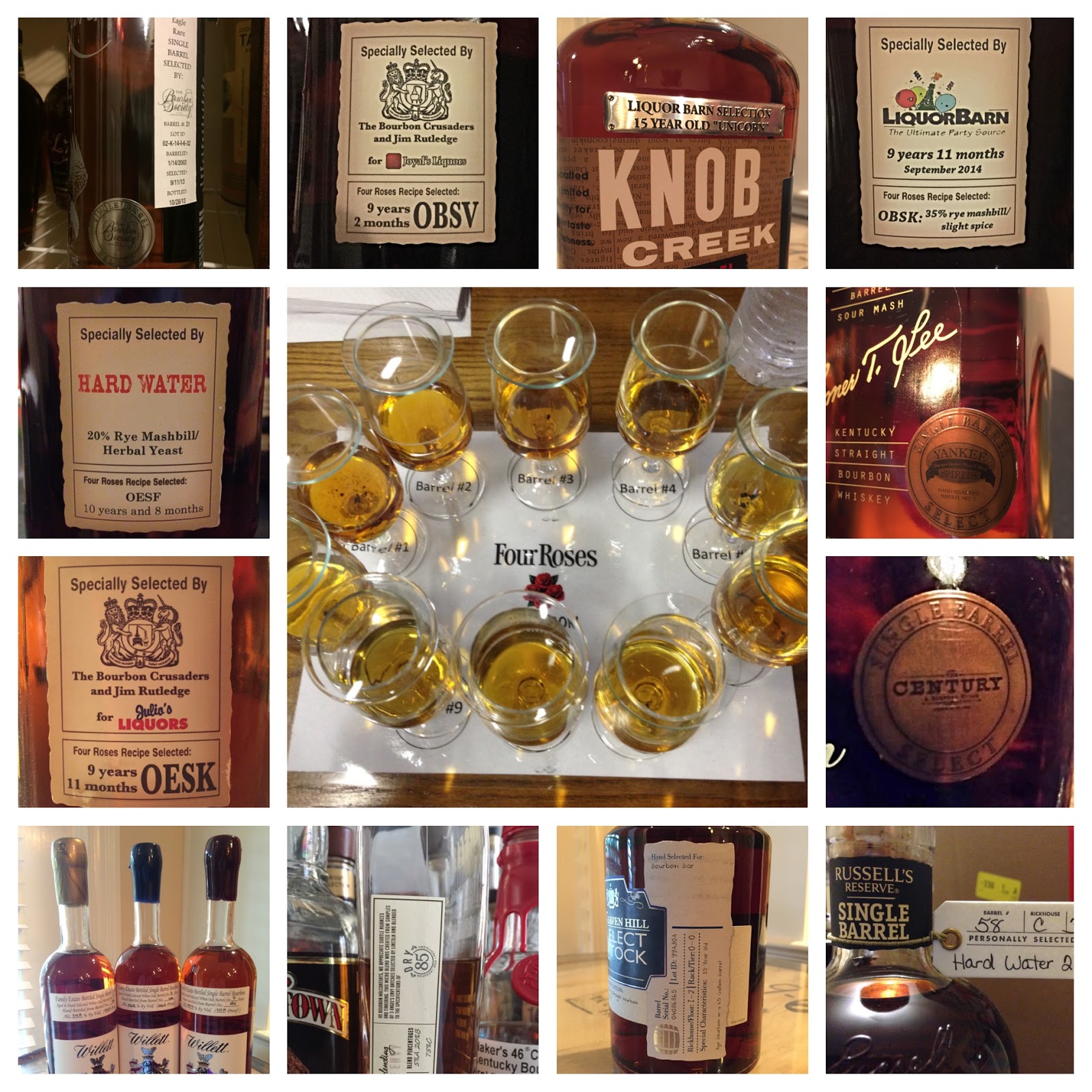
For the most part, the barrels offered for selection are going to be superior barrels. This does not mean, however, that privately-selected Bourbon is going to taste better than the standard issue of that brand. Sometimes private barrels are not better, they’re just different. Oftentimes, they can essentially taste the same as the standard, less expensive bottles, and occasionally, they’re disappointing because they’re not as good as the standard offering.
A private selection can be disappointing due to the lack of experience of the selection team, or because their personal preferences are a little off, and you can end up with a Bourbon that is too bitter, bland, or unbalanced. Additionally, very few distilleries permit bottling of private selections at barrel strength, so when proof is taken down, the flavors in the private selection change and it might not taste anything like it did straight from the barrel, so the selection team has to toy with adding the right amount of water. The key is that consumers need to look for private barrels from palates they trust.
In some circumstances the stars line up, a knowledgeable selection team has access to enough barrels, and fate includes a true honey barrel in the mix. A quick Twitter survey (thanks for all of the tweets!) came up with a great list of retailers and bars who have selected your favorite private barrels. Four Roses, Smooth Ambler, and Willett (whose program is now on a hiatus) absolutely dominated your tweets, with an occasional Old Weller Antique, Knob Creek, Woodford Double Oaked, and a few others rounding out the list.
Some of these private barrels are known by the people who selected them, like Doug Philips – whose Rye selection is spoken of in legendary terms – and newer selection groups, particularly the Bourbon Crusaders. On rare occasions, private barrels are known by their own name, like “Wheated Warrior” and “Aged Truth.”
Certain retail stores have gained a reputation through consistently great picks across all distilleries, like Liquor Barn, or an award-winning selection, like Crown Liquors with its 2014 Four Roses OBSK pick. Bars and restaurants with private barrel programs can become renowned for their picks too, like many Louisville establishments (as should be expected), but non-Kentucky players, too. Dry 85 in Annapolis, for example, has an outstanding private barrel program, but it goes a step further and has also worked with Angel’s Envy on developing unique private blends.
Consumers are starting to look not just for any private barrels, but for barrels with particular characteristics, like OBSK and OESK barrels aged on the East side of Warehouse M at Four Roses (“ME” barrels), and odd 65 gallon barrels stored upright at Heaven Hill for 15 years (which became part of mysterious private barrel of Heaven Hill Select Stock). Keep an eye and an ear tuned for these kinds of tips because this sort of information can help give the consumer confidence that the extra money will be worth it.
I haven’t been lucky enough to try any of the Doug Philips selections, Wheated Warrior, or Aged Truth, but I’ve been amazed by the quality of private barrels that are more readily available. Some of my favorite private barrels over the past several years (not necessarily ranked in order) have included:
· 2014 Four Roses OBSK, 9 year, 11 month, selected by Liquor Barn;
· 2015 Four Roses OESK, 9 year, 7 month, selected by Bourbon Crusaders for Joyal’s;
· 2014 Heaven Hill Select Stock, 15 year from 65-gallon barrels, selected by Bourbon Bar (despite being on the menu as a $40 pour, these bottles were returned under a shroud of mystery, and have since trickled out into retail);
· 2015 Knob Creek 120 proof – aged 15 years instead of the standard 9 years – selected by Liquor Barn (I’m in the middle of this one now; it’s the best Beam product I’ve had other than Booker’s 25thAnniversary).
· 2015 (first batch) Dry 85 Angel’s Envy Private Blend, comprised of three six-year old Bourbons each finished in port barrels.
What has been your favorite private barrel selection? Which retailers and restaurants or whiskey bars routinely stock the best private barrels? Your Twitter responses gave the following stops for an epic road trip across the U.S.:
Kentucky / Cincinnati
Liquor Barn (Louisville, Lexington, Bowling Green, Danville, KY)
Haymarket Whiskey Bar (Louisville, KY)
Down One Bourbon Bar (Louisville, KY)
Bourbon’s Bistro (Louisville, KY)
Westport Whiskey & Wine (Louisville, KY)
Cork ‘N Bottle (Crescent Springs, KY)
The Party Source (Bellevue, KY)
D.E.P.’s Fine Wine & Spirits (Cincinnati, OH and northern KY)
The Livery (Lexington, KY)
East
Julio’s Liquors (Wesborough, MA)
Joyal’s Liquors (West Warick, RI)
Dry 85 (Annapolis, MD)
Southeast
McScrooge’s (Knoxville, TN)
Bottles Beverage Superstore (Mt. Pleasant, SC)
Decatur Package (Decatur, GA)
Lincoln Road Package Store (Hattiesburg, MS)
Nasa Liquor (Houston, TX)
Midwest / Northern Midwest / West
Big Red Liquors (Indianapolis, Terre Haute, Bloomington, IN)
Crown Liquors (Indianapolis, IN)
Liquor Locker (Evansville, IN)
Tippins Market (Ann Arbor, MI)
Antioch Fine Wine (Antioch, IL)
Binny’s Beverage Depot (all over Chicago, IL)
West Lakeview Liquor (Chicago, IL)
Warehouse Liquors (Chicago, IL)
South Lyndale Liquors (Minneapolis, MN)
Ken & Norm’s Liquors (Minneapolis, MN)
Davidsons Liquors (Highlands Ranch, CO)
West Coast
Hard Water (San Francisco, CA)
Elixir Saloon (San Francisco, CA)
Which stores or bars are missing from this Twitter list? Please add your favorites in the comments below. Cheers!
Sipp’n Corn Review – Glenfiddich 14 Year Single Malt Scotch Whisky Bourbon Barrel Reserve
New charred oak barrels in Scotland? Maybe this is a sign that Bourbon is gaining even more worldwide traction. Maybe this is partial recognition that charred oak barrels hold the secret to whiskey – and even whisky. Or maybe this is just experimentation by our Scottish forbearers and friends. Whatever it is, I like it.
Talk of Bourbon barrels in Scotland almost always refers to used Bourbon barrels – where in their second life they mature Scotch. I’ve wondered how much flavor different barrels can impart, depending on things like how long they held Bourbon, their char level, and the type of Bourbon they aged (certainly a high-rye Four Roses barrel will result in a different Scotch than a Heaven Hill barrel that aged a wheated Bourbon, right?). And how much flavor is left in former Bourbon barrels, as an overall component of Scotch, especially when sometimes the barrels are used up to three times for Scotch?
 Now, after aging whisky for 14 years in former Bourbon barrels, Glenfiddich has finished that whisky in new charred American Oak barrels from Louisville’s Kelvin Cooperage, to “deliver a bourbon heart with the soul of a single malt.” Related to my interest in the influence of barrels, I inquired into the specifics of the finishing here. Brian Kinsman, Glenfiddich’s Malt Master, provided the answers.
I learned from Brian that Glenfiddich finished this whisky for four months, using a 3.5 char level in the Kelvin Cooperage barrels. The finishing period may vary, but typically will be three to four months. Entry ABV at the time of finishing was about 60%, and this percentage does not change materially during finishing.
Glenfiddich used new charred oak barrels for finishing in order to add intensity and sweetness, along with a color more associated with Bourbon. Climatic conditions in Scotland don’t encourage the same degree of interplay between spirit and wood as in Kentucky, so I expected the contribution of four months to be subtle. Either way, I envy the research team that got to play with varying amounts of time for finishing before reaching the desired profile.
Tasting Notes
Disclaimer: Glenfiddich kindly sent me a sample
for this review, without any strings attached.
Thank you.
|
Whisky:
|
Glenfiddich 14 Year Single Malt Scotch Whisky “Bourbon Barrel Reserve”
|
|
Age:
|
14 years in former Bourbon casks, finished for four months in new charred American Oak
|
|
ABV:
|
43% ABV (86 proof)
|
|
Cost:
|
$49.99 MSRP
|
Color:
Bright amber and darker than single malts of this age, presumably from the time spent in new charred barrels. Straight Bourbon fans will be curious about the color without additives, but this is Scotch, so we’d better get over it; Glenfiddich is able to add a small amount of caramel coloring to ensure consistency between batches.
Nose:
Unmistakably Scotch, but reminiscent of Bourbon at the same time. There’s some oak, but overall it’s light and fresh, with vanilla, honey, ripe pear and honey crisp apple, and a bit of fresh citrus. The nose did not pick up much caramel aroma from the new barrels, which I thought it might, or perhaps I’m just used to heavier caramel aromas from Bourbon.
Taste:
First and foremost, this is single malt Scotch; there’s no mistaking 100% malted barley for at least 51% corn plus rye, giving Bourbon sweetness and spiciness. Glenfiddich 14 Year is silky and rich, with sweet flavors of vanilla and honey, along with light, ripe fruit and orange zest. The finishing barrels add a lovely subtle oakiness and flavor of raw almonds for a great slow-sipping whisky.
Finish:
The finish is medium in length with lingering warmth, and some more oak, although predominantly sweet.
Bottom Line
Given the origin of American distilling and our shared history, it makes sense that Scotch devotees will want to try Bourbon, and that Bourbon enthusiasts will want to try Scotch. Those who have not yet found the balance between whiskey and whisky might also have preconceived notions about the other, like Bourbon is always candy-sweet or all Scotch tastes like that heavily-peated variety that took you by surprise. Glenfiddich 14 Year bridges that gap remarkably well.
One reason that it bridges the gap so well is that Glenfiddich has not tried to create a whisky that tastes like Bourbon, instead finding a way to remain distinctively Scotch while capturing some of the influences of Bourbon. Glenfiddich 14 Year won’t be confused with Bourbon – it’s missing caramel and a robust punch of spice – so I’m keeping my Bourbon, but I’ll be looking for Glenfiddich 14 and it will get me to try more Scotch, which perhaps was the goal of this release all along.
While Glenfiddich 14 Year is a new permanent member of the Glenfiddich line, it is only being released in the U.S., with plans to keep it here exclusively. Glenfiddich 14 could certainly enjoy a broader audience, so for those who can get it, I recommend giving it a try, especially the Bourbon enthusiast who is curious about Scotch.
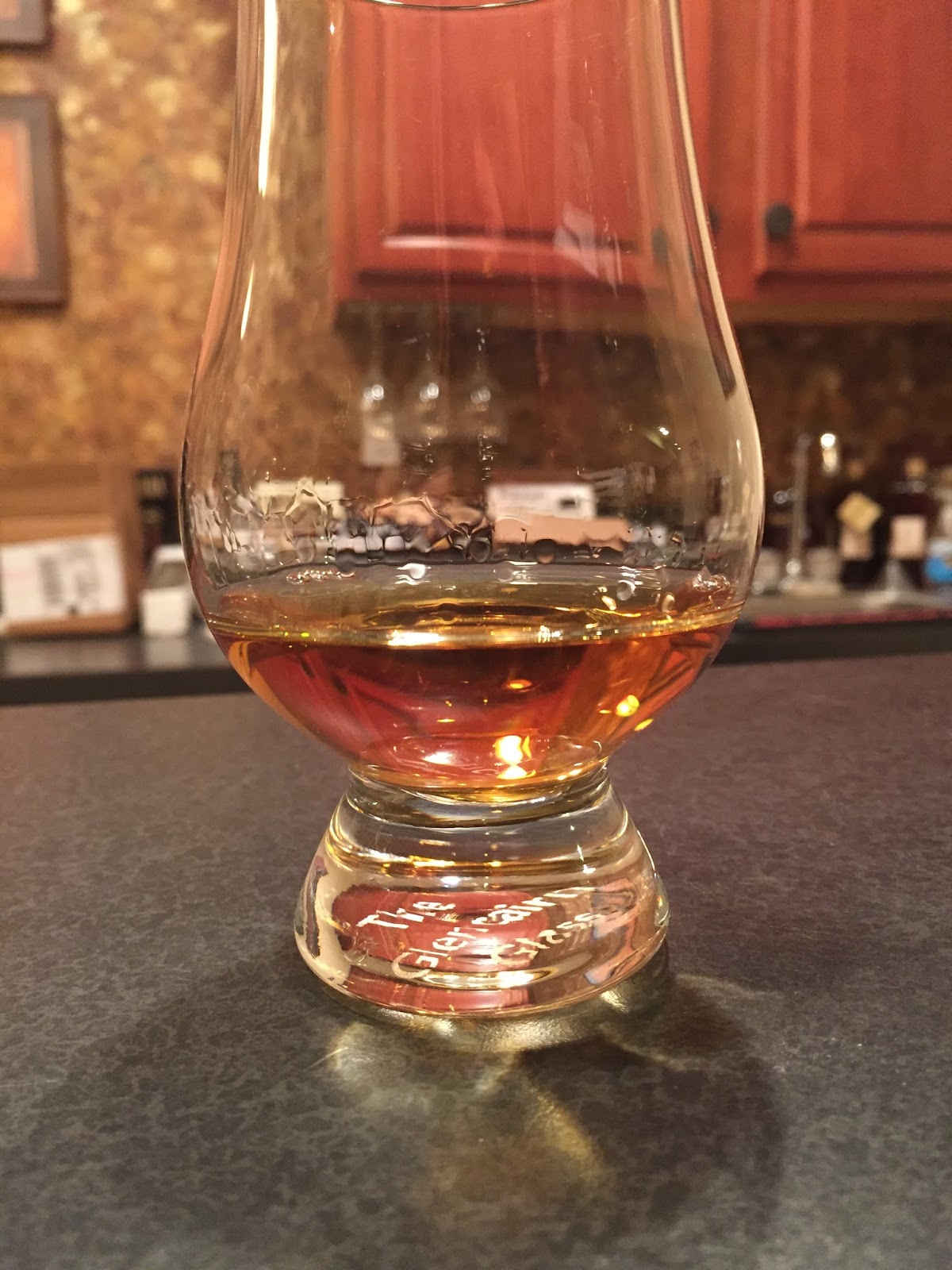
Glenfiddich 14 certainly has the color of Bourbon…
Sipp’n Corn Opinion: Sazerac Tries to Erase History by Suing the Owner of the Historic Old Taylor Distillery.
When George T. Stagg and Col. Edmund H. Taylor, Jr. parted ways effective January 1, 1887, Col. Taylor left behind the O.F.C. and Carlisle distilleries. After many changes in ownership and names, that property is now Buffalo Trace, owned by Sazerac. Col. Taylor, in the meantime, built the monument of a distillery known ever since as “The Old Taylor Distillery” in Millville, Kentucky. The Old Taylor Distillery closed in 1972, but it kept its name (including the sign), and it certainly kept its spirit and legendary status. While the brand name “Old Taylor” was bought and sold, eventually winding up with Sazerac, and the whiskey was made elsewhere, the property always remained The Old Taylor Distillery.
After decades of falling into serious disrepair, as noted in an earlier post and countless other articles, Peristyle LLC and Master Distiller Marianne Barnes came to its rescue and have been in the process of returning The Old Taylor Distillery to its former glory. The new entrepreneurs were very careful to not call their business “The Old Taylor Distillery,” likely because Sazerac was claiming rights to the Taylor brand name. A geographic location, however, does not follow a brand name that is bought and sold.
This week, months of negotiations and proceedings before the U.S. Patent & Trademark Office Trademark Trial and Appeal Board came crashing down with Sazerac’s filing of a federal lawsuit against Peristyle. In its new lawsuit, Sazerac claims that it owns the trademarks “Old Taylor” and “Col. E. H. Taylor,” and that Peristyle is offering “event-hosting services” using Sazerac’s brands “and confusingly similar variations thereof.”
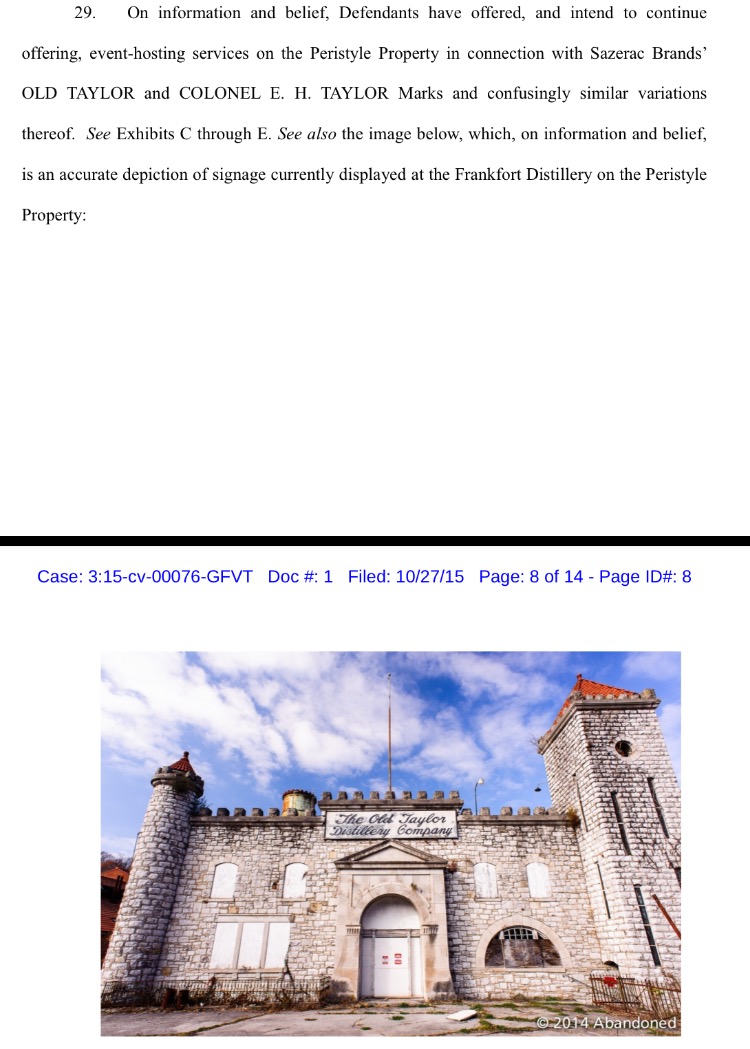
But all Sazerac could point to in its Compliant is Peristyle’s use of the true geographic name of the property – a name Sazerac could not bring itself to mention. In fact, when referring in the Complaint to the historic site known as “The Old Taylor Distillery,” Sazerac ignored that name, and instead called it the “Frankfort Distillery.” The only time Sazerac used the real name of the property in its Complaint was when it included a photograph showing the old sign still standing above the front door:
Sazerac should know that “The Old Taylor Distillery” is the name of the property, and that using a historically accurate geographic name is allowed. In the 1880’s, a former ward and protégé of Col. Taylor, James E. Pepper, tried to prevent Labrot & Graham from using “Old Oscar Pepper Distillery” as the name of the distillery that is now Woodford Reserve. The case of Pepper v. Labrot, 8 F. 29 (C.C.D. Ky. 1881) describes how the distillery built by Oscar Pepper in 1838 became known as the “Old Oscar Pepper Distillery.” Oscar Pepper died in June 1865, and the distillery was leased to Gaines, Berry & Co. (a partnership that included Col. Taylor), and the distillery continued to be known as the Old Oscar Pepper Distillery.
James gained control of the distillery, but lost it in bankruptcy, and the property was acquired by Labrot & Graham, which continued to call it the “Old Oscar Pepper Distillery.” James sued Labrot & Graham because he believed that only he should be able to use the “Pepper” name. Labrot & Graham won the case, however, because they owned what was actually called the “Old Oscar Pepper Distillery.” The court ruled that reference to “Old Oscar Pepper’s Distillery” meant the place of production, and was not a trademark.
Here, Sazerac seems to be attempting exactly what James Pepper failed to do – it’s trying to lay claim to all of Col. Taylor’s history and anything named after him. While Col. Taylor certainly made a lasting impression with the O.F.C., he failed there in 1877. It was after he moved to The Old Taylor Distillery that he became truly legendary through the passage of the Bottled-In-Bond Act of 1897 and through the brand he built at his castle. That history cannot be suppressed by Sazerac.
My posts have recounted over 100 years of litigation between Kentucky Bourbon distillers, but there has also been a tremendous history of cooperation. Bringing life back to an important, historic distillery, such as The Old Taylor Distillery, is one of those occasions when producers should have banded together and cheered on Peristyle. Sazerac took the bully approach instead, and should be ashamed for trying to erase history.
Sipp’n Corn Bourbon Review – Four Roses 2015 Limited Edition Small Batch.
I was seated next to Jim Rutledge at this past Bourbon Affair while we blended our own small batch from half-pints of an 11-year OBSV, an 8-year OESO, a 6-year OESK, and a 15-year OBSO. We learned how different recipes can complement each other, can do surprising things to each other, or can be difficult to fine-tune. My first few blends were mostly unremarkable. Then, when I landed on a blend that I thought was fantastic, I got a little cocky and traded with Jim, who had put together a blend that was practically the opposite of my components. As you might imagine, Jim’s batch tasted like it could have been in the running for a Limited Edition bottling and mine had a long way to go in comparison.
That’s how the Four Roses Limited Edition process works. They start with a test blend, tinker with it, refine it, experiment with it, and keep trying it until they reach a consensus. The 2014 Limited Edition Small Batch took upwards of 70-100 test blends (depending on who you ask) before it was finally selected. This year, however, the 2015 Limited Edition Small Batch was set after only 16 test blends. Jim and his team knew that that landed on gold.

|
Whiskey:
|
Four Roses 2015 Limited Edition Small Batch Kentucky Straight Bourbon Whiskey
|
|
Total Bottles:
|
12,672
|
|
Age:
|
16-year OBSK, a 15-year OESK, a 14-year OESK, and an 11-year OBSV
|
|
ABV:
|
54.3% (108.6 proof)
|
|
Cost:
|
$127.00 (gift shop price) or $109.00 retail
|
Tasting Notes
Color:
Deep amber with that reddish hue that comes with nice age (before turning the corner to brown).
Nose:
Despite being barrel proof, there’s no singe here. Feel free to soak up the aromas, and enjoy the “K” yeast shining through as I had hoped. It has sweet scents of caramel, dark chocolate, brown sugar, honey, and dark fruit, balanced with a great punch of spice from the high-rye mash bills, and subtle cinnamon and clove. Not as much oak as might be expected, but a great deep oak added to the balance. I love this nose.
Taste:
Creamy – please try the “Kentucky Chew” with this one, and let it coat your mouth. I don’t usually find the flavor of cherries in Four Roses, but here it is, with just a bit of orange citrus. The spice is just right, and then transitions to rich sweetness like dark chocolate I detected in the nose, along with honey, cinnamon apples, and more caramel, and a perfect balance of oak and leather. It’s such a treat when a Bourbon can be multi-dimensional, and this Limited Edition nails it. Add a drop or two of water if that’s your thing (making it a little sweeter in this case), but this Limited Edition is best enjoyed neat and slow.
Finish:
The finish doesn’t quite keep up with the expectations created by the nose and the taste, but I’m not complaining. It’s moderate in length, lingering, and warming, ultimately being dry with oak and leather, with just enough vanilla to provide balance, and mint to provide some flare.
Bottom Line:
After two years of winning “American Whiskey of the Year,” with the 2012 and 2013 Limited Edition Small Batch releases, 2014 could not “three-peat.” This 2015 release should have Four Roses back in the running, and thus far based on what I’ve been able to try this year, it’s firmly in contention.
I knew going into this that I’m a sucker for the “K” yeast. Private barrels of OBSK and OESK have been some of my all-time favorite bottles, so the heavy use of those recipes had me excited from the second that I first learned about this year’s batch. Beginning with a fantastic nose (as in hands-down best nose of the year), this Limited Edition does not disappoint. The balance of flavors is phenomenal too. The high bar set by Four Roses probably contributed to my wanting more out of the finish – expectations are stratospheric – and with a slightly more robust and longer finish, it would have already been crowned American Whiskey of the Year. This just means that I’ll have to try it blind alongside other contenders.
While there’s some sentimental value attached to the 2015 Limited Edition because it’s the last with Jim at the helm, this Bourbon blows past sentiment and will be remembered on its own merits as one of the best Bourbons of 2015.
Scores on The Sipp’n Corn Scale: 4.5
The Sipp’n Corn Scale:
1 – Wouldn’t even accept a free drink of it.
2 – Would gladly drink it if someone else was buying.
3 – Glad to include this in my bar.
4 – Excellent Bourbon and even worth its high price.
5 – Wow. I’ll search high and low to get another bottle of this.

