Brian Haara
Bourbon. Law. Author.
Sipp’n Corn Tasting Notes – Fortuna Kentucky Straight Bourbon Whiskey.
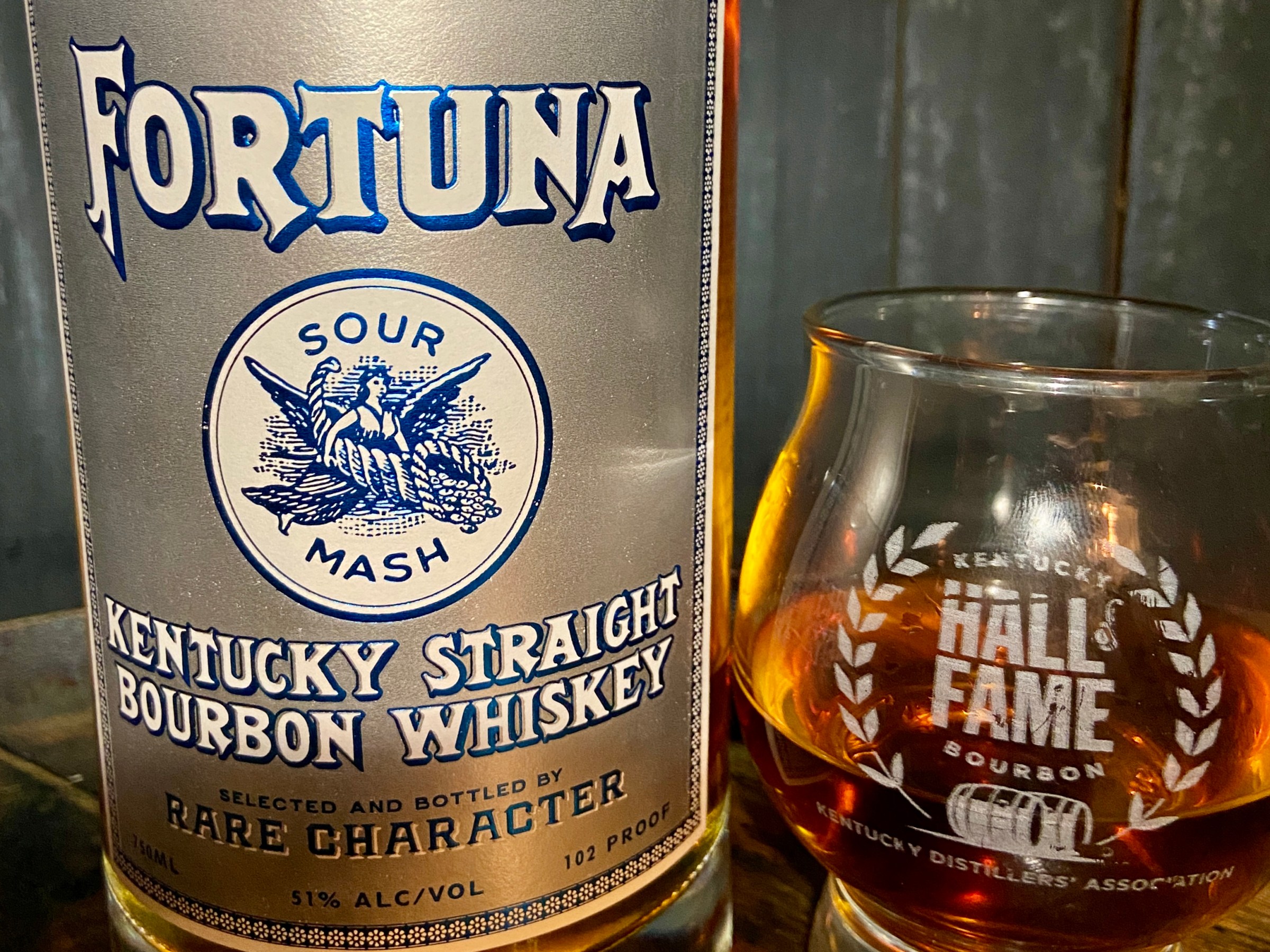
There’s a new resurgence of Old Fortuna, the historic Kentucky Bourbon brand dating back to the late 1800’s. Its first release is a small batch of just six barrels aged at least six years and bottled at 102 proof.
Fortuna was a popular brand from the late 1800’s until the midcentury downturn for bourbon, when the distillery closed. It was started by a name well-known in Louisville—the Hollenbach family. Phillip and Louis Hollenbach founded Hollenbach Bros. in 1877 and by 1882, they were blending whiskey with the Stitzels at the Glencoe Distillery for the Old Fortuna and Glencoe brands. Business was good enough that they bought the Glencoe Distillery in 1902. Prohibition shut them down, like so many other distilleries, but at least there was still medicinal whiskey. After Repeal, they built a new Glencoe Distillery and sustained Fortuna’s popularity.
Now the brand has been revived by Rare Character with a throwback label and the all-important “Kentucky” designation as its state of distillation.
Fortuna Tasting Notes
Whiskey: Fortuna Kentucky Straight Bourbon Whiskey
ABV: 51% (102 proof)
Cost: $84.99
Nose:
The caramel hits first with oak… It has some familiarities but I’m not taking a guess just yet. I get graham cracker, brown sugar, vanilla, and a more oak and rye than I had expected.
Taste:
The palate is incredibly balanced with the flavors just as predicted by the aromas. The same sweet flavors of caramel, brown sugar, and vanilla complement oak, black pepper, rye, and tobacco as a late arrival. The sweetness shifts to a bit of crème brûlée with cherries and citrus zest. It has flavor for days.
Finish:
The finish is long and classic Kentucky bourbon, not overly sweet, with a gentle warming swell.
Bottom Line
When historic brands are revived out of the blue, I tend to be suspicious. I have sales resistance. But then I tasted Fortuna…
The six-year age statement has to be coming in under the rule about having to use the youngest whiskey in the bottle because this drinks much older than a six-year bourbon. True to form, Rare Character knocks this one out of the park. I’m now curious whether anyone is better than Rare Character on getting access to prime barrels or being able to pick diamonds in the rough.
Disclaimer: The brand managers kindly
sent me a sample for this review,
without any strings attached.
Thank you.
Sipp’n Corn Tasting Notes: Elijah Craig 12-Year Barrel Proof 2022 (A122, B522, and C922).

After some wide variety in proof, the three 2022 batches of Elijah Craig Barrel Proof have established a trend of just over 60% ABV—A122 is 60.4%; B522 is 60.5%, and C922 is the highest at 62.4%. Actually, the last batch of 2021 (C921) started the trend with 60.1% ABV. I for one am happy to see these hover in a proof range of the low 120’s, and I’d like to see another one dip below 120.
But similarity in ABV has not meant similarity in flavors. C921 was sweeter and less oaky (I called it “beautifully sweet with rich dessert qualities”) while A122 was more classic Elijah Craig (I said that it had a “great balance of brown sugar, caramel apple pie, and a bit of cocoa, along with a building push of rye spice, black pepper, and oak”). Given the similarities for 2022 proofs, I thought that I’d revisit A122 and compare to B522 and C922.
Elijah Craig Barrel Proof A122 Tasting Notes
Bourbon: Elijah Craig Barrel Proof Kentucky Straight Bourbon Whiskey
Distillery: Heaven Hill
Age: 12 years
ABV: 60.4% (120.8 proof)
SRP: $59.99
Nose:
The aromas are classic Elijah Craig, known for caramel and oak, nuttiness, with vanilla and baking spice.
Taste:
Great balance of brown sugar, caramel apple pie, and a bit of cocoa, along with a building push rye spice, black pepper, and oak. It’s not a robust blast, but instead builds with complexity. This is all right down the middle of being on-profile for Elijah Craig, which is another way to say that it’s fantastic.
Finish:
Long, warm, consistent with the flavors and with the emergence of cinnamon to complement the caramel and oak.
Elijah Craig Barrel Proof B522 Tasting Notes
Bourbon: Elijah Craig Barrel Proof Kentucky Straight Bourbon Whiskey
Distillery: Heaven Hill
Age: 12 years
ABV: 60.5% (121 proof)
SRP: $59.99
Nose:
Woody aromas make me think of the hiking and camping season. There’s also vanilla and cola sweetness, but it’s mostly the woodiness, black pepper, and baking spice.
Taste:
Baking spice dominates the palate that overall is extremely consistent with the aroma. This is pure grandma’s kitchen with vanilla, allspice, clove, and cinnamon, but more like the buttered cinnamon and sugar toast. The spice is intriguing and warming.
Finish:
A long, warming finish that comes back full circle to the woodiness. Maybe just already miss fire pits and camping, but this is exactly what B522 has me thinking about.
Elijah Craig Barrel Proof C922 Tasting Notes
Bourbon: Elijah Craig Barrel Proof Kentucky Straight Bourbon Whiskey
Distillery: Heaven Hill
Age: 12 years
ABV: 62.4% (124.8 proof)
SRP: $69.99
Nose:
Like the first batch of 2022, the aromas of C922 are classic Elijah Craig with the same oakiness, nuttiness, baking spice, caramel, and vanilla. The proof is a bit more assertive than A122, however.
Taste:
The palate is also similar to A122, particularly with the creamy sweetness and brown sugar, but pretty quickly the spicier side asserts itself as a more robust bourbon. The black pepper, rye spice, and baking spice take charge with great oak influence. C922 also drinks the hottest of the three.
Finish:
Oaky, leather, drying, and long.
Bottom Line
The 2022 batches of Elijah Craig 12-Year Barrel Proof have many familial similarities and no outliers, as in some past years. They’re all more in line with the classic Elijah Craig profile and that makes it a little more difficult to rank them against each other, but overall A122 is my pick. Whichever one of these you find, as always they’re a strong buy.
Disclaimer: The brand managers kindly
sent me samples for this review,
without any strings attached.
Thank you.
Sipp’n Corn Bourbon Law Update – Bulleit forces a redesign for Redemption.

Ever since Old Crow and Old Taylor aggressively protected their trademarks in the 1800’s, setting the stage for current-day trademark law, bourbon brands have kept trademark attorneys busy.
Diageo’s Bulleit brand and W.J. Deutsch & Sons’ Redemption brand have been locked in litigation for years, but as of last week, the federal district court in the Southern District of New York entered a permanent injunction against Redemption. In sum, the court ordered Redemption to change its bottle and trade dress immediately.
In 2017, Bulleit sued Redemption, claiming that Redemption’s 2016 packaging redesign was “strikingly similar to that of Diageo’s Bulleit whiskey and copies the same vintage style and appearance,” and alleging that this infringed on Bulleit’s trademark and trade dress rights. Redemption responded with bluster, stating that Bulleit’s complaint “is devoid of any merit whatsoever” and asserted its own claims against Bulleit, even alleging that Bulleit had obtained its trademark fraudulently by making knowingly false statements to the Trademark Office.
Earlier this year, the parties went to trial in New York, with Redemption losing its counterclaims against Bulleit, but without Bulleit being awarded any damages. While Bulleit was not able to convince the jury on the issue of damages, the jury concluded that Bulleit’s trade dress is valid and protectable and that its packaging is famous, which paved the way for Bulleit to ask the court to enter an injunction.
That’s just what Bulleit did after the trial, and the court agreed that an injunction against Redemption was warranted. On September 7, 2022, the court recounted Bulleit’s use of its iconic bottle for 21 years, that it was nationally famous, and that Bulleit spent $56 million advertising in the five years before Redemption’s bottle redesign in 2016 (a year in which the court noted that Bulleit had $150 million in sales). It probably did not help that Redemption’s witnesses admitted that “consumers already know and love” Bulleit.
The jury’s conclusion that Bulleit’s trade dress was diluted by the Redemption packaging created a presumption that Bulleit was irreparably harmed, but Redemption still argued that Bulleit failed to prove a loss of any goodwill or erosion of its trade dress. The court disagreed, finding instead that Bulleit had provided “ample evidence show[ing] a loss of goodwill and the whittling away of the distinctiveness of Bulleit packaging to the detriment of its reputation and its ability to signify to the public that it is a unique product… .” When Redemption introduced its new packaging, Bulleit’s growth declined from the high 20’s, to 10 percent, and then single digits, while Redemption earned over $21 million in profits.
So, what does this mean for Redemption? First, although it might appeal, Redemption has been ordered to stop using its current packaging that looks like Bulleit’s. Whatever Redemption bottles had been sold by the brand as of September 7 can be sold to consumers, but there can be no new sales to distributors. Second, Redemption was ordered to redesign its packaging to “convey a substantially different commercial impression.”
While Bulleit’s victory was not nearly as convincing as Brown-Forman’s legendary triumph over Barton in the Woodford v. Ridgewood case, it continues a long line of authority that should keep new brands cautious and should act as a warning to marketers who push for brand redesign to capture the look and feel of popular brands. Originality is the safest way to avoid expensive lawsuits.
Sipp’n Corn Tasting Notes – Ben Holladay Bottled in Bond Missouri Straight Bourbon Whiskey.

There’s a new bourbon in town with incredible history and the wherewithal to release under the strict rules to be called Bottled in Bond. But it’s not from Kentucky. Or Indiana. Or Tennessee for that matter.
In July 2019, Missouri passed a state law for labeling whiskey as “Missouri Bourbon.” Not only must it comply with the federal standards of identity, it must also be mashed, fermented, distilled, aged, and bottled in Missouri, and the barrels must be manufactured in the state. Beginning with distillate produced on January 1, 2020, “Missouri Bourbon” must also be made with corn grown exclusively in Missouri.
Enter Ben Holladay. With localized climate and geology similar to Kentucky, and better access to prized oak for barrels, it’s a wonder that this area of Missouri didn’t develop as more competitive to Kentucky in whiskey production over the course of history. Ben Holladay has that history though, dating back to 1856, and it’s picking up making bourbon the right way and labeling it with transparency. The label shows that this bottle is comprised of 21% from the 1st floor and 79% from the 5th floor of their Warehouse C, along with distillation season and precise bottling date. The Missouri law and this labeling transparency can give Kentucky legislators and distillers some sound ideas.
Ben Holladay Tasting Notes
| Whiskey: | Ben Holladay Missouri Straight Bourbon Whiskey, Bottled in Bond. |
| Age: | 6 years |
| ABV: | 50% ABV (100 proof) |
| Cost: | $60.00 |
Appearance:
Standard amber.
Nose:
Grassy, dry wood, grain, and baking spice dominate, but I’m not really getting any of the sweet aromas that I expect. It’s mostly one-dimensional. I get a little bit of leather with deep inhalation, but we really shouldn’t be working this hard for aromas.
Taste:
The aromas had me ready to be underwhelmed, but I was misguided. It’s creamy on the palate with a base of leather and dry oak, with intriguing ginger and licorice flavors. It’s still missing caramel sweetness so it lacks some traditional balance, but the creaminess is so noteworthy that it deserves this second mention. This is best enjoyed neat.
Finish:
No real intensity and seemingly crisp before it revives itself with a lingering cola flavor, slight tobacco, and a faint slow burn.
Bottom Line
They’re onto something in Missouri. It’s not robust and instead is an easy sipper, but I’m most intrigued by the incredible creaminess. The transparency on the label is unparalleled, which earns extra points in my book. So to sum it up, since Ben Holladay is only available in select markets in Missouri and Kansas, that really means that if you’re traveling through, you have to map out liquor stores on your route.
Disclaimer: The brand managers kindly
sent me a sample for this review,
without any strings attached.
Thank you.
Sipp’n Corn Review – Beanie Babies or Bourbon?

In Bourbon Whiskey: Useful Alternative Investment or just the next Beanie Baby? (2020), authors Carson Hartig, Conor Lennon, and Keith Teltser studied nearly a decade of bourbon secondary market sales data and considered whether bourbon ought to be considered a “collectible,” like fine art, wine, or baseball cards, or a viable “alternative investment,” due to its persistent large price increases.
The researchers found that from 2011 to 2019, secondary market prices increased by about 7% per year. However, perhaps identifying when secondary market prices really skyrocketed, between 2014 and 2018, secondary market prices increased 21% per year.
Noting that collectibles tend to yield lower financial returns than stocks and generally have more risk over time, the authors conclude that bourbon might be considered a collectible if those who buy do so for a non-pecuniary reason, perhaps for perceived status of owning and being able to display particular bottles.
While that might be true for truly vintage bourbon and for many collectors, the authors found that, at least with recent annual and limited edition bourbon releases, the secondary market operates more as an alternative investment. In fact, the research shows that “secondary markets are fueled by demand for recently released products rather than unique or vintage collectible items” and the secondary market shows efficiency in the sense that the price increases are seen across distinct markets. Because of the efficiency of the market and the high returns, the authors conclude, while warning that they do not provide investment advice, that “bourbon could be a viable alternative investment,” at least with regard to limited edition bourbons from the past decade. As they must, the authors recognize that “realizing those gains is legally troublesome,” but they also promise further research and future papers to examine more bottle-specific details and the systematic risk of bourbon as an asset. I’ll be looking forward to the next article.
 Brian Haara