Brian Haara
Bourbon. Law. Author.
Book Review—Tar Heel Lightnin’: How Secret Stills and Fast Cars Made North Carolina the Moonshine Capital of the World

Criminal Law and Criminal Justice Books is a joint project of the Rutgers School of Law and the Rutgers School of Criminal Justice that features concise reviews of significant books with a connection to the law, and they asked me to review Tar Heel Lightnin by Daniel S. Pierce. Here’s a link to the Rutgers book review website, or just keep reading:
Tar Heel Lightnin’: How Secret Stills and Fast Cars Made North Carolina the Moonshine Capital of the World.
Author: Daniel S. Pierce
Publisher: The University of North Carolina Press (2019)
Tar Heel Lightnin’ proves that moonshine is the key to understanding North Carolina’s history. In doing so, author Daniel Pierce succeeds in treating moonshiners historically with the necessary caveats and without romanticizing criminals into wholesome heroes. Additionally, Tar Heel Lightnin’ discusses the context of moonshine’s role in history by addressing southern poverty, southern justice, and southern pride.
Those southern characteristics might not have been enough on their own to propel moonshine into such a significant historical position, so Tar Heel Lightnin’ goes to the root: activists and politicians who tried to mandate a certain view of paternalistic morality while eroding our rights systematically through unfair taxation and prohibition. Rebellion is a time-honored way of reacting to taxation and prohibition, and with North Carolina’s economic conditions and southern virtues, rebellion took the form of moonshining. As moonshine became part of the culture, Pierce shows one way in which the human spirit can overcome adversity, while, as is often the case, creating a different kind of adversity. Explaining the context of what created, expanded, and sustained moonshine in North Carolina is the real gift of Tar Heel Lightnin’.
Understanding that context doesn’t necessarily need North Carolina to be the “Moonshine Capital of the World,” and that declaration probably falls into the same bucket as the exaggerations of the North Carolina tourist traps that Pierce describes cropping up in the 1920’s. Indeed, moonshining is nothing new to the United States, let alone unique to North Carolina.
The first tax on Irish Whiskey in the early 1660’s drove distillation into the hills as moonshiners. Our young nation experienced the same pushback when we instituted our first internal revenue statute in 1791, which of course taxed distillers. Each time that our nation imposed a new tax or increased the tax rate, moonshining grew, not just in North Carolina, but in every countryside, holler, and swamp where making whiskey was a way of life. That area was predominantly in the southeast, bounded by the Ohio and Mississippi Rivers. And Kentucky—which has long been the epicenter of legal whiskey distilling—is claimed in earlier works to also be the center of illegal distilling.
As if it were a race worth winning, authors want their home state to wear the dubious crown. But the story can be told without declaring any particular state to have been “The Moonshine Capital.” Instead, Tar Heel Lightnin’ won me over with the personalities and with context woven artfully through the stories of real people. Commentary on the moonshiners of The Andy Griffith Show and the influence on NASCAR and The Dukes of Hazzard helped to show the reach and influence of North Carolina moonshiners to mainstream culture.
Even more detail is provided by breaking up the chapters with inset summaries of significant characters—part of Pierce’s “North Carolina Hall of Fame (and Shame)”. Occasionally I was torn by these insets when they seemed too repetitive or ran on, causing a disruption in the flow of the main text. More often, though, the tidbits in these insets brought the characters to life by telling more stories, perhaps the best way to build an understanding of context and the next step of interpreting causality. And in the end, Pierce convinces me that moonshine is indeed the key to understanding the history of North Carolina.
Whiskey From Home!

Whiskey From Home—a free worldwide virtual event with seminars, tastings, food pairings, and cocktails—is this coming Saturday, May 2, starting at 12 noon eastern. Join us for 5 ½ hours of livestreamed whiskey-soaked entertainment on all of your favorite platforms! I’ll be presenting on “E.H. Taylor Despised George T. Stagg (And Other Stories of Bourbon Justice).” Find out everything here: Whiskey From Home
Register on Eventbright and then get your code to receive a 50% discount on Bourbon Justice direct from Potomac. Use this link: Bourbon Justice
Whiskey From Home includes bourbon history, the best bourbons to buy right now, craft whiskey exploration, how to host a kick-ass tasting, and blind flights. Viewers can purchase bourbon, food, and cocktail ingredients from their local stores to follow along with cocktail breaks, a virtual food pairing with Peggy Noe Stevens, and a virtual bourbon tasting with Fred Minnick. With an integrated live chat, participants can interact with each other and with the presenters—giving everyone social distancing at home the chance to attend a CDC-approved whiskey conference.
I hope to see you there!
Sipp’n Corn Tasting Notes: Elijah Craig Straight Rye

I’ve often said that Elijah Craig Small Batch Bourbon is the most consistent and best value in all of bourbon. As Rye Whiskey continues to gain in popularity, Heaven Hill has expanded beyond its Rittenhouse brand and one of my favorite Rye Whiskeys—Pikesville—to fill an obvious gap between those two with the newest addition, Elijah Craig Kentucky Straight Rye Whiskey.
Elijah Craig Straight Rye Tasting Notes
Whiskey: Elijah Craig Straight Rye
Distillery: Heaven Hill
Age: not stated
ABV: 47% (94 proof)
Cost: $29.99
Appearance:
Medium amber.
Nose:
Mild caramel aromas on a backbone of black pepper.
Taste:
The flavors begin with bourbon-like caramel, but more like the Homemade Ice Cream & Pie Kitchen’s Dutch Apple Caramel Pie (readers from Louisville will understand), rounded out by cinnamon, baking spices, and black pepper with a slight kick of mint. It’s an easy-drinking whiskey without much oak influence and it’s best poured neat.
Finish:
Sweetness shines in the finish—more caramel along with vanilla, but followed by the rye grain influence and shifting to an elegant rye spice as it fades.
Bottom Line
At a mere 51% rye grain (the bare minimum to be a Rye Whiskey), the new Elijah Craig Straight Rye drinks much like a really high-rye bourbon, which because of the corn sweetness and more nuanced and complex flavors, I prefer to the flood of Indiana 95% ryes. Plus, Heaven Hill is positioning Elijah Craig Straight Rye at a value price, which is unique under the current whiskey mindset. I hope that as Heaven Hill’s stock of Rye Whiskey continues to grow and age that we’ll see more of an oak contribution in Elijah Craig Straight Rye, but in the meantime, Heaven Hill has another winner.
Elijah Craig Straight Rye was released in January 2020. Currently you’ll only be able to find it in North Carolina, South Carolina, Georgia, and Oregon (hopefully Kentucky is not too far behind). But what I’m really hoping for is that once Heaven Hill has enough older stock, we’ll see an Elijah Craig 12-year Barrel Proof Rye.
Disclaimer: The brand managers kindly
sent me a bottle for this review,
without any strings attached.
Thank you.
Sipp’n Corn Tasting Notes: Four Gate X3—Batch 2 (Outer Loop Orbit); Batch 3 (Foundation); Batch 4 (Split Stave™ by Kelvin).

Four Gate knocked it out of the park on their first release so I was excited to receive samples of the next three batches, all crafted differently to showcase barrel finishing versus the good ‘ole “foundation” of bourbon.
Batch 2 uses a unique barrel finish of orange curaçao liqueur barrels (back when orange liqueur was gaining popularity in the 17th Century, an orange found only on the Caribbean island of Curaçao was a favorite) that were then used for gin before being used by Four Gate.
Batch 3 is called “Foundation” for a reason—it’s pure bourbon from the traditional, historical mash bill without any finishing, plus it’s age-stated, barrel-proof, and non-filtered, so all of the boxes are checked.
Batch 4 is where Four Gate and its partners at Louisville’s Kelvin Cooperage went all mad-scientist. They crafted toasted barrels, then #2 char barrels, then #4 char barrels, broke them all down and rebuilt them by alternating the staves. The end result looked like one of those optical illusion spirals. Then Four Gate filled the rebuilt barrels with a blend of 5½ year-old and 12 year-old Kentucky Straight Bourbon Whiskey, resting for another five months.
Batch 2—Outer Loop Orbit Tasting Notes
Bourbon: Four Gate Outer Loop Orbit orange curaçao gin finished bourbon
Distillery: Undisclosed
Age: 5½ blended with 12-year
ABV: 60.15% ABV (120.3 Proof)
Cost: $199.99
Appearance:
Golden amber.
Nose:
Botanical gin hits right away, faint orange zest, herbal notes, and fresh pine.
Taste:
As predicted by the aromas, the gin is big again, with some pleasant chocolate orange cream. The botanicals of the gin overpower most of the bourbon notes as pine and nuttiness return.
Finish:
At first I thought that it was short, but then it built into a long but subtle finish with soft—not tangy—orange citrus and more botanicals.
Batch 3—Foundation Tasting Notes
Bourbon: Four Gate Kentucky Straight Bourbon Whiskey
Distillery: Undisclosed
Age: 9 years, 9 months
ABV: 59.7% ABV (119.4 Proof)
Cost: $199.99
Appearance:
Brown side of amber.
Nose:
Classic bourbon at first impression (caramel and vanilla balanced by spice and oak), and then it expands beyond caramel and spice to dried dark fruit, black pepper, lilac, praline, and oak.
Taste:
A robust version of the aromas, but without the floral elegance. It’s all power, but with great balance, and wow, it’s satisfying. Maybe it’s the pastry sweetness that balances the spice so well.
Finish:
Nice firm hug that fades but lasts with the right amount of oak.
Batch 4—Split Stave by Kelvin Tasting Notes
Bourbon: Four Gate Split Stave Kentucky Straight Bourbon Whiskey
Distillery: Undisclosed
Age: 5½ blended with 12-year
ABV: 57.8% ABV (115.6 Proof)
Cost: $174.99
Appearance:
Most brown of the three with slight gold hues.
Nose:
Oaky right away. Oak. Then more oak. Finally some brown sugar, cocoa, mint, and black tea.
Taste:
Yup, oak again. Rye spice, earthiness, leather, cinnamon, and char. The sweetness is deep, but mostly hidden by the oak. A drop of water made it a creamy delight like custard.
Finish:
Shorter than Foundation, but really overall different. It starts bigger and richer—think rich, gooey chocolate and old library leather—but fades faster.
Bottom Line
Foundation was a monster hit for me. This is what barrel strength bourbon is supposed to be, and it proves yet again that 8-10 years is one of the sweet spots for bourbon. And for a bourbon with a percentage of rye grain lower than I normally seek out, I don’t miss the rye. It reminds me of a certain “straight from the barrel” bourbon.
Split Stave wasn’t too far behind Foundation for me; I love the creativity and the outcome. My fingers are crossed that Four Gate will find a way to use the Split Stave barrels for an imperial stout. Outer Loop Orbit was a little more difficult for me to handle because of the strong botanical influence of the gin. Plenty of people like that, but I’ve always been resistant to more herbal bourbons and ryes, and I’ve never been a gin fan, so this isn’t really any surprise for my personal palate. All in all, we continue to see tremendous ingenuity and results from Four Gate.
Disclaimer: The brand managers kindly
sent me samples for this review,
without any strings attached.
Thank you.


Sipp’n Corn Tasting Notes: Heaven Hill Bottled in Bond 7-year Kentucky Straight Bourbon Whiskey
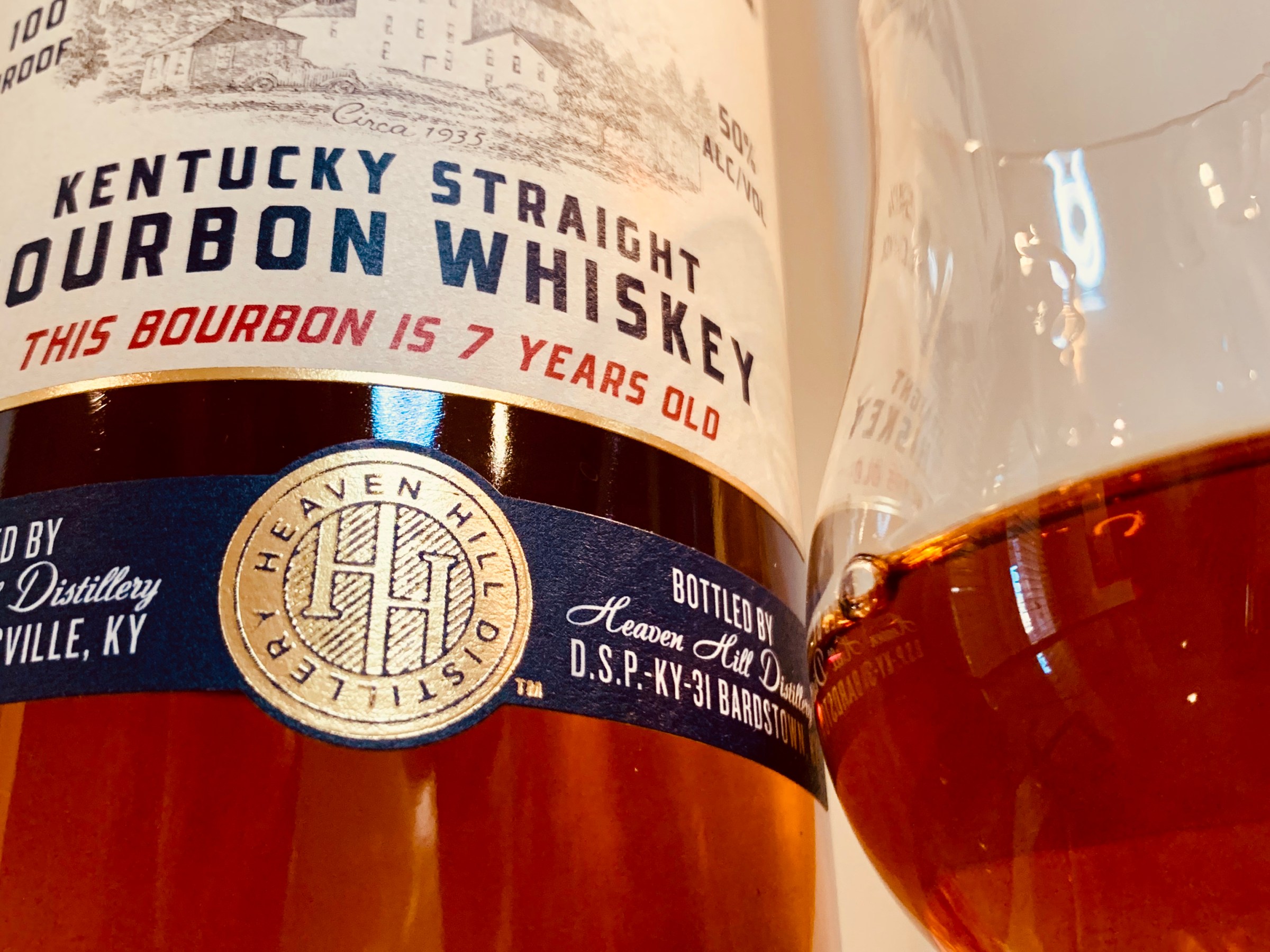
Until just over a year ago, Heaven Hill had the hands-down best price performer in all of Bourbon—a six-year age stated Bottled in Bond for only $11.99. In previous posts I had called it the standard-bearer for all of the new “craft” whiskies; if one of those new $50.00 whiskies couldn’t be better than Heaven Hill 6-year Bottled in Bond, then why bother?
But it was such a limited release and there really wasn’t any way that it could be profitable for Heaven Hill. We Kentuckians loved having it and outsiders loved finding it when they visited, but I think that everyone knew that it couldn’t possibly survive the bourbon boom.
After being rumored a few times, the news finally became official—Heaven Hill discontinued its namesake 6-year Bottled in Bond. Some stores immediately raised the price, all local stores limited the number of bottles that could be purchased, and the secondary market price reached $40-50 per bottle and higher.
Then last June came the announcement that many of us figured was destined to follow—the release of a new 7-year Bottled in Bond in a beautifully-labeled bottle with a real cork closure and a suggested retail price of $39.99.
Heaven Hill was already the leading distillery with the most Bottled in Bond brands. It’s a nod to history, quality, and heritage, and I’m thankful that Heaven Hill embraces the tradition of Bottled in Bond. This new 7-year brand also brings with it a style that among Heaven Hill’s other Bottled in Bond brands is only outdone by the gorgeous Old Fitzgerald decanter series. I was excited to receive a bottle because it has limited distribution which does not include Kentucky, and I wanted to compare it to the former 6-year brand.
Heaven Hill 7-year Bottled in Bond Tasting Notes
Bourbon: Heaven Hill Bottled in Bond Kentucky Straight Bourbon Whiskey
Distillery: Heaven Hill
Age: 7 years
ABV: 50% (100 proof)
Cost: $39.99
Appearance:
Amber copper.
Nose:
Beautiful oak with traditional caramel and vanilla, layer of mint, and leather.
Taste:
Caramel and vanilla, of course, and more rich sweetness like toffee, balanced with cinnamon, oak, and that leather-tobacco flavor that I usually find only on older bourbon. The balance is tremendous.
Finish:
Medium in length, again with great balance. This is an absolute classic bourbon.
Bottom Line
Let the people gripe about losing a value; Heaven Hill 7-year Bottled in Bond is delicious and worth every penny of its price. It’s still a value and a must-try.
Currently you’ll only be able to find Heaven Hill 7-year in California, Texas, New York, Georgia, Florida, Illinois, South Carolina, and Colorado, but hopefully Kentucky is not too far behind.
Disclaimer: The brand managers kindly
sent me a bottle for this review, without any
strings attached. Thank you.
 Brian Haara