Buffalo Trace Private Barrel Selection – Buffalo Trace, Eagle Rare, Weller, Elmer T. Lee and Blanton’s (Whew!)

The rumblings about the demise of the private barrel selection program at Buffalo Trace aren’t quite accurate yet, although it’s certainly true that not all brands are available for private barrels.  Don’t even ask for Weller 12 or Pappy.  But surprisingly, Elmer T. Lee and Blanton’s were in the mix last week when I had the pleasure of giving my 2 cents on the selection of Buffalo Trace, Eagle Rare, Weller Special Reserve, Old Weller Antique, Elmer T. Lee and Blanton’s with the experts at Cork ‘N Bottle (click here for the website) and the Whiskey Barrel Society.
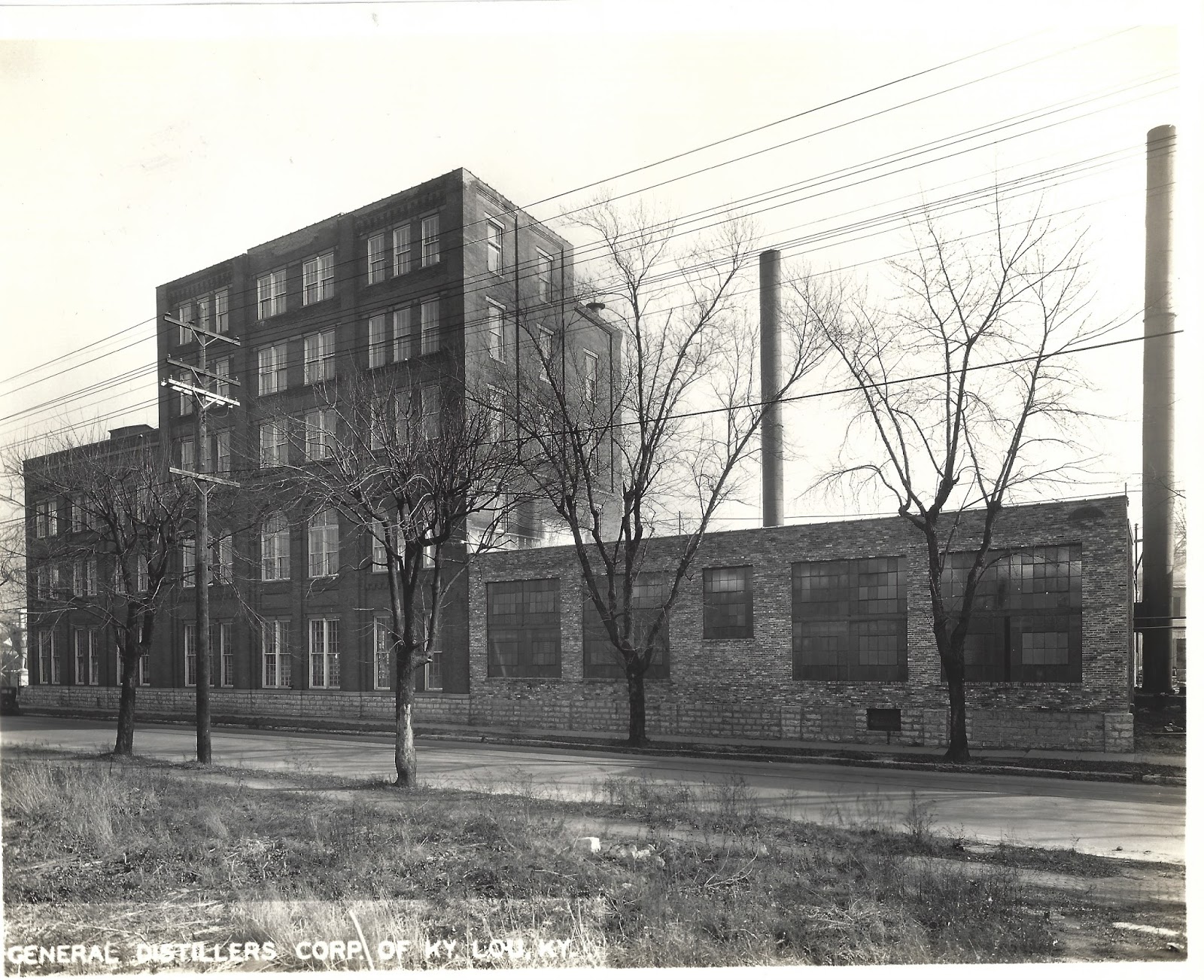
The history at Buffalo Trace is palpable. Distilling on this picturesque site situated on the Kentucky River began as early as 1811.  It moved from a small distillery to an industrial complex when Col. E. H. Taylor, Jr. bought the property in 1870 and christened his distillery the “O.F.C.” (“Old Fire Copper”) Distillery.  Col. Taylor was a titan of bourbon, and during his life he owned interests in other famous distilleries like the Carlisle Distillery (built with his then-partner, George T. Stagg, next to the O.F.C.), the Old Oscar Pepper Distillery (later Labrot & Graham and now Woodford Reserve), the J.S. Taylor Distillery, and the abandoned but recently purchased Old Taylor Distillery.
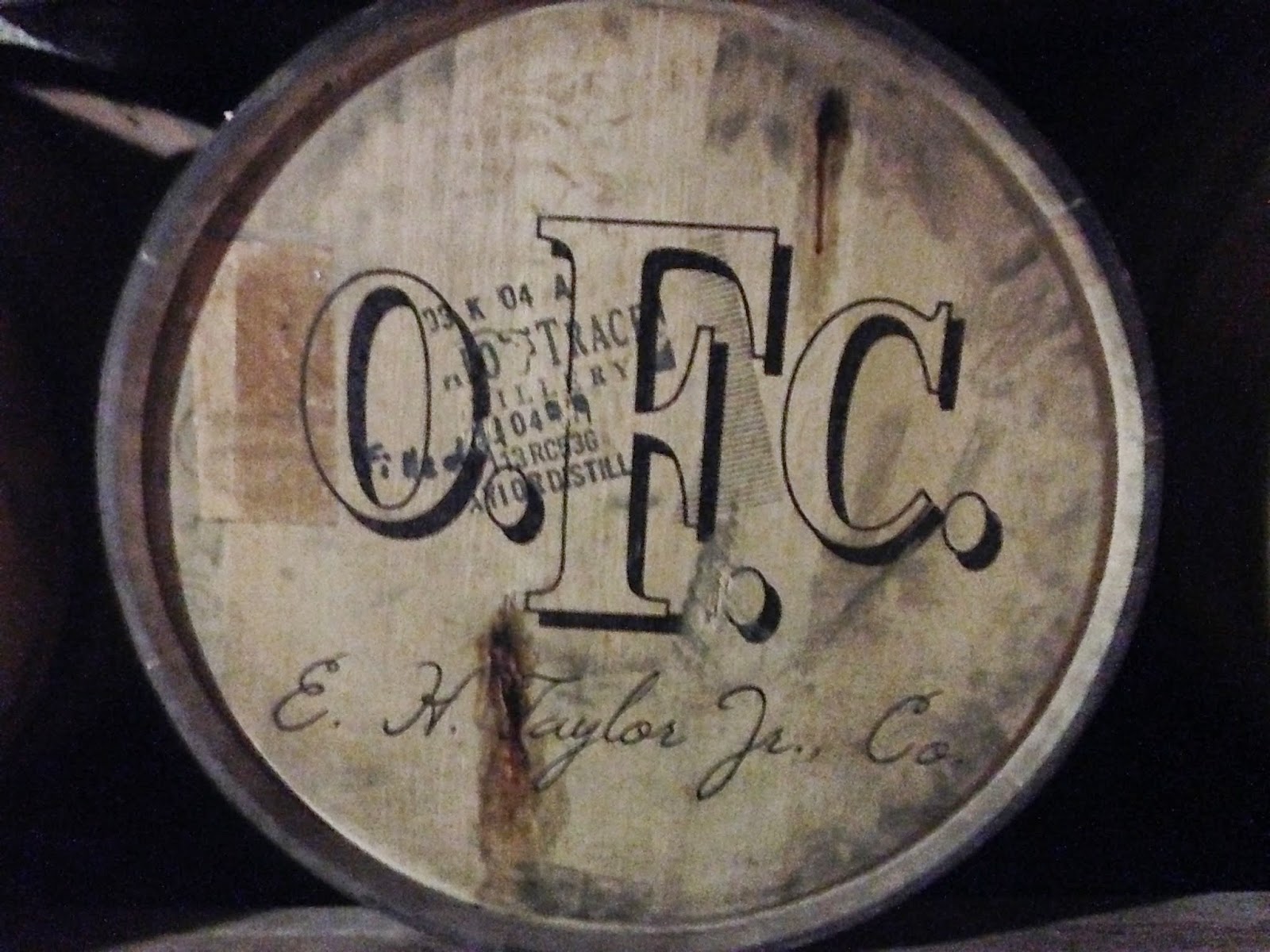
Our pre-barrel-selection tour included the standard stop inside Warehouse C, built in 1881.  I’ve been on the tour before and heard mostly the same speech, so I started looking at barrel heads and found this one:
Other information on the barrel showed that it was made with mash bill #1 but Fred, our tour guide, didn’t know what this was, and Buffalo Trace hasn’t responded to my inquiries.
We also saw a new version of “O.F.C.” aging, which is made with a new recipe using white corn, which was reported to have been the way Col. Taylor did it.
Our walk through the Albert B. Blanton Bottling Hall whetted my appetite even more.  They just so happened to be bottling the upcoming edition of the Buffalo Trace Antique Collection George T. Stagg, which this year weighs in at 138.1 proof.  I’ve never seen more than two bottles of George T. Stagg in one room, so needless to say, this was pretty awe-inspiring.
 
Still, of course, the whole point of the trip was to help select barrels, and we had our work cut out for us because Cork ‘N Bottle had thirty-nineto choose from.  The tasting room at Buffalo Trace is located in Warehouse H, which was built in 1934 by then-Master Distiller Col. Albert B. Blanton.  We started with eighteen barrels of Buffalo Trace, from which we selected eight, then moved to selecting four barrels of Eagle Rare.  Then we hit some of my favorites:  We got to pick two out of six barrels of 7½ year-old Weller (one for W.L. Weller Special Reserve and the other for Old Weller Antique; all barrels were about 121 proof), one out of three Elmer T. Lee barrels (9 years old and about 130 proof) and one out of three Blanton’s (6 years old at about 125 proof).  What a day!
I’ve reviewed most of these brands, but never the namesake brand, so this is the perfect opportunity to review the standard variety of Buffalo Trace bourbon available everywhere.  Buffalo Trace bourbon uses the distillery’s mash bill #1, which is shared with Eagle Rare, the E.H. Taylor, Jr. collection, the George T. Stagg collection, Old Charter, and Benchmark.  This is the “low-rye” mash bill, which is estimated to contain only about 10% rye grain.  Even Buffalo Trace’s “high-rye” mash bill is not particularly high, reportedly with only about 15% rye grain.
Bourbon:        Buffalo Trace Kentucky Straight Bourbon Whiskey
Distillery:        Buffalo Trace, Frankfort, Kentucky
Age:                NAS (Buffalo Trace tells me 8-9 years though)
Proof:             90 proof
Cost:               $23.99
Color:
Nice traditional amber.
Nose:
The primary scents are vanilla, corn, with just a bit of leather and mint, and not much oak to speak of.  Overall it has a pleasant nose, although not the most intriguing, and more alcohol smell than I expected for the proof.
Taste:
The taste starts with corn, brown sugar and a little toffee, and quickly moves to spice, before giving hints of toast and oak.  There seems to be a bit of dark fruits, but it’s very subdued.  A little water goes a long way and probably removes too much of the spice.
Finish:
The finish is medium in length with slight bitterness that I didn’t expect, but mostly licorice, rye spice and oak.
Bottom Line:
While I certainly like it, Buffalo Trace bourbon has never been my personal favorite, and except for George T. Stagg, I’m generally more a fan of the mash bill #2 bourbons.  Still, there is no denying that Buffalo Trace is a great mid entry-level buy, and it’s heads and shoulders above many of its competitors.  I’ll definitely get the Cork ‘N Bottle private barrel bottling in the fall, but frankly I’m more excited about the Old Weller Antique, Elmer T. Lee and Blanton’s private barrels.
Score on The Sipp’n Corn Scale:    3.0
The Sipp’n Corn Scale:
1 – Wouldn’t even accept a free drink of it.
2 – Would gladly drink it if someone else was buying.
3 – Glad to include this in my bar.
4 – Excellent bourbon.  Worth the price and I’m sure to always have it in my bar.
5 – Wow.  I’ll search high and low to get another bottle of this.
 

The Duke v. Duke University – and what’s Wild Turkey got to do with this?

*Updated August 8, 2014 after Duke University filed a Motion to Dismiss in response to the Complaint, and after numerous requests to Duke Spirits and Wild Turkey for information.

Last week John Wayne Enterprises, LLC sued Duke University over the use of John Wayne’s nickname, “Duke.”  In February 2013 John Wayne Enterprises filed a trademark application to register the mark “Duke” for use with alcoholic beverages except beer.  Duke University filed an objection to this and other uses of “Duke,” claiming that it would cause confusion and dilute and tarnish Duke University’s trademark.  The Complaint calls Duke University’s position “ludicrous.”  Remember folks, Complaints only tell one side of the story.

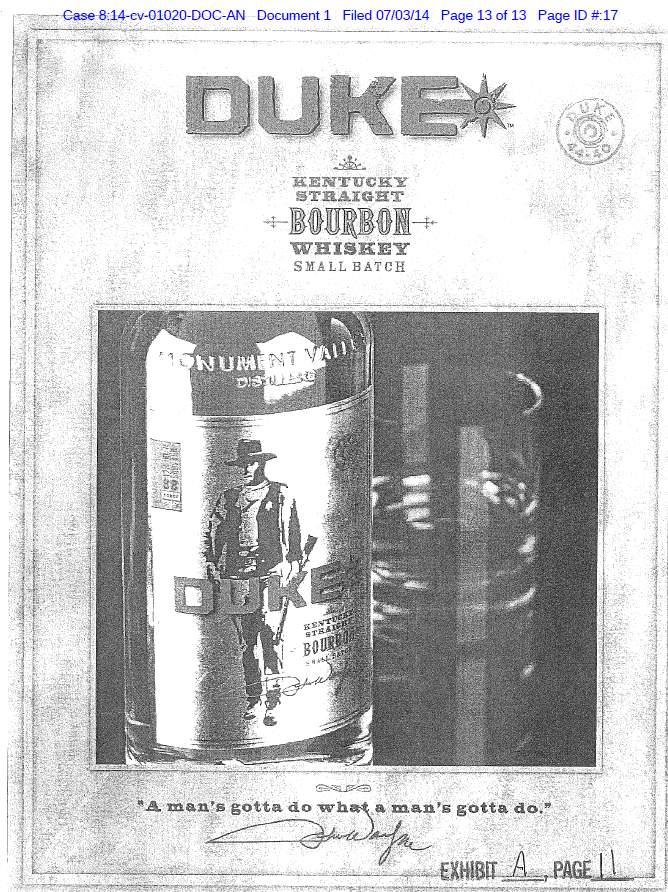
Here’s an image of the planned 88-proof Kentucky Straight Bourbon Whiskey provided to the Court:
And Click here to viewa copy of the entire Complaint.

Comment below or on Twitter on whether you think “Duke” should be allowed as a bourbon brand.  In the meantime, I’m looking into why “Duke Spirits” is not registered to do business with the Kentucky Secretary of State and into the statement on the back label that Duke Bourbon has been crafted in collaboration with Jimmy and Eddie Russell (without mentioning Wild Turkey).

UPDATE
On August 7 Duke University filed a Motion to Dismiss in response to the Complaint, arguing that a lawsuit in California is improper and arguing that the lawsuit was premature.
Duke Spirits has refused to comment, despite numerous requests.  It also came to light since my original post that Duke Spirits changed its TTB-approved label (see left side of image below), which claims that the bourbon was “crafted in collaboration with legendary Master Distiller, Jimmy Russell” and later mentioned Jimmy again, along with Eddie Russell.  The label actually used by Duke Spirits omits any reference to Jimmy or Eddie Russell.
Remember, Duke Spirits claims on its Twitter profile to be “An artisan distiller crafting small batches of superior bourbon, whiskey and brandy.  Calistoga, California.”  And while the label states “Distilled by Duke Spirits, Lawrenceburg, Kentucky”, Duke Spirits is not registered to do business in Kentucky and apparently is not located in Lawrenceburg or anywhere else in Kentucky.
Wild Turkey was more forthright in responding to me, for which I’m thankful, but it claimed to be bound by a confidentiality restriction, so it could neither confirm nor deny that Duke Bourbon is really Wild Turkey (even though the cat seems to be out of the bag through the TTB-approved label).
I’ve never rooted for Duke University for anything.  I guess there’s a first time for everything.

James E. Pepper’s Fraud Previews The Taft Decision.

There’s a rule in the law that when you ask for an injunction, you can’t have been a bad guy too.  In 1893 when James E. Pepper tried to protect his “Old Pepper” brand, he learned this rule the hard way.
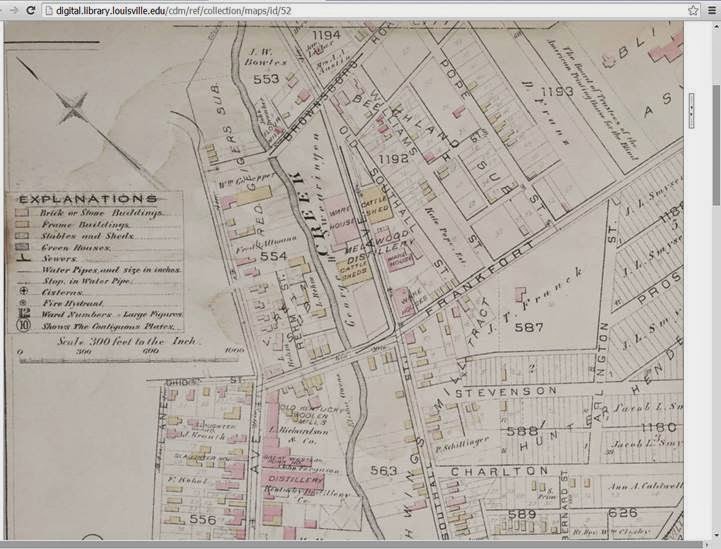
The events described in Krauss v. Jos. R. Peebles’ Sons Co., 58 F. 585 (S.D. Ohio 1893) all take place after James Pepper went bankrupt in 1877 and lost his father’s distillery in Versailles, Kentucky – the famed “Old Oscar Pepper Distillery” where Old Crow was born – to Labrot & Graham.  They also take place after Pepper unsuccessfully sued Labrot & Graham (here’s my Pepper v. Labrot & Graham post).
After losing his father’s distillery and losing the right to use the “Old Oscar Pepper” name, James Pepper built a new distillery in Lexington, Kentucky.  He started distilling there in May 1880 and designed this new shield trademark, which he printed on gold paper for labels:
As many new whiskey distillers know, starting a new distillery has high front-end expenses with a long wait before any whiskey is fit to sell.  Perhaps to account for this reality, Pepper sold newly-filled barrels to the Jos. R. Peebles’ Sons Co., a large Cincinnati grocer and liquor dealer, for aging and bottling, and kept other barrels in his own warehouse.
Then, after six years of aging, Pepper was ready to sell his first run of bourbon in 1886.  Peebles was also selling (and had been selling) this bourbon under the “Old Pepper” brand, but after Pepper got into the bottling business, he supplied the gold shield labels to Peebles and other bottlers.  Pepper also continued bulk barrel sales to Peebles after 1886, through 1893, when Pepper decided make Otto Krauss his sole distributor, and contracted with Kraus to sell him 30,000 cases per year, plus 1,000 barrels of bourbon and 500 barrels of rye per year.
Peebles still had a large supply of Old Pepper bourbon, so it continued to bottle and sell it, using the same labeling it had always used.  Krauss took exception (and I’ve read separately that James Pepper was a silent partner with Krauss), and sued Peebles in the spring of 1893, asking for an injunction to prohibit Peebles from labeling its bottles as “Old Pepper.”
The judge for the case was none other than William Howard Taft, Sixth Circuit Judge from 1892-1900, before his single term as President (1908 – 1912) and eventual service as United States Supreme Court Chief Justice (1921 – 1930).  Whiskey fans most likely know him as President Taft for his “Taft Decision” in 1909, which clarified the Pure Food & Drug Act and finally answered the question “What is whiskey?” by defining “straight,” “blended” and “imitation” whiskey.
Circuit Judge Taft found some disturbing evidence in the case that might have influenced his “Taft Decision” as President 16 years later.  Evidence was presented showing, despite Pepper’s labels and guarantees to the public, that at least since December 1891 he had been buying bourbon from other distilleries and blending it with his own bourbon – all the while still guaranteeing to the public that it was distilled by him, as genuine and unadulterated Old Pepper.
The percentages varied each month, but Judge Taft recited the exact percentage of “foreign” whiskey that Pepper blended into his bottles of Old Pepper on a monthly basis over the course of 19 months.  It was often over 50% foreign whiskey, with a high of 66% foreign whiskey in one month, and an average of over 1/3 of every bottle being foreign whiskey over that period.  Judge Taft took Pepper and Krauss to task.  He recited all of the express guarantees contained all over the Old Pepper label that it was pure, unmixed with other whiskey, that the bottle contained nothing but Old Pepper bourbon distilled at the James E. Pepper Distillery in Lexington, by James Pepper himself.  Judge Taft ruled that this was “a false representation, and a fraud upon the purchasing public,” and “the public are entitled to a true statement as to the origin of the whisky, if any statement is made at all.”
So Krauss and Pepper could not stop Peebles from using the Old Pepper trademarks because Krauss and Pepper were themselves engaged in fraud.  I’d be willing to bet that this 1893 decision influenced President Taft in 1909 when he defined the standards for labeling whiskey.  In fact, in 1909 President Taft wrote that through his decision, “the public will be made to know exactly the kind of whisky they buy and drink…”  That’s an admirable goal that we’re still working toward today, as we’re faced with similar resistance from a few producers and non-distiller producers, along with sometimes lax enforcement of existing laws by TTB.  James Pepper might have fared better today with TTB than he did in 1893 against Taft.

Sipp’n Corn Bourbon Review – Elijah Craig 12 Year Barrel Proof – Three Editions

It’s no secret that Elijah Craig 12-Year is one of the best values of all of bourbons (usually under $30.00).  Heaven Hill has taken its popular Elijah Craig 12-Year bourbon to new heights with small batch barrel proof editions.  This review compares the Evan Williams Bourbon Experience gift shop edition (129.7 Proof; the only white label), with the third edition (133.2 Proof; brown label) and the just-released fifth edition (134.8 proof; brown label).  Look for the latest edition at your favorite retail stores because the price is a bit higher at the Bourbon Experience ($40 range at retail vs. $55 at the Bourbon Experience) and, unfortunately, I’ve confirmed with the Bourbon Experience that they’re out.  Wherever these land, they’ll be gone in a heartbeat.
The Elijah Craig 12-Year Barrel Proof batches have all forgone chill filtering, which contributes to the dark brown color and leaves more flavors behind, but which also results in a slight cloudiness when water is added.  Chill filtering involves chilling the whiskey significantly, so fatty acids and proteins created during distillation can be filtered out, thus removing cloudiness in the bottle.  I understand this is done for mostly cosmetic reasons.
Elijah Craig 12 Year Barrel Proof – 129.7 Proof ($54.99 – Bourbon Experience price)
I reviewed this edition of EC12 against other high-proof options last December (“The High Octane Challenge”).  The color is outright mahogany brown.  On re-taste, the nose is more complex than the other two, blending caramel, oak and apple, with only a slight burn from the high proof.   The taste is really remarkable, with more sweetness of caramel, vanilla and butterscotch, along with pepper and cinnamon spice and hints of oak and almonds, with some slight dark chocolate bitterness.  The finish featured these same flavors too, along with a hint of mint, and it was really long and warm.
Elijah Craig 12 Year Barrel Proof – 133.2 Proof ($54.99 – Bourbon Experience price)
The winter’s edition seems to be the darkest brown of the three.  The nose has deep oak and leather notes, along with brown sugar.  The initial taste gave the strongest and hottest bite out of the three, even though it’s not the highest proof (but show me someone who can distinguish 134.8 proof from 133.2 proof…).  Remember, the ABV calculates to 66.6, so maybe it’s just the power of suggestion.  In addition to the heat, this edition seems to be the spiciest, but after a splash of water, sweet flavors opened up, but it’s still dark cherries, nuts, oak and deep earthy flavors.  This one had the longest finish of the three.
Elijah Craig 12 Year Barrel Proof – 134.8 Proof ($54.99 – Bourbon Experience price)


Dark brown color?  Check.  This edition has the hottest nose, so seriously, don’t inhale too intensely before you add water.  Water removes the sting and opens up balanced caramel, oak and pepper.  The taste balanced those same flavors with an incredibly robust blast.  Try this one with different amounts of water and you’ll see definite changes in flavor profile, bringing out some vanilla, toast and dark fruit flavors.  The finish was long like the others, but probably better balanced than the third edition.
Bottom Line:
I’ve also tried the first release (a 134.2 proof gem) shared by a friend.  Like the editions that followed, it was tremendous, and had slightly different flavors like caramel apple and cinnamon crumb cake.  But out of all that I’ve tried, the 129.7 proof white label expression nudged out its higher-proof brothers.  Each of these editions has its own distinct characteristics, but of course they also have a lot of similarities.  After all, they’re all Elijah Craig, they’re all 12 years old, and they’re all relatively close in time on distillation (and therefore aging seasons).  I would expect future editions to have a little more variation from these three since those barrels will have experienced different aging seasons.
In addition to all being excellent, one of the most surprising features to me is the drinkability at such a high proof.  Don’t drink a whole glass neat, but definitely try it for the full experience, and also enjoy what a Glencairn or NEAT glass can do for the nose (although the nose is astounding even without a special glass).  Then you’ll want to use ice and a splash of water to lower the proof, but be careful to not go anywhere near the standard 94 proof.
Score on The Sipp’n Corn Scale:
EC12 – 129.7 Proof:  4.5
EC12 – 133.2 Proof:  4.0
EC12 – 134.8 Proof:  4.25
The Sipp’n Corn Scale:
1 – Wouldn’t even accept a free drink of it.
2 – Would gladly drink it if someone else was buying.
3 – Glad to include this in my bar.
4 – Excellent bourbon.  Worth the price and I’m sure to always have it in my bar.
5 – Wow.  I’ll search high and low to get another bottle of this.
Want more information on the non-gift shop Elijah Craig Barrel Proof releases?  Check out this great summary by Bourbonr:  Elijah Craig Barrel Proof Release Cheat Sheet.

Sipp’n Corn Bourbon Review – Wild Turkey Diamond Anniversary

Wild Turkey Diamond Anniversary is a commemorative bourbon to honor Jimmy Russell, the longest-serving active Master Distiller in North America.  Jimmy started at Wild Turkey in 1954, and he trained under legends Bill Hughes and Ernest W. Ripy (the son of the original distiller).  Jimmy’s son Eddie is the fourth in a line of family distillers, and he’s been at Wild Turkey since 1981.  Eddie worked with different blends to find the right way to celebrate his father’s 60 years.
Its first public tasting was on April 15 at the official grand opening of Wild Turkey’s new state-of-the-art Visitor Center, and it was released for sale only at the Visitor Center beginning on April 16.  If you can’t make it to Lawrenceburg, be on the lookout for a limited distribution this August.
Bourbon:        Wild Turkey Diamond Anniversary (Limited Edition)
Distillery:        Wild Turkey Distillery, Lawrenceburg, Kentucky
Age:                NAS, but a blend of 13 and 16 year-old barrels
Proof:             91 proof
Cost:               $124.99
Tasting Notes
Color:
Light amber and a bit bright.  I was expecting darker given the ages, but I suppose that I’m seeing the result of the lower proof and filtration.
Nose:
Sweetness from caramel and honey, along with dry grass, oak, cedar and old barn (but in a good way).
Taste:
It initially seemed higher proof than it is, but that sensation went away after sitting for 5-10 minutes, and was replaced with a nice, warm sensation.  There was less oak than I expected from the age.  It was creamy with rye spice, subtle sweetness and some citrus.  The citrus gave it lightness that is not typical with Wild Turkey.  Excellent balance.
I thought that I would like it with ice, but didn’t (it muted the flavors).  On my second day of tasting, I tried it with a Whiskey Disks stone, and that was exactly what it needed.  Drink this one neat with your favorite whiskey stone to give it some chill.
Finish:
The finish was lingering but not long, and it wasn’t particularly warm except on the tongue.  There was more oak in the finish than with most Wild Turkey brands, along with pepper spice balanced with honey.
Bottom Line
Diamond Anniversary is unlike everything else in the Wild Turkey stable.  Some people were expecting a robust powerhouse consistent with the “#NEVERTAMED” reputation that Wild Turkey has earned (or its earlier “Give ‘Em The Bird” campaign).  Don’t expect Diamond Anniversary to be as in-your-face as those marketing campaigns or the new custom-built Wild Turkey motorcycle, which was also revealed at the release event:
Kudos to Eddie Russell for giving us something new and distinguishable.  While this difference is bound to throw some people for a loop, can you imagine the criticism if Diamond Anniversary tasted like Russell’s Reserve or Rare Breed?
The price and sub-101 proof are also bound to startle devoted Wild Turkey fans.  On top of that, Diamond Anniversary faces very stiff competition from other recent limited edition and commemorative bottles.  Most recently, Wild Turkey’s Lawrenceburg neighbor, Four Roses, has hit another home run with its 2014 Limited Edition Single Barrel, which is priced about $25 less than Diamond Anniversary, and which is cask strength.
Given the luck of timing, then, Diamond Anniversary will strike some people as over-priced and under-proofed.  While I admit that 101-proof would have been a nice part of the tribute, 91-proof is perfect for sipping and I’ll trust Eddie Russell any day of the week to add the right amount of water.  There are better bourbons, and some of those cost less money (the price hurts Diamond Anniversary on my scale), but that can’t detract from the merits of Diamond Anniversary and the true master distillers behind it.  This is a one-of-a-kind bourbon with great balance, so it deserves some room on your shelf.
Score on The Sipp’n Corn Scale:  3.0
The Sipp’n Corn Scale:
1 – Wouldn’t even accept a free drink of it.
2 – Would gladly drink it if someone else was buying.
3 – Glad to include this in my bar.
4 – Excellent bourbon.  Worth the price and I’m sure to always have it in my bar.
5 – Wow.  I’ll search high and low to get another bottle of this.